Distance & Displacement
Speed & Velocity
Graphing Speed
Acceleration
Graphing Acceleration
100
It's a point against which motion is measured.
What is a reference point?
100
This is the rate at which an object is moving at a given moment in time.
What is instantaneous speed?
100
It's the dashed line that represents the estimated values that are either higher or lower than the actual data collected.
What is extrapolation?
100
It's the change in velocity over time.
What is acceleration?
100
This represents the object's magnitude of acceleration.
What is the slope of a line on a speed-time graph.
200
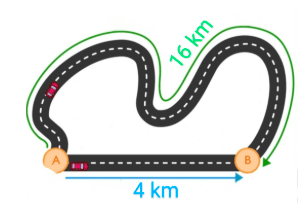 The green path represents _____ and blue path represent ______.
What are distance and displacement.
Green path: distance; Blue path: displacement
200
This tells you how quickly and in what direction the object is moving in relation to a reference point.
What is velocity?
200
It's the steepness of a graph line and it represents speed on a distance-time graph. The steeper line indicates a greater speed.
What is slope?
200
Explain why the term deceleration is NOT acceptable in physics.
Deceleration is NOT acceptable because we must always give the direction of the acceleration because that is what tells a physicist whether an object is slowing down or speeding up.
200
This shows the acceleration on a speed-time graph.
What is the slope of a line?
300
 Describe at least two frames of references for the photo.
What are:
The riders aren't moving relative to each other
AND
The people riding are moving relative to someone watching from the ground.
300
This is step 5 when completing the problem-solving steps. (Hint: It's not mentioned in the book, but Mrs. Dorado still requires it.)
What is ANSWER THE QUESTION?
300
A flat, horizontal line indicates this speed.
What is zero?
300
Give the equation for acceleration in words.
What is acceleration of an object equals final velocity minus initial velocity divided by the time it takes for the object to accelerate.
a=Vf -Vi /t
300
This looks like a CURVE rather than a straight line on a distance-time graph.
What is acceleration?
400
This is the difference between vector and scalar quantity.
What is direction?
400
Give the mathematical equation for speed in words.
What is speed equals distance divided by the time to travel that distance? (v=d/t)
400
Complete the following problem on the board:
Find the speed of a car if it traveled 340 miles in 20 seconds.
Show all steps.
What is:
1. d=340 m; 20s; v=? in m/s
2. v=d/t
3. v=340m/20s
4. v=340m/20s = 17 m/s
5. The speed of a car was 17 miles per second.
400
These are the three ways velocity can change and cause acceleration.
What are:
1. if the object speeds up
2. if the object slows down
3. if the object changes direction
400
A biker that slows to a stop is an example of this kind of acceleration.
What is negative acceleration?
500
The 5K class took 45 minutes to run a 5 kilometer loop around the church ending where they began. This was their total displacement.
What is zero?
500
Complete the following question on the board, showing all FIVE steps in your answer:
What is the average speed of an object that travels 800 miles in 4 hours? Put your answer in units of miles per hour.
What is:
Step 1: d=800 mi; t=4 hours; v= ? in mi/h
Step 2: v=d/t
Step 3: v=800 mi/4h
Step 4: 800mi/4h =200 mi/h
Step 5: The average speed of an object that travels 800 miles in 4 hours is 200 mi/h.
500
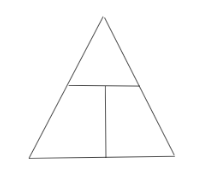 Draw and label the following diagram on the board to show the formulas for how to calculate time, distance and speed. Write out the formula for each.
What is: 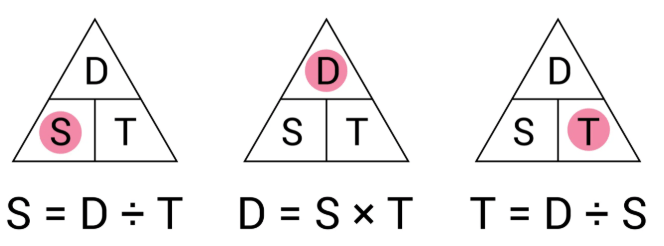
500
Complete the mnemonic device for helping you divide by fractions:
When dividing by fractions, don't ask why, just _____ the bottom and _________.
Hint: See the units for acceleration.
What is:
When dividing by fractions, don't ask why, just FLIP the bottom and MULTIPLY.
500
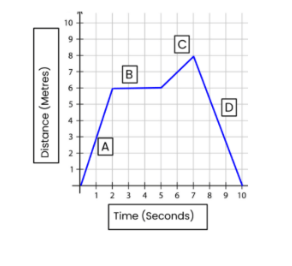 Give a description of what's happening in section B.
What is no acceleration?