Solving Equations
End Behavior
Polynomials
Miscellaneous
Exponents/ Imaginary numbers
100
Solve the following equation
3/(x+2)=2/(x-4)
x=16
100
Find the vertical asymptotes for the rational function. Leave your answer as an equation.
f(x)=(2x)/(4x-5
x=5/4
100
If the following is a polynomial, state the degree, leading coefficient, and constant term. If not a polynomial, say why it is not a polynomial.
f(x)=3x^2-4x^5+1/2x-18
Degree: 5
Leading Coefficient:-4
Constant:-18
100
Give the next three terms in the sequence. Then state if the sequence is geometric, arithmetic, or neither.
64, 16, 4...
Geometric
1, 1/4, 1/16
100
Simplify the following in terms of i
root()(-15
root()15i
200
Solve for x
2root3(x-6)+4=0
x=-2
200
Find the horizontal asymptote for the following rational function. Leave your answer as an equation.
g(x)=(4-3x)/(9x)
y=-1/3
200
Find the x-intercept of the following polynomial. Leave your answer as an ordered pair(s).
f(x)=x^2(2x+3)(x-4)
(0,0), (-3/2,0), (4,0)
200
Solve the following equation for x.
root()(x+4)+16=0
No solution
200
Simplify in terms of i
(-2+3i)(4-5i)
7+22i
300
Solve for x
4(x+3)^2-8=28
x=0,-6
300
Complete the end behavior statement for the following polynomial.
As x gets larger in the positive direction, y gets larger in the ____________ direction.
As x gets larger in the negative direction, y gets larger in the _____________ direction.
f(x)=2x+x^2-3x^3
As x gets larger in the positive direction, y gets larger in the negative direction.
As x gets larger in the negative direction, y gets larger in the positive direction.
300
Find the y-intercept for the following polynomial. Leave your answer as an ordered pair.
f(x)=(x-4)(x+2)(x-1)
(0,8)
300
Georgia wanted to rent a craft room for her candle making business. If it costs $45 per month to rent the room and $4.50 in materials to make each candle, how many candles does Georgia need to make for the average cost per candle to be $5.25 or less?
60 or more candles
300
Simplify. Show your steps!
4^(-3/2)
1/8
400
Solve for x (be careful when distributing a negative!)
x/(x-1)-7/(x)=1/(x(x-1))
x=6
400
Complete the end behavior statement for the rational function. As x gets larger in the positive/ negative direction, y approaches ____________
g(x)=(2x^2+5x-7)/(x+4)
y=2x-3
400
Sketch the following polynomial.
f(x)=-x(x+2)^2(x-3)
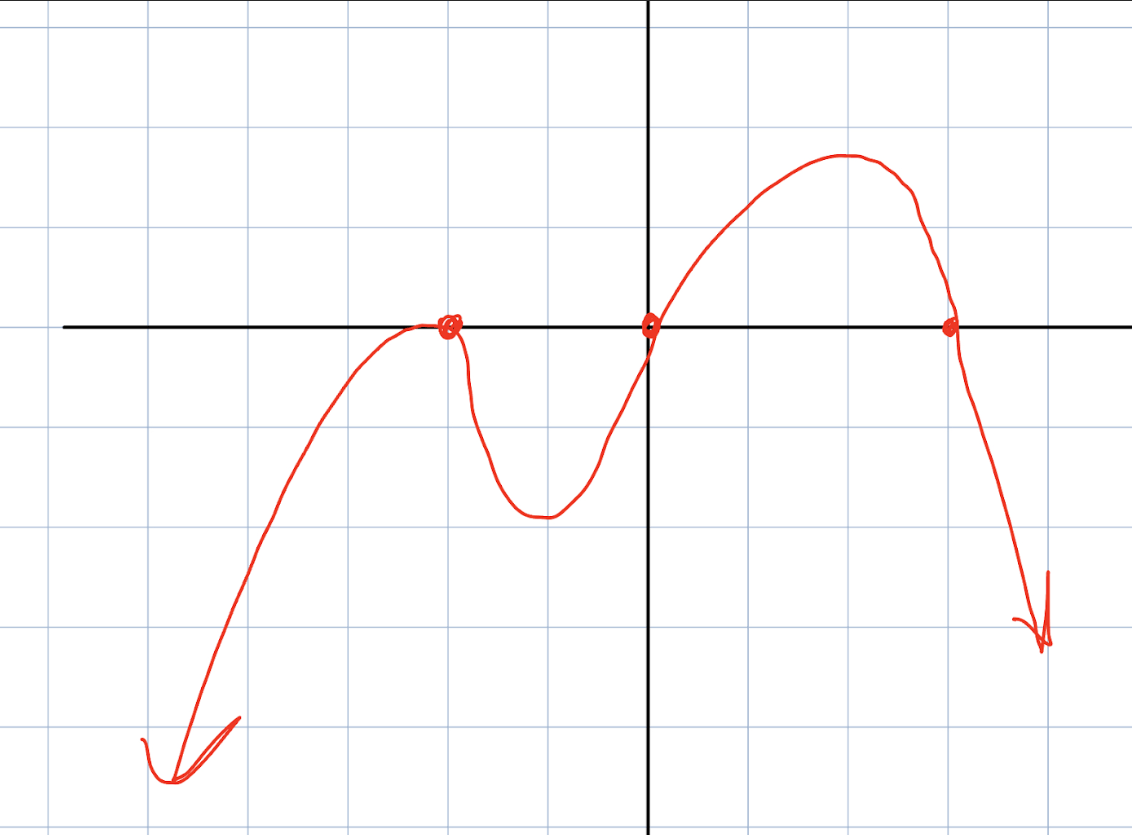
400
Simplify. Make sure there are no negative exponents in your final answer.
(-2x^-2y^4)^3
(-8y^12)/x^6
500
Find the points of intersection for the two polynomials. Give your answer as an ordered pair(s)
g(x)=(2x-1)(x-3)
h(x)=(x-3)(x+4)
(5,18)
(3,0)
500
Simplify. Make sure there are no negative exponents in your final solution.
(4x^-3y^8)/(6x^2y^5)
(2y^3)/(3x^5