Fabric Testing 1, 2, 3. . .
(Continued in C.15)
Chapter 15 - Determining Fabric Quality
Wash and Wear
(Continued in C. 12)
Chapter 12 - Care/Renovation of Textiles
Mixed Bag
100
Ideally, seam strength should be _____________ the breaking strength of the fabric

(options: greater than or less than)
What is less than?

seam strength = the force required to break a seam
reasoning: seams are easier to repair than re-weaving/knitting the body of the fabric (see slide #3 for further information)
100
The ideal number of stitches per inch is in the ___________ range

A. 8-12
B. 4-6
C. 1-5
D. 15-20
What is A. 8-12? (see slide #3 for additional information)
100
_____________ is a wet process that uses water and cleansers such as soap and _______________ to remove soils from clothing
What is laundering, detergent? (see slide #3 for additional information)
100
Bleach, which is a laundry additive, comes in two forms = ______________ and ______________ such as hydrogen peroxide
What is chlorine and non-chlorine?

bleach will remove stains, but cannot clean a garment fully (see slide #4 for further information)
100
_______________ is the industry standard in color matching
Who/What is Pantone?

color properties = hue, chroma (saturation), and value (see Slide #19 in C.15 for additional information)
200
Surface friction is tested in relation to ____________________

A. flame resistance and air permeability
B. abrasion resistance and yarn distortion
C. thermal insulation and stiffness
D. wrinkle resistance and dimensional stability
What is B. abrasion resistance and yarn distortion?

Abrasion Resistance: Resistance to the wearing away of any part of a material when rubbed against another material (Most end uses)

Yarn Distortion: change in symmetrical fabric surface appearance by the sliding or shifting of yarns following the application of rubbing action of force (Low yarns per inch)

see slide #9 for more information
200
Breaking strength refers to the force required to ______________________
A. Break a seam
B. Rupture a fabric
C. Continue a rip already started in the fabric
D. Break a fabric when it is under tension
What is D. Break a fabric when it is under tension?

Devices Used: CRT, CRE, and CRL machines (see slide #8 for further information)
200
___________________ is a wet process using agitation above the human hearing range to dissolve and displace contaminants
What is ultrasonic washing? (see slide #9 for additional information)

new version = Dolfi
200
_______________, previously known as "bluers", are added to water and/or detergent in order to achieve _____________

A. fluorescent brighteners, whiter whites
B. surfactants, lower surface tension
C. starches, body in limp fabrics
D. fragrances, a clean smell that masks chemical odors
What are A. fluorescent brighteners, whiter whites? (see slide #4 for additional information)
200
_____________, the most commonly used manufactured fiber, is difficult to remove soils from due to its hydrophobic and oleophilic nature
What is polyester? (see slide #2 in C.12 for additional information)
300
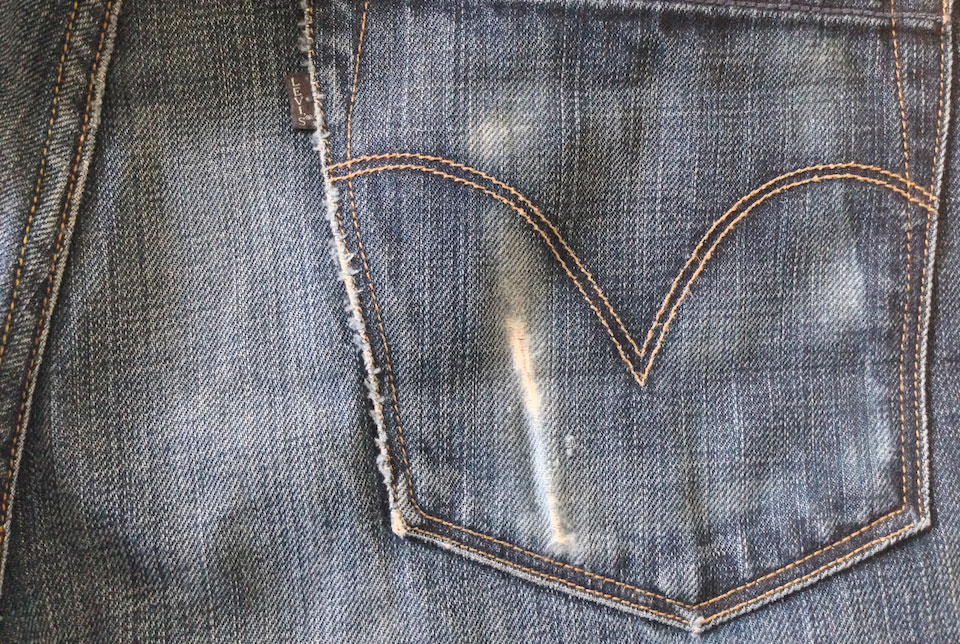
Identify the colorfastness issue pictured below:
What is frosting?

Additional colorfastness test considerations: burnt gas fumes, crocking, light, and laundering (see slide #20 for additional information)
300
______________ refers to the force needed to continue a pre-existing rip in the fabric
A. Tearing Strength
B. Bursting Strength
C. Seam Strength
D. Breaking Strength
What is A. Tearing Strength?

Device used: Elmendorf Tear Tester (see slide #8 for further information)
300
___________________ are viable alternatives to dry cleaning

A. Dryel and Professional Wet Cleaning
B. Ultrasonic and Spot Cleaning
C. Professional Wet Cleaning and Laundering
D. Spot Cleaning and Dryel
What is A. Dryel and Professional Wet Cleaning?

Dryel = in-home dry cleaning system, wet cloth uses solvents
Professional wet cleaning = highly controlled wet process using water and cleaners that can replace solvent use (see slide #8 for additional information)
300
Soils, such as grass stains and juice, are considered _______________ whereas grease and candle wax are _______________

A. hydrophobic, oleophilic
B. water soluble, non-water soluble
C. launderable, dry cleanable
D. natural, synthetic
What is B. water soluble, non-water soluble? (see slide #2 and 5 for additional information)
300
Decode the first icon pictured below:
What is iron with high heat?
400
Of the options below, ______________ is not part of the appearance testing of textiles:

A. Pilling Propensity
B. Soil Release
C. Crocking
D. Wrinkle Resistance
What is C. Crocking? (belongs under colorfastness testing)

additional appearance testing consideration: stiffness (see slide #9 for additional information)
400
The Mullen tester is used to assess ______________, or the amount of pressure required to rupture a fabric
What is bursting strength?
400
Dry cleaning is a wet process that most commonly uses ____________ rather than water to remove soils from clothing

A. Compounds like Carbon Dioxide (CO2)
B. Solvents like Perchlorethylene (Perc)
C. Additives like Chlorinated bleach (Clorox)
D. Detergents like Tannin (TaN)
What is Solvents like Perchlorethylene (Perc)?

Perc = most common solvent at this point, but may be a carcinogenic and being replaced by CO2 (see slide #6 for additional information)
400
Coffee and alcohol are ________________ (water soluble or non-water soluble) and contain _____________, which leaves invisible stains on garments
What is water soluble, tannin? (see slide #7 for additional information)
400
Vinyl ________________ and polystyrene plastics being dissolved in solvents are both reasons that these fabrics should not be cleaned using the ______________ method

A. Crocking, Laundering
B. Delaminated, Professional wet cleaning
C. Destruction, Dryel
D. Cracking, Dry cleaning
What is D. Cracking, Dry cleaning? (see slide #7 in C.12 for additional information)
500
Air permeability, dimensional change, durable press, flame resistance, and stretch in elastic fabrics are all related to the ______________________ testing of textiles
What is functional/functionality?

See slide #16 for further information
500
The combined efforts of conduction, convection, and radiation, known as ___________________, can be assessed using infrared scans like the images below:

What is thermal insulation? (see slide #18 for additional information)

flammability: fabric's ability to burn, assessed based on Ignition properties, Burning rate, Burning properties, Ease of extinguishing, By-products, Extent of damage, and Rate of heat transfer
500
When you get your blood on a garment item, your own ___________ will help you remove the stain

A. Sweat
B. Urine
C. Saliva
D. Tears
What is C. Saliva

If taken to a dry cleaner, blood and other pesky stains are removed in the spotting process (see slide #6 for additional information) cool water and scrubbing generally works on other people's blood
500
_________________ are laundry additives that lower surface tension and helps with __________

A. Surfactants, Stain removal
B. Fabric softeners, Minimizing wrinkles
C. Enzymes, Stain breakdown
D. Starches, Providing body to limp fabrics
What is A. Surfactants, Stain removal? (see slide #4 for additional information and a full list of laundry additives)
500
Decode the second symbol on the following care label:
What is do not bleach? (See slide #10 of C.12 for additional information)

In order: wash in 40 degree C. water, do not bleach, iron using medium heat, dry clean option: "P" is a code for the dry cleaner, do not tumble dry, dry flat

very useful link: http://www.mwcleaners.com/blog/symbols-clothing-tags-read-labels/
M
e
n
u