The Seven-Years' War
Prelude to Revolution
The American Revolution
Creating A Nation
Random Sauce
100
“This is the Country, which the French have many Years envied us, and which they have been long meditating to make themselves Masters of: They are at length come to a Resolution to attack us. . . in one of the best of those Colonies, Virginia; and in that part of it which lies on the River Ohio. . . . The French however if they find their Way to the Coast of Virginia, will easily over-run the provinces, because each Province considers itself as independence of the Rest, and the Invaders from Canada all act under one Governor; to unite 13 Provinces which fill an Extent of 1600 Miles is not easy . . . Canada must be subdued.”
The Maryland Gazette, 1755
What conflict is this excerpt describing?
The Seven Years' War (the French and Indian War)
100
What was a consequence of the Seven Years' War?
1. The British Empire gained control of North America east of the Mississippi River.
2. The British Empire accrued a large amount of debt
100
What did the British Parliament do in response to the Boston Tea Party?
It passed the Coercive Acts (also called the Intolerable Acts), a series of punitive measures aimed at subduing the Massachusetts colony.
100
The Connecticut Compromise (a compromise between the Virginia and New Jersey Plans) created...
a bicameral legislature, featuring a lower house based on population (House of Representatives) and an upper house (Senate) where each state had two votes.
100
What did the Treaty of Paris in 1763 do?
Ended the Seven Years' War
200
What caused the Seven Year's War between the British and French?
Competing claims to colonial land
200
The presence of British soldiers in American cities fueled many of the colonial resentments that brought on this event, and later the American Revolution
The Boston Massacre
200
Who were the Minute Men?
local and state militias formed by American Revolutionary War soldiers, named for their willingness to fight at a moment's notice
200
What uprising of disgruntled farmers and Revolutionary War veterans in Massachusetts led to the creation of a stronger central government that would better be able to handle military and economic problems than the Articles of Confederation?
Shays' Rebellion
200
Salutary neglect (also called benign neglect) characterized the relationship between the British Empire and its American colonies from the mid-1600s until the end of the Seven Years' War. What did salutary neglect entail?
Lax enforcement of British law and trade regulations in the American colonies
300
What was the immediate result of the French losing the Seven Years' War to the British?
France lost major territorial claims in colonial North America
300
The British Empire's Proclamation of 1763 prohibited white settlers from crossing over the Appalachian mountains into territory reserved for Native Americans. White settlers responded by...
ignoring the Proclamation Line and protesting against the British Empire's attempt to contain westward migration.
300
Parliament passed the Coercive Acts (also called the Intolerable Acts) intending to isolate the "troublemakers" in Boston from the other colonies, but their gambit backfired. Why?
The Acts helped to unify the American colonies
(which then sent delegates to the First Continental Congress to coordinate a response to the British empire.)
300
The Constitution established three branches of government, which provide a system of checks and balances on each other.
What are the three branches of government, and name an institution that makes up each branch.
1. Executive (President, VP, Cabinet, Bureaucracy)
2. Legislative (Congress)
3. Judicial (Supreme Court and other federal courts)
300
At the First Continental Congress in 1774, delegates from each colony met in Philadelphia to...
How about the Second Continental Congress?
1. Coordinate a unified colonial response to the Coercive Acts.
2. declaring independence from the British Empire.
400
What was a significant cause of the trend from 1755-1762 shown in the table?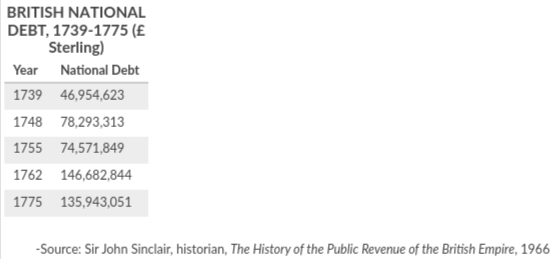
costs of involvement in the Seven Years’ War with France
400
Why did Native American tribes join together against the British in the rebellion known as Pontiac's Uprising (1763-1766) following the Seven Years' War?
1. Unlike the French, the British did not maintain trade relations with Native Americans and refused to sell them the weapons and ammunition they needed to hunt
2. They objected to the British taking over territory that had been ceded by the French, claiming that the French had no right to give away Native American lands
400
Who were the Sons of Liberty?
members of a secret society that rebelled against the British Empire through protests that were often violent and destructive.
400
The Articles of Confederation, the first governmental structure of the United States, delegated very little power to the central government.
What could the federal government NOT do under the Articles of Confederation?
1. Raise an Army
2. Levy taxes
400
Name TWO contributions women made to the American Revolution
1. Spinning and wearing clothes made from homespun cloth to boycott British goods
2. Actings as spies against the British
3. Raising money for the Continental Army
500
Examine the image and answer the question below.
What effect did the Proclamation of 1763 have on the relationship between Britain and the American colonies?
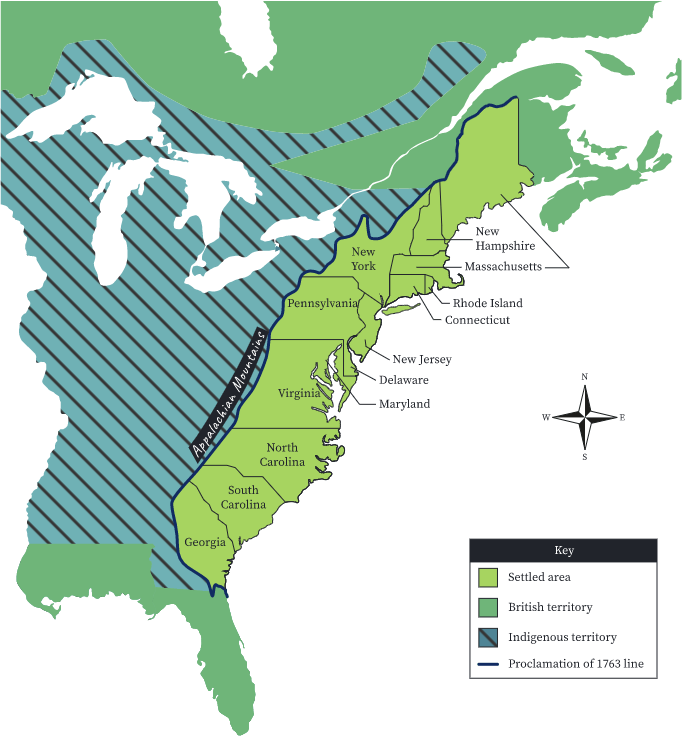
Tensions increased between Britain and the American colonies over territorial expansion.
500
British Parliament passed the Stamp Act in 1765. The Act levied a tax on all printed material in the American colonies, leading to widespread protests. Why did the American colonists object to the Stamp Act?
They believed that Parliament had no right to tax them as they had no direct representation in that legislative body.
"No taxation without representation"
500
What was the Olive Branch Petition?
The American colonists attempt to repair their relationship with the British Crown rather than separate from it as late as 1775
500
At the Constitutional Convention in Philadelphia in 1787, delegates from 12 states debated...
how to organize a central government that was sufficiently powerful while maintaining a balance of power between states.
500
How did American colonists respond to the passage of the Townshend Acts of 1768, which aimed to raise revenue by imposing taxes on glass, lead, paint, and tea?
I will accept 2 responses
1. They organized boycotts of British goods, and merchants signed nonimportation agreements vowing not to buy or sell British goods
2. They formed committees of correspondence to rally opposition to British policies and educate colonists about their rights