Graphing: How Will It End?
Multiplicity: Bounce or Cross?
Beyond Synthetic: What's the Remainder?
Theorem-ical Thinking
At the Peak of Vertex Form
100
What is the degree of the polynomial AND it's leading coefficient?
f(x)=3x^5-4x^2+x-7
degree 5
leading coefficient 3
100
How many zeros does the following function have?
f(x)=-x^3+x^2+3x-3
The degree is 3 so this function has 3 zeros.
100
Factor the polynomial:
x^2+2x-8
(x+4)(x-2)
100
Name a Theorem to find all positive or negative possible zeros?
Descartes Rule of Signs
100
What is the vertex of f(x)?
f(x) = 3(x-5)^2+13
(5, 13)
200
When the degree is even and leading coefficient is positive, both ends point ____. When the degree is even and the leading coefficient is negative, both ends point ______.
up, down
200
What are the zero's AND the multiplicity of each zero for the function below?
f(x)=x^2(x-5)(x+5)
x=0 multiplicity 2
x=5 multiplicity 1
x=-5 multiplicity 1
200
Factor the polynomial:
5x^2-35x+60
5(x-4)(x-3)
200
Name a theorem to find all possible zeros.
rational root theorem
200
Write an equation in vertex form of the parabola below. Assume it is not being stretched.
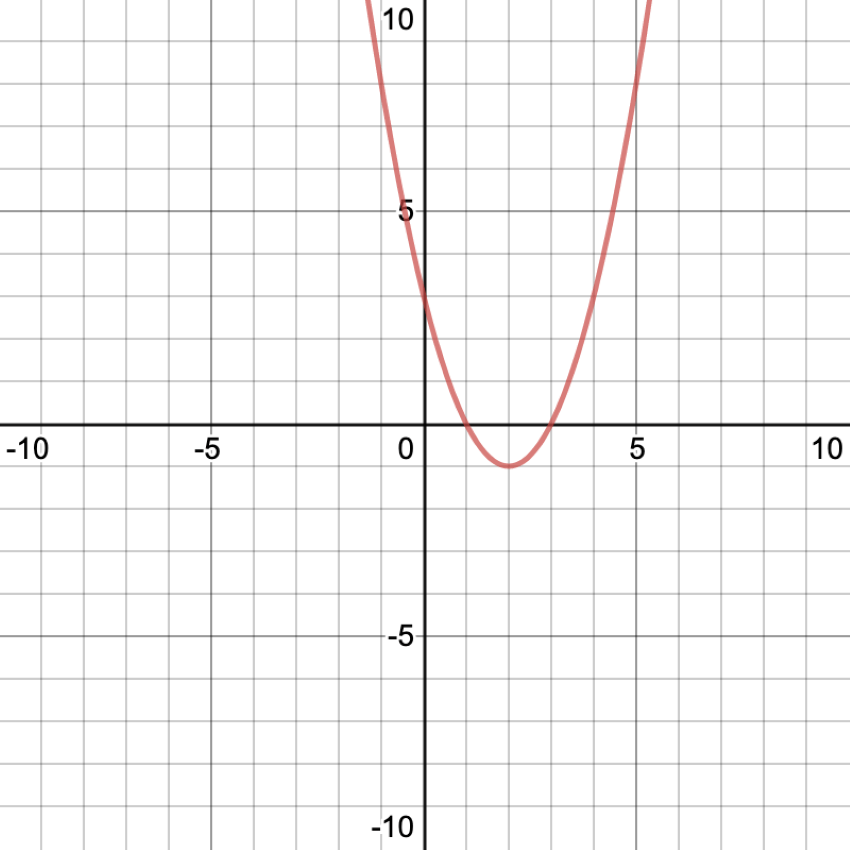
(x-2)^2-1
300
Based on the graph below, does the polynomial have an even or odd degree AND is the leading coefficient positive or negative?
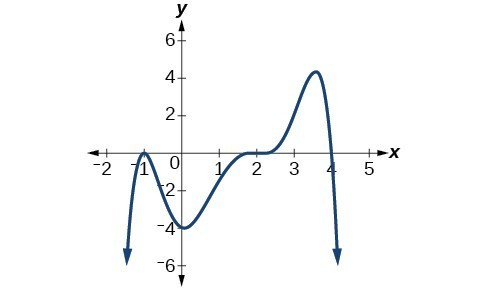
Even, negative
300
What are the x-intercepts of the following function? What is the multiplicity of each?
f(x)=2(x+2)^2(x+4)^2
x=-2 multiplicity 2
x=-4 multiplicity 2
300
Factor completely if you know (x-3) is a factor of the polynomial below.
x^3+5x^2-9x-45
(x-3)(x+3)(x+5)
300
If the x intercept is x=0
Write a factor that will produce this zero, it must be a multiplicity of 2.
multiple answers x2
300
Rewrite in vertex form:
f(x)=x^2+8x+16
f(x)=(x+4)^2
400
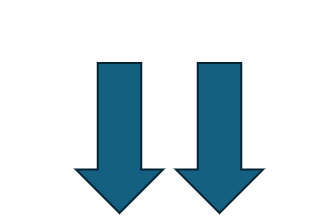
What is the end behavior of the following polynomial function?
f(x)=-2x^4-x^3+4x-5
400
What are the zeros (and multiplicity of each zero - even or odd) for the function graphed below.
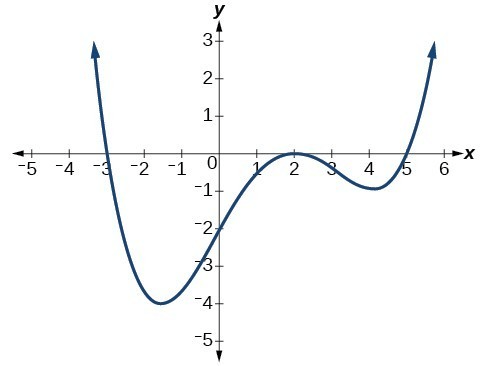
x=-3 odd
x=2 even
x=5 odd
400
Divide
f(x)=(4x^2-5x-21)/(x-3)
4x+7
400
Find the y-intercept of the following polynomial:
y=0
400
Rewrite in vertex form:
f(x)=x^2-10x+24
f(x)=(x-5)^2-1
500
What is the end behavior in limit notation of the following polynomial function?
f(x)=-5x^3+3x^2-x+7
lim(x->oo), f(x)->-oo
lim(x->-oo), f(x)->oo
500
A 7th degree polynomial was graphed below. Each zero has a multiplicity of 1. How many imaginary zeros does the polynomial have?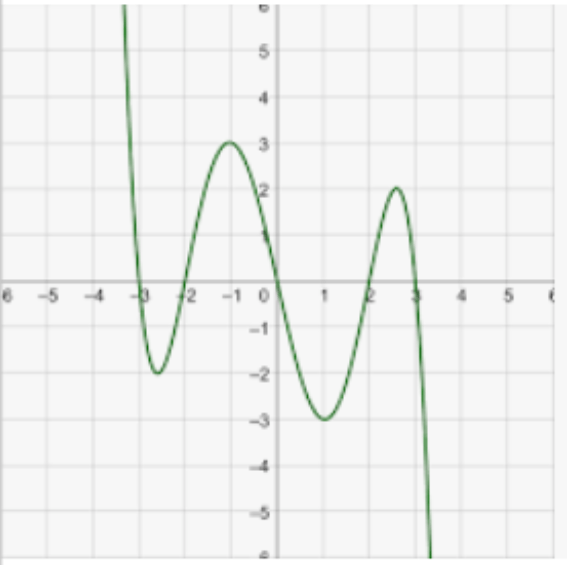
2
500
What is the remainder when you divide f(x) by (x+3)?
f(x)=x^2+4x+6
Remainder is 3
500
What is the Fundamental Theorem of Algebra?
The degree of a polynomial is equivalent to the number of zeros that polynomial has.
500
Rewrite in vertex form:
g(x)=3x^2+9x+17
g(x)=3(x+3/2)^2+41/4