Derm
Derm 2
Misc
Heme
Pulm
100
Diagnosis of infection-related skin erosions with honey-colored crust
Impetigo
100
This distinct nail deformity, characterized by thin, spoon-shaped nails that concave upward, is most classically associated with severe iron deficiency anemia or Plummer-Vinson syndrome.
Koilonychia
100
Characterized by a triad of inflammatory arthritis, splenomegaly, and severe neutropenia, this rare complication typically occurs in patients with long-standing, aggressive rheumatoid arthritis.
Felty's syndrome
100
This targeted antidote is a humanized monoclonal antibody fragment designed to rapidly reverse the anticoagulant effects of the direct thrombin inhibitor dabigatran.
What is Idarucizumab or Praxbind
100
This occupational lung disease, characteristically demonstrates "eggshell" calcification of the hilar lymph nodes on a chest radiograph.
What is Silicosis?
200
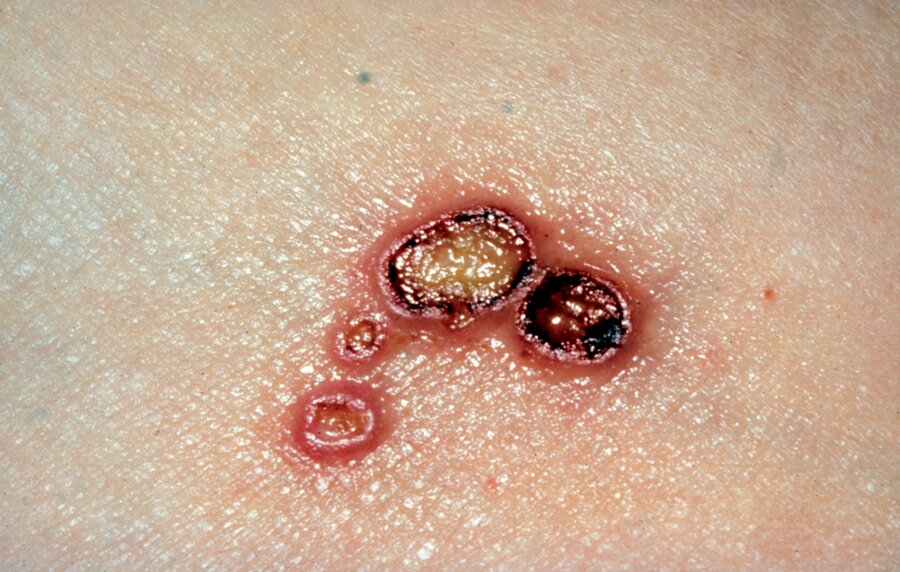
This is a deep variant of staphylococcal or streptococcal impetigo characterized by papules, pustules, or nodules that progress to punched-out ulcers with overlying eschar.
Ecthyma- They almost always occur on the legs or feet and are usually caused by Streptococcus pyogenes.
200
Patients carrying the HLA-B*1502 allele are at a severely elevated risk for Stevens-Johnson syndrome and toxic epidermal necrolysis when prescribed this specific anticonvulsant medication.
Carbamazepine
200
This calculation, which compares the change in the anion gap to the change in bicarbonate, is used to detect a hidden metabolic alkalosis or non-gap metabolic acidosis in a patient who already has a high anion gap metabolic acidosis.
Delta-Delta ratio or Delta ratio
200
Synonym for 5q minus syndrome
Myelodysplastic Syndrome (MDS
200
To meet the 2012 Berlin Definition for severe Acute Respiratory Distress Syndrome (ARDS), a patient’s PaO2/FiO2 ratio must fall below this specific numeric threshold while on a minimum PEEP of 5 cm H2O.
What is 100?
300
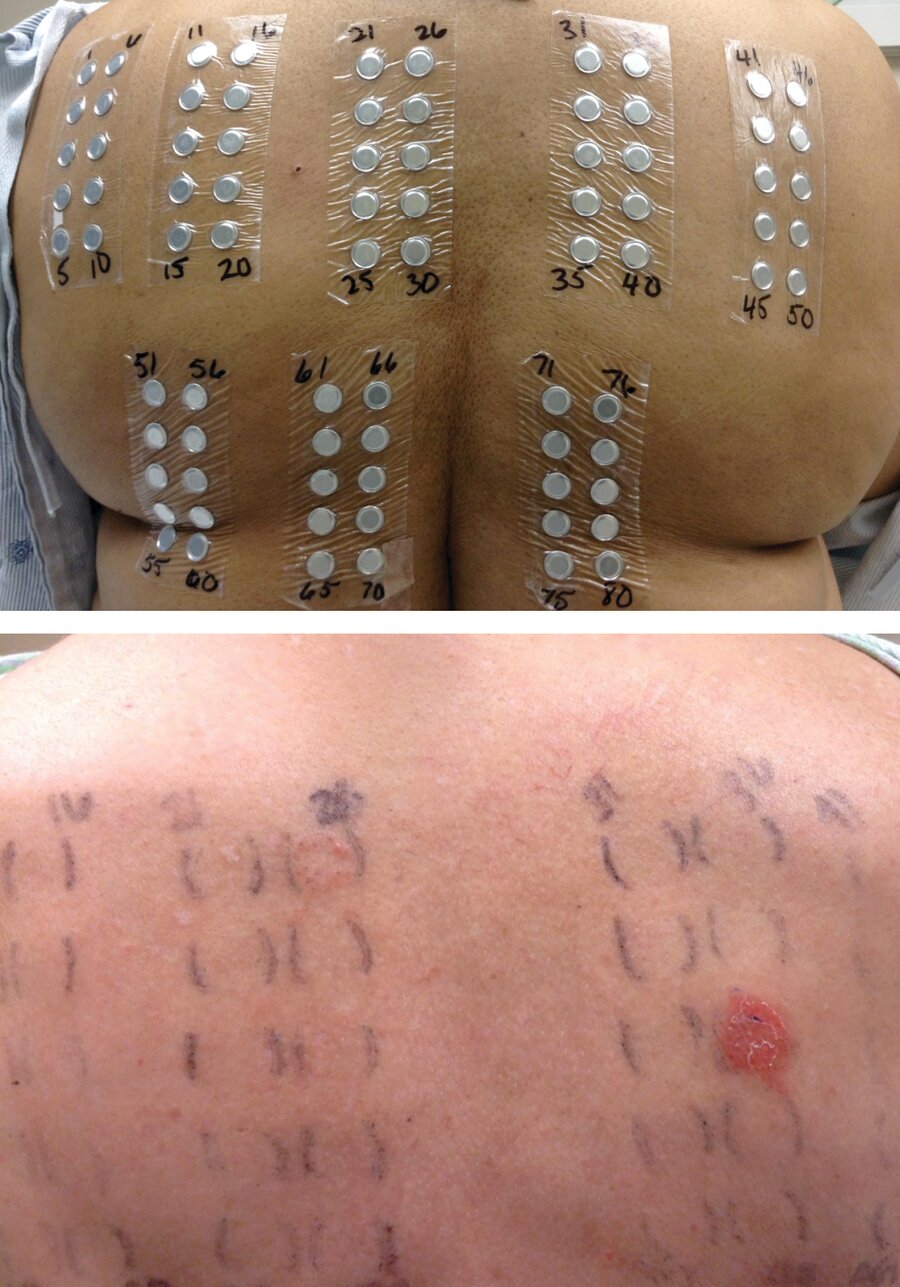 What test is being shown in this image?
Epicutaneous Patch Testing
Epicutaneous patch testing is commonly applied to the back (top) to evaluate for allergic contact dermatitis. The erythematous patch identified 48 hours after epicutaneous patch testing (bottom) indicates a positive reaction to a specific allergen.
300
This diagnostic sign occurs when scraping a psoriasis plaque removes the silver-white scale, revealing pinpoint bleeding points underneath due to the rupture of dilated capillaries in the elongated dermal papillae.
What is the Auspitz sign?
300
This specific bacterial pathogen is the most common cause of culture-negative infective endocarditis associated with exposure to infected livestock or farm animals,
Coxiella burnetii causing Q fever
300
Gene involved in Paroxysmal Nocturnal Hemoglobinuria (PNH)?
PIGA gene
classically diagnosed via flow cytometry looking for CD55 and CD59 deficiency.
300
This complex acid-base disturbance is the classic signature of severe salicylate (aspirin) toxicity, combining two primary acid-base disorders due to direct stimulation of the medullary respiratory center and uncoupling of oxidative phosphorylation.
Primary Respiratory Alkalosis and Primary High Anion Gap Metabolic Acidosis
400
A positive “dimple sign,” wherein the lesion becomes indented upon application of lateral inward pressure is seen with this condition
Dermatofibromas- are benign, fibrohistiocytic lesions that are thought to represent scar-like reactions to local trauma (e.g., bug bite, folliculitis). The extremities are most commonly affected, particularly the legs of young women. The lesions appear as tan to brown, discrete papules that often have a slightly darker brown ring encircling a central sclerotic area.
400
When executing a primary closure on the lower leg or forearm, sutures should ideally be oriented parallel to these structural skin lines to minimize wound tension and scar widening.
What are Langer's lines (or relaxed skin tension lines)?
400
This enzyme activity should be tested before starting Azathioprine or 6-MP
requires mandatory screening for thiopurine methyltransferase (TPMT) or NUDT15 enzyme activity before initiation to prevent severe, life-threatening myelosuppression.
400
What is the mutation in the JAK2 gene that causes Polycythemia Vera in 95% of the cases?
V617F mutation
400
This rare interstitial lung disease, primarily affecting young women of childbearing age, is caused by neoplastic proliferation of atypical smooth muscle cells and is strongly associated with TSC1/TSC2 mutations and recurrent chylothorax.
What is Lymphangioleiomyomatosis (LAM)?
500
 This tumor is a benign, non-cancerous growth that develops in, under, or around the fingernails or toenails and are a classic cutaneous hallmark of tuberous sclerosis complex
Koenen tumor (also known as a periungual or subungual fibroma
500
This clinical sign refers to the presence of subtle, linear, white bands or striae across the fingernails, historically associated with arsenic poisoning but also seen in heavy metal toxicity and acute systemic stress.
What are Mees' lines (or Aldrich-Mees lines)?
Leukonychia striata.

500
2026 Nobel Prize in Physiology or Medicine was awarded jointly to Karl Deisseroth, Peter Hegemann, and Georg Nagel for which discoveries
For their discoveries concerning light-gated ion channels and optogenetics.
Channelrhodopsin Discovery: Hegemann and Nagel discovered channelrhodopsin, a light-sensitive protein that makes cells reactive to light when introduced into them.
Optogenetics Innovation: Deisseroth adapted this light-sensitive protein into mammalian nerve cells, enabling scientists to switch individual neurons on or off using blue light in living brains
500
Name the translocation in Burkitt lymphoma
characterized by a t(8;14) translocation that moves the MYC proto-oncogene next to the immunoglobulin heavy chain locus, classically showing a "starry sky" appearance on histology.
500
This is a rare pulmonary Mycobacterium avium complex (MAC) infection. It typically affects slender, immunocompetent, postmenopausal women. It is characterized by bronchiectasis and a pattern historically linked to habitual voluntary cough suppression.
Lady Windermere syndrome