The Universe
Stars & Stardust
Planets & Solar Systems
Measurements & Dating
Earth, Moon & Telescopes
100
How old is the universe, and what evidence supports this estimate?
About 13.8 billion years; rate of expansion of the Universe.
100
On an HR diagram, where are hot, dim stars located?
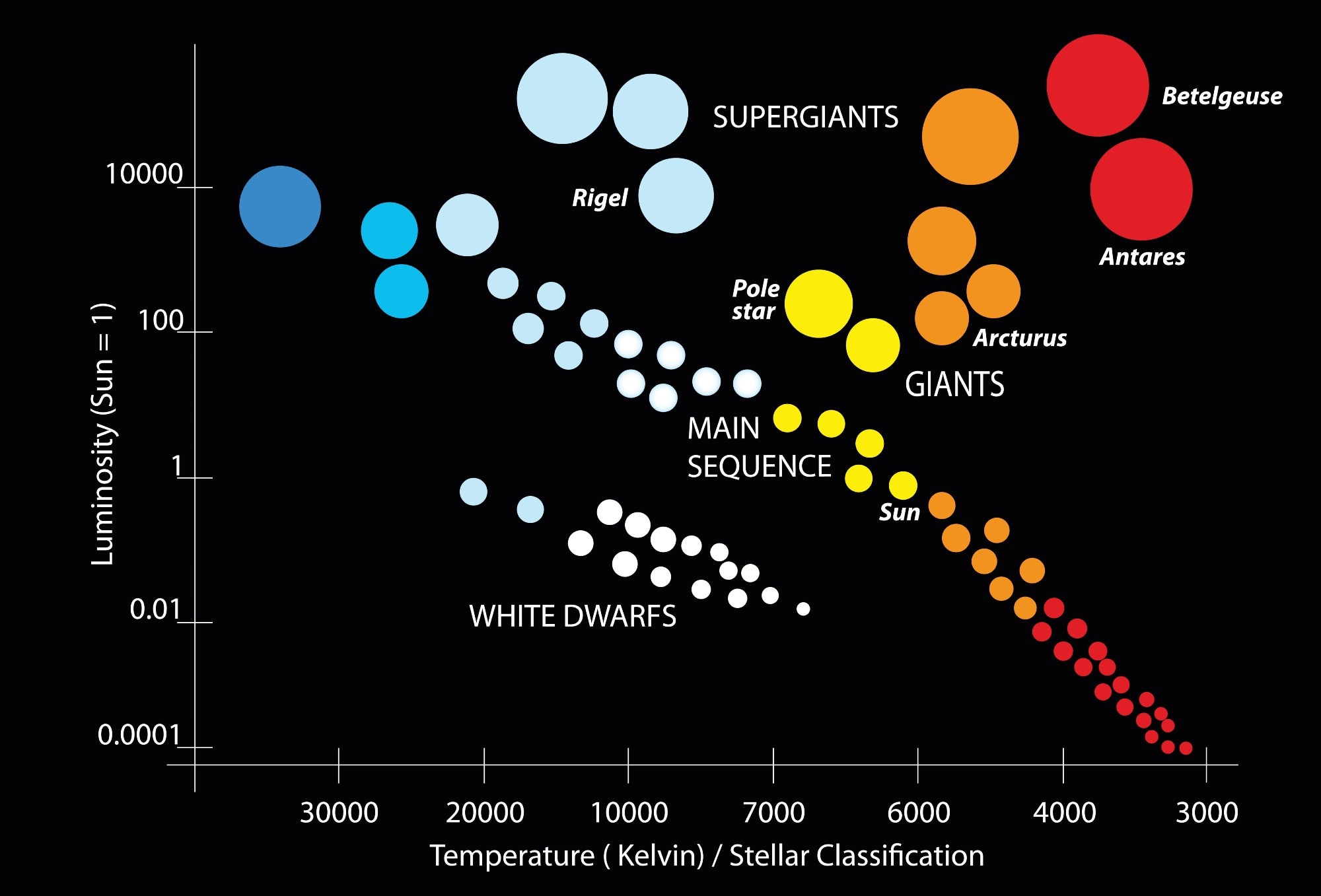
Lower left (white dwarfs).
100
Give at least three differences between terrestrial planets and gas giants.
Composition: Terrestrial planets are mostly rock and metal; gas giants are mostly hydrogen, helium, and ices.
Size and density: Terrestrial planets are small with high density; gas giants are very large with low density.
Location and formation: Terrestrial planets formed inside the frost line, close to the Sun; gas giants formed beyond the frost line, where ices condensed and cores captured gas.
100
What is a light-year, and when is it the best unit to use?
Distance light travels in one year; best for stars/galaxies.
100
What causes Earth’s seasons?
Earth’s tilt and revolution; sunlight angle and day length change.
200
What three key observations support the Big Bang Theory?
Redshift of galaxies
cosmic microwave background
hydrogen & helium abundance.
200
Which type of stars end as neutron stars or black holes?
High-mass stars.
200
According to the nebular hypothesis, why are outer planets so large?
Beyond the frost line, ices condensed, cores grew quickly, and they captured gas.
200
How is an astronomical unit (AU) defined?
Average Earth–Sun distance (~150 million km).
200
Why do space telescopes produce clearer images than ground telescopes?
No atmosphere to blur or absorb light.
300
Why does redshift get larger the farther away a galaxy is?
Because the universe is expanding, distant galaxies move away faster, stretching their light more.
300
Why are supernovae important for life on Earth?
They create and spread heavy elements like carbon, oxygen, and iron.
300
What are the two reasons gas giants can keep light gases like hydrogen and helium today, but Earth cannot?
They have stronger gravity and colder temperatures, so gases don’t escape.
300
A sample has gone through three half-lives. What fraction of the parent isotope remains?
1/8 (12.5%).
300
Why is it summer in the Southern Hemisphere when it’s winter in the Northern Hemisphere?
Because Earth’s axis is tilted—when one hemisphere tilts toward the Sun, the other tilts away.
400
Why is the cosmic microwave background evidence for a Big Bang?
It’s leftover radiation from ~380,000 years after the Big Bang, when atoms first formed.
400
Describe the journey of carbon atoms from the Big Bang to being part of our bodies.
Big Bang made H/He → stars formed → fusion created carbon → supernova spread it → new nebula formed Sun/planets → Earth → life.
400
What role did the frost line play in shaping the solar system?
Inside frost line only rock/metal condensed; beyond it, ices condensed, forming bigger planets.
400
A meteorite started with 16 g of parent isotope. After 2 half-lives, how much remains?
4 g.
400
Give one piece of evidence that supports the Giant Impact Hypothesis.
The Moon’s composition is very similar to Earth’s mantle material.
500
How does the abundance of hydrogen and helium support the Big Bang model?
The Big Bang predicts ~75% hydrogen and ~25% helium, and observations match that.
500
Tell the story of what happens when a low-mass star like the Sun runs out of hydrogen, compared to a massive star.
Sun-like star: becomes red giant → sheds outer layers → planetary nebula → white dwarf. Massive star: expands into a supergiant → collapses/explodes as a supernova → neutron star or black hole.
500
Explain step by step how the solar nebula formed the Sun and planets.
Gravity collapsed a nebula →
Sun formed at center →
disk of dust/gas →
planetesimals grew →
planets formed.
500
How do scientists use radioactive dating to determine the age of the Earth and meteorites?
Measure parent vs. daughter isotopes and compare with known half-lives.
500
What evidence shows that a supermassive black hole is at the center of our galaxy?
Stars near the center orbit very fast around an invisible, massive object.