Kepler's Laws of Planetary Motion
The Moon
The Big Bang
Stars
ESSRT
100
Kepler's 1st Law states that all celestial objects orbit the Sun in this shape
Ellipse
100
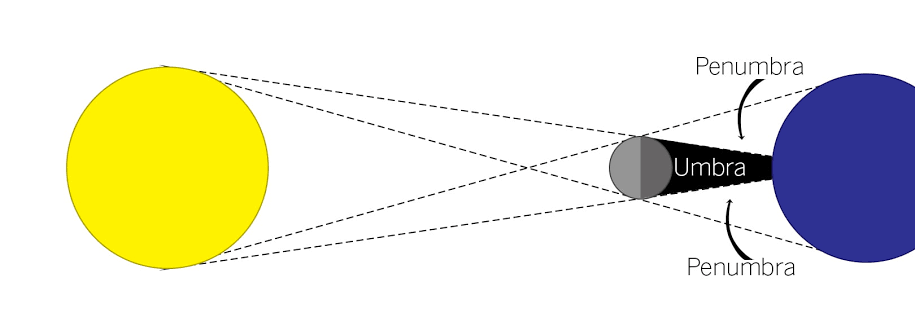
draw the positions of the Earth, Sun and Moon during a solar eclipse. Include a sketch of the shadow.
100
Cosmic microwave background radiation helps support the Big Bang Theory because
It is the residual heat/energy from the explosion of the universe
100
the life cycle of a star depends on
its mass
100
Canopus is what type of star and what color is it?
Supergiant, yellow-white
200
To create an ellipse, there are two foci in the center of orbit. What are the two foci?
the Sun and NOTHING
200
the Moon take this many days to orbit the Earth
27.3 days
200
The universe formed how long ago?
13.8 billion years ago
200
stars are formed by this process
fusion
200
compare the eccentricity of Jupiter and Saturn
Jupiter is more eccentric (closer to 1) than Saturn
Saturn has a (slightly) more circular orbit than Jupiter (closer to 0)
300
describe the periods of revolution for planets close to the Sun vs. far from the Sun
planets closer to the Sun have shorter periods of revolution and planets farther from the Sun have longer periods of revolution
300
this is the reason we Earthlings see the same side of the Moon all the time
the Moon has the same period of revolution and rotation
300
The farther a celestial body is from Earth, the _________ it moves
faster
300
describe the temperature, mass, luminosity and size of main sequence stars
its all AVERAGE, nothing spectacular
300
During a massive star's death, carbon will fuse into oxygen for this amount of time
600 years
400
Celestial objects orbit the Sun in equal _________ in equal time
area
400
When describing moon phases, waning means the bright side of the moon is _________ and waxing means the bright side of the moon is _________
waning=disappearing
waxing=growing
400
The redshift supports the Big Bang theory because
Objects that are moving away from us appear red because their wavelengths are getting stretched, supporting the idea that our universe is constantly expanding
400
the first star stage for every single star (Sun-like stars and Massive stars)
protostars
400
After supernova, a massive star will turn into
neutron star OR black hole
500
what is the difference between perihelion and aphelion?
perihelion is when a celestial object is closest to the Sun in its orbit, and aphelion is when a celestial object is farthest from the Sun in its orbit
500
it takes this many days to see all the moon phases
29.5 days
500
the Big Bang theory states that the universe originated as
a small, hot, dense point
500
Early stars are composed of
(provide percentages of two elements)
75% hydrogen and 25% helium
500
this is the solar radii of Pollux
10 solar radii