Planets
Stars
More Stars
Space Instruments
Vocabulary
Planets and more
Miscellaneous
100
The force that keeps planets in orbit around the Sun.
What is gravity?
100
Cloud of dust and gas in space that may form a star
What is a nebula?
100
Stage in a star's life cycle when the star expands, cools, and glows red
What is a red giant?
100
What is the difference between absolute and apparent magnitude?
Absolute: How bright a star actually is; Apparent: How bright a star appears to be from Earth.
100
The average distance between Earth and the Sun
What is an astronomical unit?
100
Saturn is most well know for this feature
What are highly visible rings?
100
Property of electromagnetic waves that determines the type of radiation
What is a wavelength?
200
The planets in order from the Sun
Mercury, Venus, Earth, Mars, Jupiter, Saturn, Uranus, Neptune
200
How stars produce heat and light energy
What is nuclear fusion?
200
Remains of a collapsed star so dense not even light can escape
What is a black hole?
200
This space-based telescope transmits photographs of stars, galaxies, nebulae, and other space objects
What is the Hubble Space Telescope?
200
Space and all the matter and energy that exist in it
What is the universe?
200
Largest and smallest planets
What are Jupiter and Mercury?
200
The shape of the Milky Way galaxy
What is a spiral-shaped galaxy?
300
Characterized by being small, dense, with solid rocky surfaces
What are the inner planets?
300
Allows scientists to determine the distance to nearby stars
What is parallax?
300
Ursa Major is an example
What is a constellation?
300
A vehicle for space exploration that carries instruments but not people
What is a space probe?
300
Large group of billions of stars, dust, and gas held together by gravity?
What is a galaxy?
300
Venus is the hottest planet for this reason
What is its dense atmosphere that traps heat?
300
Where would you find our Sun on this diagram?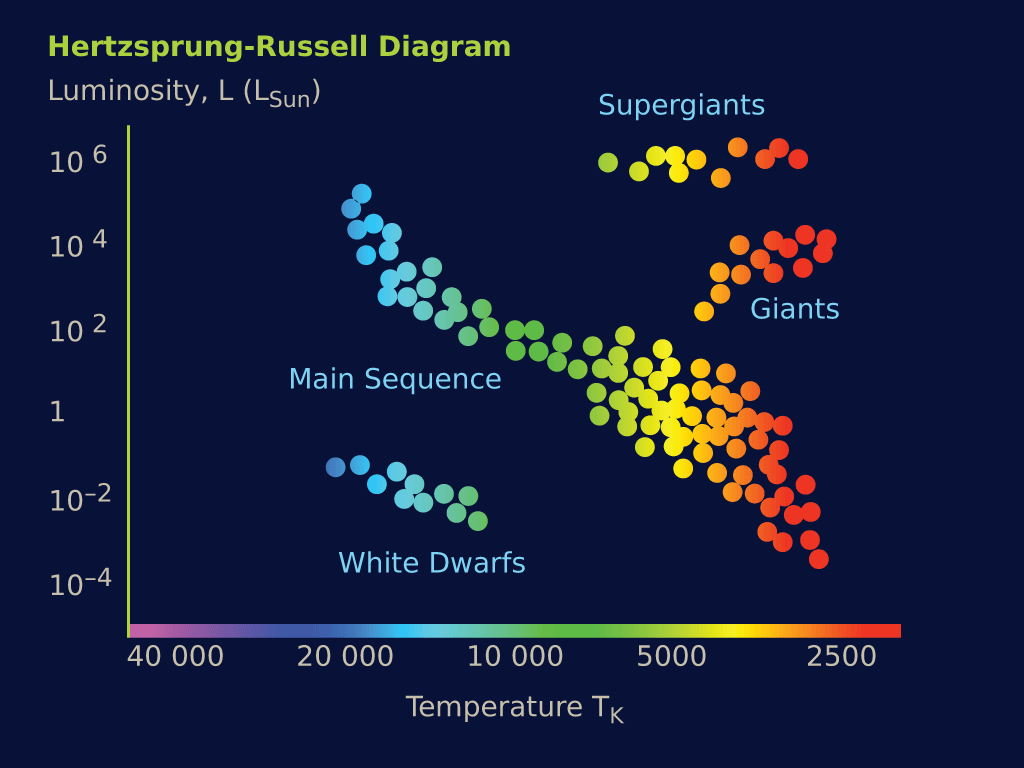
Near the middle on the main sequence
400
Jupiter is most well known for this
What is the Great Red Spot?
400
Scientists decide how to place stars on an H-R diagram by...
What is a star's composition and temperature?
400
Range of colors that make up visible light
What is a spectrum?
400
This uses curved mirrors to collect and focus light from space
What is a reflecting telescope?
400
A band on a temperature-brightness graph that includes 90% of stars
What is the main sequence?
400
A natural satellite that revolves around a planet
What is a moon?
400
Where would you find a hot, bright star on this diagram?
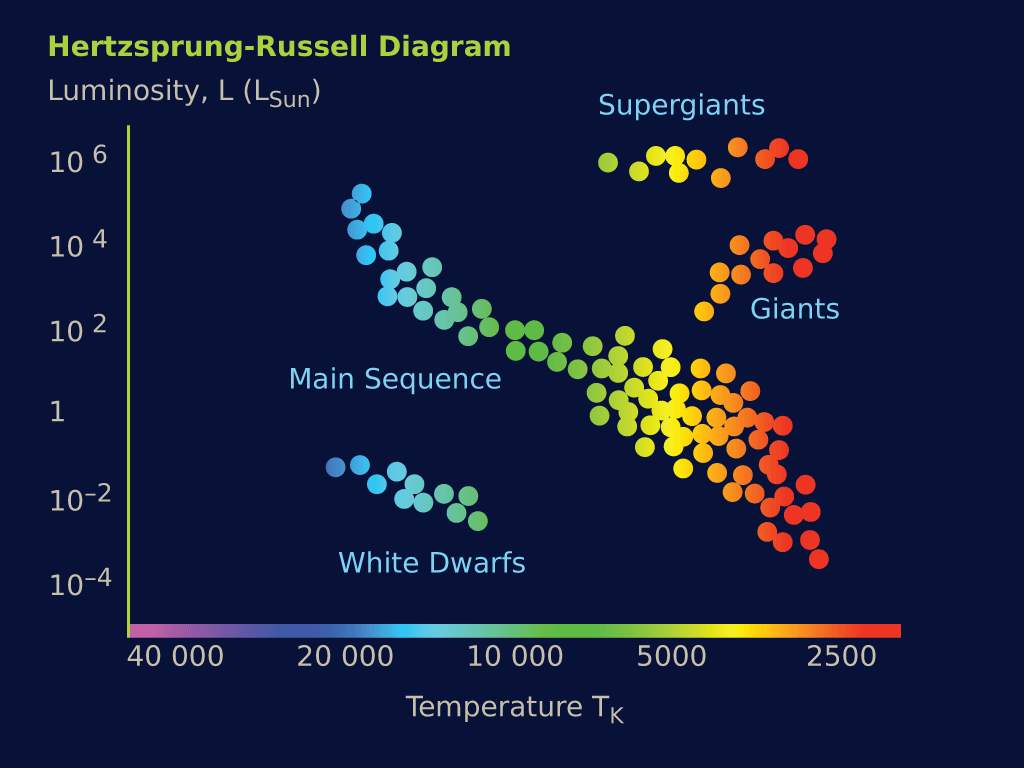
Near the top of the main sequence
500
This planet appears reddish because...
Mars appears red because of iron oxide on the surface
500
An indicator that a star is moving away from Earth
What is red shift?
500
List the life cycle stages of a medium mass star and then tell how a massive star differs
Stellar nebula - protostar - main sequence - *red giant -planetary nebula - white dwarf - black dwarf *red supergiant - supernova - neutron star or black hole
500
How do astronomers detect objects in space that do not give off or reflect visible light?
Using radio and infrared telescopes, artificial satellites and space-based telescopes to detect x-rays, gamma rays, and ultraviolet rays.
500
Small, rocky objects orbiting the Sun between Mars and Jupiter
What are asteroids?
500
Three types of objects found in our solar system not including planets, moons, or the Sun
What are comets, asteroids, and meteors?
500
Where would you find a cool, dim star on this diagram?
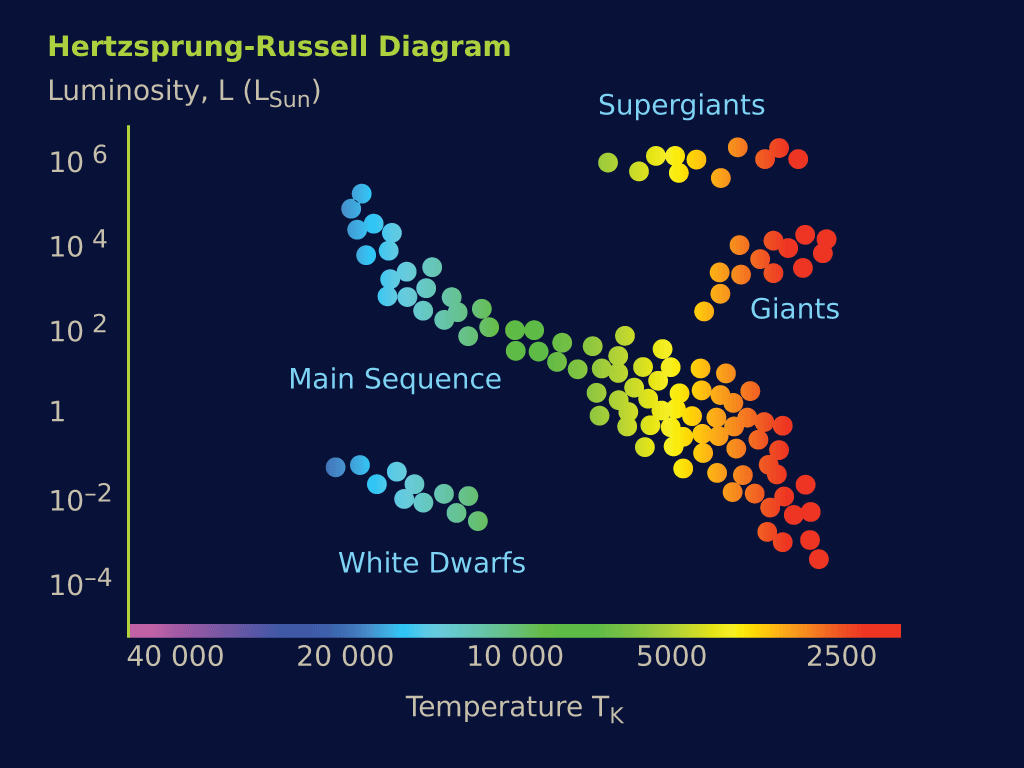
Near the bottom of the main sequence