Don't Judge!
I'm most important!
You Ain't got no rhythm!
Culture strike!
Your labs Hemolized!
100
Following a motor vehicle crash, a nurse stops and offers assistance. Which of the following actions are most appropriate? Select all that apply
1. The nurse needs to know the Good Samaritan Act for the state.
2. The nurse is not held liable unless there is gross negligence
3. After assessing the situation, the nurse can leave to obtain help.
4. The nurse can expect compensation for helping.
5. The nurse offers to help but cannot insist on helping.
Answer: 1,2,5
Rationale:
The nurse is subject to the limitations of state law and should be familiar with the Good Samaritan laws in the specific state. Gross negligence would be described by the individual state law. Unless there is another equally or more qualified person present, the nurse needs to stay until the injured person leaves. The nurse should ask someone else to call or go for additional help. The same client rights apply at the scene of an accident as well as those in the workplace.
100
A 16-year old patient with cystic fibrosis is admitted with increased shortness of breath and possible pneumonia. Which nursing activity is most important to include in the patient’s care?
A. Perform postural drainage and chest physiotherapy every 4 hours.
B. Allow the patient to decide whether she needs aerosolized medications.
C. Place the patient in a private room to decrease the risk of further infection.
D. Plan activities to allow at least 8 hours of uninterrupted sleep.
Answer: A
- Option A: Airway clearance techniques are critical for patients with cystic fibrosis and should take priority over other activities.
- Option B: Although allowing more independent decision making is important for adolescents, the physiologic need for an improved respiratory function takes precedence at this time.
- Option C: A private room may be desirable for the patient but is not necessary.
- Option D: With increased shortness of breath, it will be more important that the patient has frequent respiratory treatments than 8 hours of sleep.
100
Name this cardiac rhythm and what is given to remedy it!
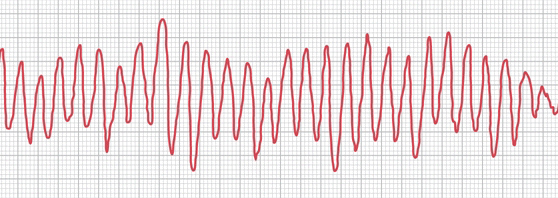
Name: Torsades de pointe
Remedy: Magnesium sulfate
100
A clinic nurse is preparing to examine a Hispanic child who was brought by the mother for his first physical check-up. While assessing the child, the nurse would avoid doing which of the following?
A. Weighing the client.
B. Asking the mother questions about the child.
C. Having an interpreter if necessary.
D. Admiring the child
Answer: D
Admiring a Hispanic-American child during the first encounter with a stranger should be avoided since this may give the child with the "evil eye" (the child will get sick). If this is done, it can be avoided by touching the child afterward.
100
A client went to the emergency room with sudden onset of high fever and diaphoresis. Serum sodium was one of the laboratory test taken. Which of the following values would you expect to see?
A. 130 mEq/L.
B. 148 mEq/L.
C. 143 mEq/L.
D. 139 mEq/L.
Answer: B.
The normal sodium level is 135-145 mEq/L. Diaphoresis and a high fever can lead to free water loss through the skin, resulting in increased sodium level (hypernatremia).
200
When a client is confused, left alone with the side rails down, and the bed in a high position, the client falls and breaks a hip. What law has been broken?
A. Assault
B. Battery
C. Negligence
D. Civil tort
Answer: C
Knowing what to do to prevent injury is a part of the standards of care for nurses to follow. Safety guidelines dictate raising the side rails, staying with the client, lowering the bed, and observing the client until the environment is safe. As a nurse, these activities are known as basic safety measures that prevent injuries, and to not perform them is not acting in a safe manner. Negligence is conduct that falls below the standard of care that protects others against unreasonable risk of harm.
200
After a change of shift, you are assigned to care for the following patients. Which patient should you assess first?
A. A 60-year old patient on a ventilator for whom a sterile sputum specimen must be sent to the lab.
B. A 55-year old with COPD and a pulse oximetry reading from the previous shift of 90% saturation.
C. A 70-year old with pneumonia who needs to be started on intravenous (IV) antibiotics.
D. A 50-year old with asthma who complains of shortness of breath after using a bronchodilator.
Correct Answer: D. A 50-year old with asthma who complains of shortness of breath after using a bronchodilator.
- Option D: The patient with asthma did not achieve relief from shortness of breath after using the bronchodilator and is at risk for respiratory complications. This patient’s needs are urgent.
- Options A, B, and C: The other patients need to be assessed as soon as possible, but none of their situations are urgent. In COPD patients pulse oximetry oxygen saturations of more than 90% are acceptable.
200
Name this rhythm and what is given to remedy it!

Name: A-Fib!
Remedy: diltiazem(calcium channel blocker)
long term medications include anticoagulant to decrease the risk for stroke due to clotting that occurs during priods of A-fib as the ineffective cardiac contractions fail to eject all the blood from the heart, the blood pools and clots, when the rhythm reverts to normal, clots may be sent out systemically.
200
Select all of the signs and symptoms of hyperthyroidism.
A. Cool skin
B. Thickened bodily hair
C. Heat intolerance
D. Constipation
E. Insomnia
F. Increased appetite
G. Palpitations
Answer: C,E,F,G
The signs and symptoms of hyperthyroidism include heat intolerance, increased appetite, palpitations and insomnia among others such as thinning hair, the loss of hair, increased sweating, weight loss, emotional instability and diarrhea.
200
A male client with atrial fibrillation who is receiving maintenance therapy of warfarin (Coumadin) has a prothrombin time of 37 seconds. Based on the result, the nurse will follow which of the following doctor's order?
A. Administering the next dose of the warfarin.
B. Increasing the next dose of warfarin.
C. Decreasing the next dose of warfarin.
D. Withholding the next dose of warfarin.
Answer: D.
The normal prothrombin time is 9.6 to 11.8 seconds (male adult). A therapeutic level PT level is 1.5 to 2 times higher than the normal level. Since the value of 37 seconds is high, the nurse should expect that the client next dose of warfarin will be withheld.
300
A client is brought to the emergency department by EMS after being hit by a car. the name of the client is unknown, and the client has sustain a severe head injury and multiple fractures and is unconscious. An emergency craniotomy is required. Regarding informed consent for the surgical procedure, which is the BEST action?
A. obtain a court order for the surgical procedure
B. ask the EMS team to sign the informed consent
C. transport the victim to the operating room for surgery
D. call the police to id the client and locate the family.
Answer: C
No informed consent needing during an emergency situation if the client/patient is unable to communicate.
300
A child undergoes a tonsillectomy for treatment of chronic tonsillitis unresponsive to antibiotic therapy. After surgery, the child is brought to the recovery room. Which of the following actions should the nurse include in the child’s plan of care?
1. Institute measures to minimize crying.
2. Perform postural drainage every 2 hours.
3. Cough and deep-breathe every hour.
4. Give ice cream as tolerated.
Answer: 1
The Reworded Question: What should you do after a tonsillectomy? Step 1. Are all the answer choices implementations? Yes.
Step 2. Can you answer the question based on your knowledge of a tonsillectomy? If not, continue to Step 3.
Step 3. Ask yourself, “What will cause the client the least amount of harm?”
Answer choice (1), minimizing crying, will help prevent bleeding. Keep in consideration. Answer choice (2), postural drainage, may cause bleeding. Eliminate. Answer choice (3), coughing and deep-breathing, may cause bleeding. Eliminate. Answer choice (4), giving ice cream, may cause the child to clear his throat, causing bleeding. Eliminate. The correct answer is (1). The nurse must prevent postoperative hemorrhage, a complication seen after this type of surgery. Crying would irritate the child’s throat and increase the chance of hemorrhage.
300
Name this rhythm and what medication or procedure is done to remedy it( medication or procedure not both)
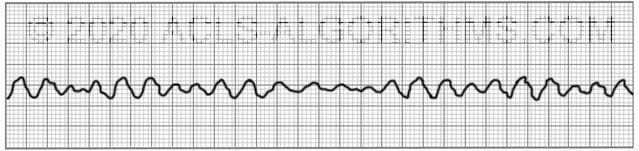
Rhythm: Ventricular Fibrillation! (V-Fib)
Procedure: Defibrillation.
300
A nurse is preparing to deliver a food tray to a Jewish client. The nurse checks the food on the tray and notes that the client has received hamburger and whole milk as a beverage. Which is the appropriate action for the nurse?
A. Ask the dietary department to replace the hamburger with crabs.
B. Replace the whole milk with fat-free milk.
C. Call the dietary department and ask for a new meal tray.
D. Deliver the designated food tray to the client.
Answer: C
"You may not cook a young animal in the milk of its mother" -Torah says (Ex.23:19). From this, it is derived that milk and meat products may not be combined together. Not only may they not be cooked together, but they may not be served together on the same table and surely not eaten at the same time. This rule is followed observantly by the Jewish people so the appropriate nursing action is to call the dietary department to change the meal tray of the patient.
300
A client is receiving a continuous intravenous infusion of heparin sodium to treat deep vein thrombosis. The client's activated partial thromboplastin time is 77 seconds. Based on this result, the nurse anticipate which of the following prescription?
A. Maintain the rate of the heparin infusion.
B. Decrease the rate of the heparin infusion.
C. Increase the rate of the heparin infusion.
D. Discontinue the heparin infusion
Answer: A
The normal activated partial thromboplastin time is between 20 to 36 seconds. In the treatment of deep vein thrombosis, the therapeutic range is to maintain the aPTT level between 1.5 and 2.5 times the normal. This means that the client's aPTT level should not be less 30 seconds or greater than 90 seconds. Thus the client's aPTT of 77 seconds is within the normal therapeutic range, and the dose/rate should not be changed.
400
The nursing supervisor is preparing a staff development program concerning the legal parameters of torts. Which example would the supervisor include as an intentional tort? Select all that apply!
A. Administering a 0900 medication at 1030.
B. Administering a medication to an incorrect client.
C. Performing an invasive procedure without an informed consent.
D. Telling a client that their medication will be withheld if client does not behave.
E. Raising the side rails without a prescription when a client is at risk to fall.
Answer: C & D
C. Performing an invasive procedure without an informed consent. D. Telling a client that their medication will be withheld if client does not behave. C., & D. Correct: An intentional tort occurs when a person intends to perform an action that causes harm to another. Performing an invasive procedure without consent is considered battery because the client has not given consent for the procedure. Threatening to withhold a medication is intentionally threatening to harm the client by not administering the medication
400
A client with multiple injuries is rushed to the ED after a head-on car collision. Which assessment finding takes priority?
A. Irregular apical pulse
B. Ecchymosis in the flank area
C. A deviated trachea
D. Unequal pupils
Answer: C
Following the rules of A-B-C's :)
400
A nurse is watching the cardiac monitor, and a client’s rhythm suddenly changes. There are no P waves; instead there are wavy lines. The QRS complexes measure 0.08 second, but they are irregular, with a rate of 120 beats a minute. The nurse interprets this rhythm as:
A. Sinus tachycardia
B. Atrial fibrillation
C. Ventricular tachycardia
D. Ventricular fibrillation
Answer: B
Atrial fibrillation is characterized by a loss of P waves; an undulating, wavy baseline; QRS duration that is often within normal limits; and an irregular ventricular rate, which can range from 60 to 100 beats per minute (when controlled with medications) to 100 to 160 beats per minute (when uncontrolled).
400
Which of the following food items would be appropriate for a Jewish client who follows a kosher diet?
A. Shrimp and mussels.
B. Beef and pork.
C. Tuna and salmon.
D. Cheese and milk.
Answer: C
In the Jewish religion, Only fish that have scales and fins are allowed such as tuna and salmon; Option A: Shellfish such as shrimps, crabs, mussels, and lobsters are forbidden. Option B: Meats that are allowed include animals that are vegetable eaters, cloven-hoofed, and ritually slaughtered. Option D: Cheese and milk coming from animal fat are prohibited.
400
The nurse is reviewing the laboratory result of a client receiving digoxin (Lanoxin) and notes that the result is 2.5 ng/mL. The nurse plans to do which of the following?
A. Give the next dose.
B. Notify the physician.
C. Check the client's pulse rate.
D. Increase the next dose as ordered.
Answer: B.
Normal value therapeutic range for digoxin is 0.5 to 2 ng/mL. A level of 2.5 ng/mL indicates a toxicity. The nurse should immediately inform the physician, who may give further instructions about holding the next doses of digoxin.
500
The nurse asks if the client has an advance directive. The client responds by saying, "What is an advance directive?” What is the nurse’s best response to the client’s question?
A. Specifies your wishes regarding your personal effects and finances should you become unable to make decisions.
B. Specifies your wishes regarding healthcare and your finances should you become incapacitated.
C. Similar to a will, it specifies your wishes for burial should you die during hospitalization.
D. Specifies your wishes regarding healthcare and treatment options should you become incapacitated.
E. The person signing the advanced directive must be competent.
Answer: D & E
An advance directive is a legal document prepared by a competent individual that specifies what treatments, if any, the client desires should the client become incapacitated or unable to make informed healthcare decisions in the future. The person signing the advance directive must be able to understand and agree with the document.
500
Several clients arrive in the ED with the same complaint of abdominal pain. Designate them for care in order of the severity of their condition.
A. A 25-year-old woman complaining of dizziness and severe left lower quadrant pain who states she is probably pregnant.
B. A 42-year-old woman with moderate right upper quadrant pain who has vomited little amounts of yellow bile and whose symptoms have worsened over the past week.
C. A 38-year-old man complaining of severe occasional cramps with three episodes of watery diarrhea hours after meal.
D. A 12-year-old girl with a low-grade fever, anorexia, nausea, and right lower quadrant tenderness for the past 2 days.
E. A 53-year-old man who experiences discomforting mid-epigastric pain that is worse between meals and during the night.
F. A 68-year-old man with a pulsating abdominal mass and sudden onset of “tearing” pain in the abdomen and flank within the past hour.
The correct order: F, A, D, B, C & E
- (Most severe) The 68-year-old man with pulsating mass is experiencing an abdominal aneurysm that may rupture, and he may abruptly deteriorate.
- The 25-year-old woman with lower left quadrant pain is at risk for ectopic pregnancy, which is a life-threatening condition.
- The 12-year-old girl needs evaluation to rule out appendicitis.
- The 42-year-old woman with vomiting needs evaluation for gallbladder problems, which seems to be worsening.
- The 38-year-old man has food poisoning, which is usually self-limiting.
- The 53-year-old man with mid-epigastric pain may have an ulcer, but followup diagnostic testing and educating lifestyle modification can be scheduled with the primary health care provider. (least severe)
500
A nurse is caring for a client with unstable ventricular tachycardia. The nurse instructs the client to do which of the following, if prescribed, during an episode of ventricular tachycardia?
A. Breathe deeply, regularly, and easily
B. Inhale deeply and cough forcefully every 1 to 3 seconds
C. Lie down flat in bed
D. Remove any metal jewelry
Answer: B
Cough cardiopulmonary resuscitation (CPR) sometimes is used in the client with unstable ventricular tachycardia. The nurse tells the client to use cough CPR, if prescribed, by inhaling deeply and coughing forcefully every 1 to 3 seconds. Cough CPR may terminate the dysrhythmia or sustain the cerebral and coronary circulation for a short time until other measures can be implemented.
500
A critically ill hispanic client tells the nurse through an interpreter that she is Roman Catholic and firmly believes in the rituals and traditions of the Catholic faith. based on the client's statements which actions by the nurse demonstrate cultural sensitivity and spiritual support? select all that apply
A. ensures that a close kin stays with the client
B. makes a referral for a catholic priest to visit the client
C. removes the crucifix from the wall in the client's room
D. administers the sacrament of the sick to the client if death is imminent
E. offers to provide a means for praying the rosary if the client wishes
F. reminds the dietary department that meals served on fridays during Lent do not contain meat
A. ensures that a close kin stays with the client B. makes a referral for a catholic priest to visit the client E. offers to provide a means for praying the rosary if the client wishes
In times of illness, a roman catholic client may turn to prayer for spiritual support. this may include rosary prayers or visits from a priest, who is the spiritual leader in the roman catholic faith. close family members usually want to stay with a dying family member in order to hear the wishes of the client, allowing the soul to leave in peace.
500
You’re assessing your patient’s morning labs. The metabolic panel shows the following results below. Which results are abnormal? Select all that apply:
A. Potassium 2 mEq/L
B. Sodium 110 mEq/L
C. BUN 10
D. Magnesium 2.3 mg/dL
E. Phosphorus 1 mg/dL
F. Glucose 96 mg/dL
G. Creatinine 5 mg/dL
Answer: A, B, E, G