CH 12
CH 15
CH 16
CH 13
ANY CHAPTER
100
Wind that blows from land to sea
Land Breeze
100
What is it called when plants give off moisture into the atmosphere?
Transpiration
100
The _________ is the major source of energy for wind, air and ocean currents
the sun
100
A boundary between two air masses
A front
100
Carbon dioxide, methane, water vapor and ozone are examples of.......
Greenhouse Gases
200
How do we know when one layer of the atmosphere starts and the other stops?
Based on the changes in temperature that occur
200
Water in gas form is called...
Water Vapor
200
When thinking about matter, what is volume?
a measurement of how much space matter occupies
200
measures the temperature of the air in degrees Celcius and Fahrenheit
Thermometer
200
These storms are the most destructive, are circular in shape with intense winds, and form in late summer over warm, tropical ocean.
Hurricanes
300
Layer of the atmosphere where the ozone is located
Stratosphere
300
When you heat a substance, do the particles gain or lose energy?
The particles gain more energy
300
A horizontal movement of ocean water that is caused by winds and that occurs at or near the ocean surface
Surface Currents
300
Severe weather followed by cool temperatures
Cold Front
300
Why do local winds like sea and land breezes occur?
Because of differences in heating and cooling of land and water
400
How do global winds travel?
High to low pressure
400
As molecules of water vapor lose energy in the atmosphere, what happens to them?
they condense
400
What are convection currents?
The transfer of heat in a gas or a liquid
400
Warm air is _______ and ________
less dense, rises
400
What weather tool is in this picture?
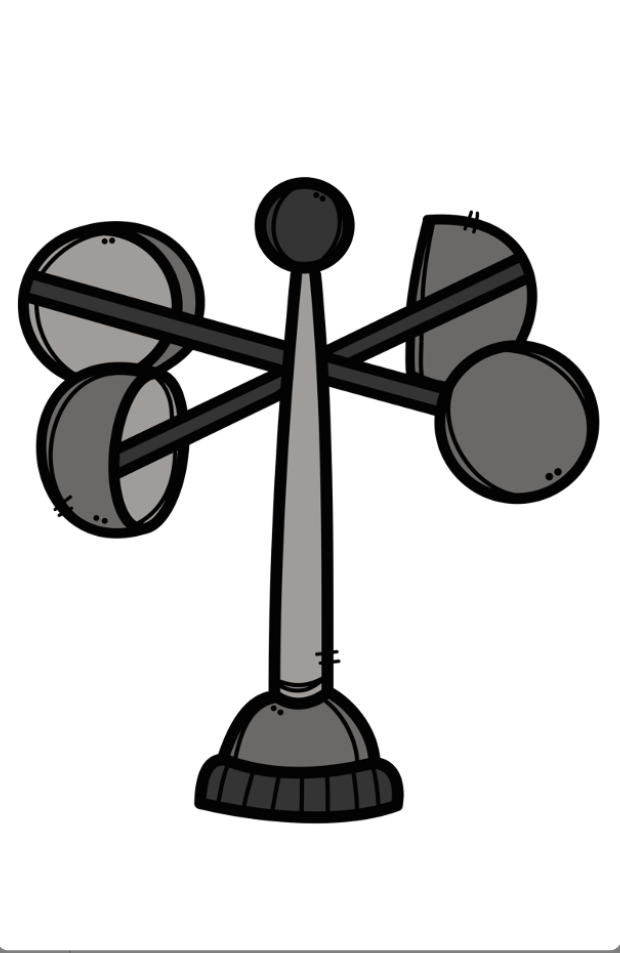
Anemometer
500
Differences in _______ separate the layers of the atmosphere
Temperature
500
The continuous process of changes to water as it moves from Earth's surface to the atmosphere and back is called...
The Water Cycle
500
In the __________________ currents travel in a counter-clockwise direction.
Southern Hemisphere
500
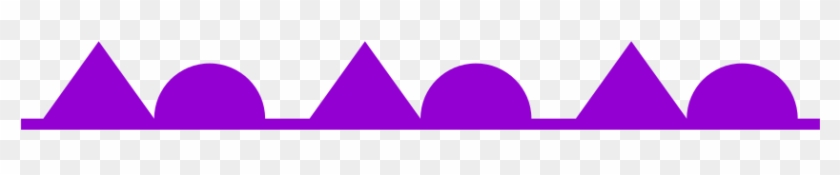
What type of front is this?
Occluded Front
500
Why does the troposphere contain almost all of the mass of the atmosphere?
Because gravity pulls all of the molecules in the air down into that layer
600
Put the layers of the atmosphere in order, starting at the bottom/Earth's surface
Troposphere, Stratosphere, Mesosphere, Thermosphere, Exosphere
600
Precipitation that doesn't get absorbed into the soil or evaporate. Collects in rivers, lakes, ponds, or oceans is called...
Runoff
600
The Coriolis Effect creates circular currents of ocean water, known as _______.
Gyre
600
What is relative humidity?
The amount of water vapor in the air compared to how much space is available for holding water vapor
600
Gases move from high-pressure areas to low-pressure areas. This movement of gases creates _____.
Wind