Atom
Periodic Table
Reactivity
Bonding
HODGE PODGE
100
Anything that has mass and takes up space.
What is matter?
100
The number of protons is found by looking at this.
What is the atomic number?
100
What determines how reactive an atom is?
What is electrons?
100
Type of bonds formed between metals and non-metals.
What is an ionic bond?
100
Forms hydrogen ions when dissolved in water.
What is an acid?
200
Smallest unit of all living and non-living things.
What is an atom?
200
The number of protons and neutrons.
What is the atomic mass number?
200
What determines what element something is?
What is proton (number)?
200
Type of bond formed between two non-metals.
What is a covalent bond?
200
Forms hydroxide (OH-) ions when dissolved in water.
What is a base?
300
The subatomic particle that determines what element it is and it's charge.
What is a proton. Positive.
300
The elements on the periodic table are arranged by this.
What is the atomic number. (number of protons)
300
The most reactive group on the periodic table.
What is the alkali metals?
300
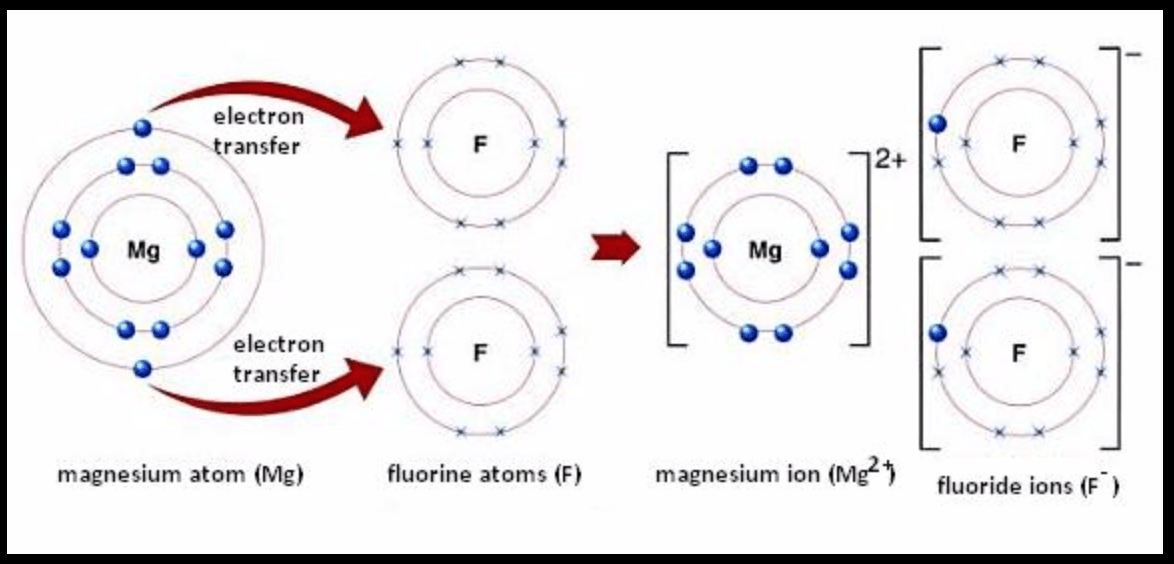
Type of bond formed when electrons are transferred from one atom to another and WHY this bond stays together
What is an ionic bond?
Stays together because of the attraction between cations (positive ions) and anions (negative ions).
300
Type of change (physical or chemical) when wood burns.
What is a chemical change?
400
The subatomic particle that determines reactivity of the atom. State charge too.
What is an electron; negative.
400
The period number tells us the number of these.
What are shells/energy levels?
400
The non-reactive group on the periodic table.
What are the noble gases?
400
What happens to the electrons in a covalent bond AND why does the molecule stay together?
What is sharing?
Covalent bonds stay together because the electrons are traveling around each orbital. IT creates a "force" field.
400
Type of change (physical or chemical) when rocks erode?
What is a physical change?
500
When an atom has different numbers of neutrons.
What is an isotope?
500
The group number tells us the number of these.
What are valence electrons?
500
What group on the periodic table usually reacts with the alkali metals?
What are the halogens? (Crime Alley, Group "7")
500
Why do atoms react/bond? EXPLAIN!!!!
To become STABLE!!! They want their outer shell full of electrons by either transferring away, accepting or sharing electrons.
500
Show how Magnesium and Florine bond and what type of bond they form.