Atomic Structure
Missing Atomic Info.
Isotopes
Radioactive Isotopes and Radiation
Miscellaneous
100
Which subatomic particle has a charge of -1 and is found outside of the nucleus?
Electrons
100
What is the mass number of an atom containing 7 protons, 7 electrons, and 7 neutrons?
14
100
Which statement best describes isotopes of the same element?
A. Same mass number, different atomic number
B. Same number of neutrons, different protons
C. Same number of protons, different neutrons
D. Same number of electrons, different charge
C. Same number of protons, different neutrons
100
What is radiation?
(Hint: Think about the electromagnetic spectrum)
Energy that travels in the form of waves and/or particles. (Ex: x-rays, UV radiation, gamma rays, alpha particles)
100
How do you know if an atom/ion is neutral or has a charge? (Your answer should mention protons and electrons)
An atom is neutral if there is an equal amount of protons (positive) and electrons (negative). An ion has a charge if there is an unequal amount of protons and electrons (i.e. if there is more positive charge than negative, or if there is more negative charge than positive)
200
Which subatomic particle is equal to the atomic number of an atom?
Protons
200
What is the atomic number and number of neutrons for an atom that has 13 protons and a mass number of 27?
Atomic number = 13
Neutrons = 14
200
True or false: Two isotopes will have the same atomic number.
True (they are the same element, they just have a different number of neutrons and different mass)
200
Which type of radiation has the greatest power? (Alpha, beta, or gamma)
Gamma
200
Are the following atoms isotopes or not?
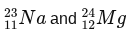
Not isotopes!
300
How do you calculate the mass number of an atom?
Add together protons and neutrons
300
What is the number of protons and number of electrons for an atom with an atomic number of 19 and a charge of +1?
Protons = 19
Electrons = 18
300
An isotope that is unstable and releases radiation is called a ___________
radioactive isotope
300
What happens to radioactive isotopes over time?
They decay/break down into more stable substances.
300
A neutral atom of nitrogen has an atomic number of 7 and has 7 neutrons. What is its mass number?
A. 7
B. 9
C. 14
D. 18
C. 14
400
Which change would create a negative ion?
A. Gaining electrons
B. Losing electrons
C. Gaining neutrons
D. Losing neutrons
A. Gaining electrons
400
What is the charge and element symbol of an atom with 16 protons and 18 electrons?
Symbol = S
Charge = -2
400
What is a possible use for an isotope? (Think back to your midterm project)
-cancer cell/tumor detection, treating cancer, nuclear energy production, sterilizing medical equipment, agriculture (controlling pests, improving fertilizer, and preventing spoilage), radiometric dating (determining the age of fossils or nonliving things), powering space crafts, etc.
400
What is a benefit and a risk of radioactive isotopes?
Benefit(s): medical uses, nuclear power/energy
Risks(s): biological harm (mutating/killing healthy cells)
400
Are the following atoms isotopes or not?
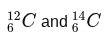
Yes, they are isotopes.
500
What is the element symbol of an atom with 4 protons, 5 neutrons, and 4 electrons?
Be (4 protons = atomic # 4)
500
An atom has an atomic number of 24 and has 25 neutrons. What is the mass number and element symbol for this atom?
Mass number = 49
Element symbol = Cr
500
An atom has 19 protons and 20 neutrons. What could be a possible amount of protons and neutrons that an isotope of this element could have?
An isotope of this element would have to have 19 protons and can have any number of neutrons other than 20 (isotopes have a different # of neutrons/mass number).
500
How is a radioactive isotope different from a normal isotope?
Radioactive isotopes are unstable/high energy and have an uneven proton to neutron ratio. Radioactive isotopes will decay/break down over time to produce more stable isotopes.
500
Are the following atoms isotopes?
An atom with 12 protons and 13 neutrons vs. an atom with 12 protons and 14 neutrons.
Yes, they are isotopes.