Periodic Table
Vocab
Chemical Formulas
Phase Changes of Matter
Miscellaneous
100
What is the purpose of the periodic table of elements?
The table has all of the elements organized in a specific way so it is easy for scientists to use and to study elements. It also gives us the basic information of each element.
100
What is an atom?
The smallest unit of which matter can be divided into.
100
What is a subscript? (NOT what it represents)
It is the small number that falls after/below an element symbol.
100
Describe the difference between melting and freezing.
Melting: Solid to Liquid
Freezing: Liquid to Solid
100
What is the smallest subatomic particle?
An electron
200
On the periodic table, what does the letter in each square stand for?
It is the Element Symbol, representing the abbreviation for each individual element.
200
What is an elemental molecule?
Contain two or more of the SAME atom chemically bonded together.
200
When there is no subscript after an element, how many atoms of that element are in a compound/molecule?
Example: CO2
One atom of that element!
Example: One Carbon
200
Describe the difference in density between a solid to a gas.
A solid's molecules are tight knit and in uniform, while gas's molecules are completely free and fast moving.
200
Where can you easily find the atomic mass of any element?
Underneath the element's symbol on the periodic table.
300
What do the different color sections represent?
They represent different groupings of elements with similar properties to each other.
300
What is the charge of a proton, neutron, and electron?
Proton - positive
Neutron - Neutral/No charge
Electron - negative
300
What does a subscript represent?
Example: H2O
How many atoms of that specific element are in the molecule or compound listed.
Example: Water has 2 atoms of Hydrogen.
300
Show with your hands the main three states of matter: solid, liquid, and gas.
Show Ms. Englebert with hands to be correct :-)
300
Is water an element? Why or why not?
It is not because it is made up of two different types of atoms/elements, Hydrogen AND Oxygen.
400
What does the number above the element symbol represent? (#10)
Atomic Number, which represents the number of protons in a single atom of that element.
400
What is a compound?
Contains two or more DIFFERENT atoms chemically bonded together.
400
How many atoms of each element are in the following compound:
H2CO3
Hydrogen: 2
Carbon: 1
Oxygen: 3
400
Describe the change in molecule movement when water changes from a solid to a liquid.
Molecules in a solid state are tight knit, uniformed, and moving a little bit like vibrating. Where molecules in a liquid state are free flowing, and moving faster than in a solid state.
400
What does the dividing "staircase" on a periodic table represent? 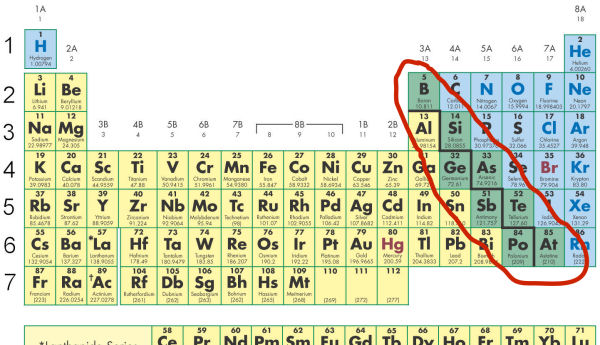
To the right: nonmetals
To the left: metals
500
What is the difference between a period and a group on the periodic table?
A period reads each row, left to right.
A group reads each column, top to bottom.
500
What is a chemical formula?
It is a representation (or recipe) of what elements and how many, are present within a substance.
500
Explain how a chemical formula is like a recipe when baking.
A chemical formula reads like a recipe by telling exactly what elements and how many of each are included in a substance. Just like a recipe for baking tells us what ingredients and how much of each for the recipe.
500
What is the difference between sublimation and deposition?
Sublimation: Solid to Gas
Deposition: Gas to Solid
500
If not directly stated, how can you determine how many electrons a specific atom has?
The atomic number, is the amount of protons an atom has which is the SAME as the amount of electrons that atom has.