Aerodynamics
Aircraft Systems
Situational
Callsigns
100
What are the four fundamental forces of flight?
Lift, Weight, Thrust, Drag.
100
What is the purpose of an aircraft's APU?
An APU is a small engine that provides electrical power and air pressure while the main engines are off, allowing systems to operate and engines to start.
100
You are defensive against an enemy fighter that has a small angle advantage but is rapidly losing energy. You still have more speed than them. What should you avoid doing?
A) Using your energy advantage to create separation
B) Forcing them to continue spending energy
C) Pulling hard to slow down and force an overshoot.
D) Looking for a reversal opportunity
The correct answer is C.
Even though forcing an overshoot can be useful, pulling hard too early can waste your energy advantage and put you into a slow-speed fight where the enemy may have the advantage. Since the enemy is already losing energy, your best option is to stay fast, make them continue spending energy, and wait for a better opportunity to reverse the fight.
100
What airplane uses the callsign "Fighting Falcon"?
F-16
200
An aircraft can stall at any airspeed. Explain why.
The separation of airflow from the wings.
200
A fighter aircraft uses a Radar Warning Receiver (RWR). What information does it provide to the pilot, and what does it not tell them?
An RWR detects and identifies radar emissions, showing the direction and sometimes the type of radar threat. It does not directly detect aircraft.
200
An enemy fighter is on your six with a high closure rate. You are slower and cannot outrun them. What defensive maneuver can you use to force them into an overshoot and regain the advantage?
A) Pull into a sustained flat turn and match their turn rate
B) Perform an S-turn to increase their closure and force them past you
C) Climb vertically and reduce airspeed immediately
D) Accelerate away and attempt to extend
The correct answer is B. An S-turn forces the attacking aircraft to constantly adjust its flight path while closing on you. Since they are faster, their momentum carries them forward, causing them to overshoot. Once they pass in front of you, you can reverse the fight and attempt to get behind them.
200
What aircraft uses the callsign "Black Alligator"?
Ka-52
300
What happens to lift when an aircraft increases its Angle of Attack?
Lift increases.
300
What is an ILS, and what two main pieces of guidance does it provide to the pilot?
ILS provides precision landing guidance using, typically used to help a pilot land during IFR flight conditions. It provides the following information to the pilot: The Localizer guides the aircraft left and right to align with the runway. While the Glideslope guides the aircraft up and down on the correct decent path.
300
You notice you have significantly more energy and are closing too quickly on your opponent during a dogfight, putting you at risk of an overshoot. What maneuver should you use to control your closure rate and maintain the advantage?
A) Initiate a high yo-yo
B) Initiate a low yo-yo
The correct answer is A. Initiating a high yo-yo trades your excess speed for altitude, bleeding of your airspeed and allowing you to maintain your enemy's six.
300
What aircraft uses the callsign "Tiger"?
The Eurocopter
(Bonus for the F-11)
400
An aircraft stalls and the left-wing drops. The pilot applies hard right aileron to raise the left wing. Explain why this can make the situation worse instead of correcting it.
When a wing drops during a stall, the airplane may start entering a spin. Using opposite aileron can make the stall worse by causing one wing to stay more stalled than the other, increasing the roll. The correct way to recover is to lower the nose and reduce Angle of Attack first, not try to force the wings level with ailerons.
400
An aircraft is flying an ILS approach. The localizer needle is centered, but the glideslope needle is above the aircraft. What does this mean, and what should the pilot do?
The aircraft is flying below the glideslope. The pilot needs to adjust the descent profile and climb slightly or reduce the descent rate to recapture the correct glide path.
400
During a one-circle fight, you overshoot the bandit’s flight path and end up in front of them. You still have more energy but are now defensive. What maneuver is most appropriate to regain the advantage?
A) Immediately reverse into a high-G turn
B) Perform a low yo-yo to regain closure and force a nose position
C) Use a vertical maneuver (such as an oblique loop) to force a reversal while preserving energy
D) Deploy airbrakes and slow down to match the opponent
The correct answer is C.
If you overshoot in a one-circle fight, the enemy now has the advantage because they are behind you. Since you still have more energy, use a vertical maneuver to regain the advantage. This allows you to trade speed for altitude, slow down, and force the enemy to lose energy trying to follow you. A flat turn, low yo-yo, or airbrakes would waste your advantage or make the overshoot worse.
400
What aircraft uses the NATO callsign "Flogger"?
Mig-23
500
Why can a power-on stall be more dangerous than a normal stall in a single-engine aircraft?
A power-on stall happens with high thrust and high Angle of Attack. The increased power creates stronger left-turning tendencies like P-factor and torque, which can cause one wing to drop and potentially lead to a spin if the pilot does not reduce AoA.
500
What altitude is this indicating?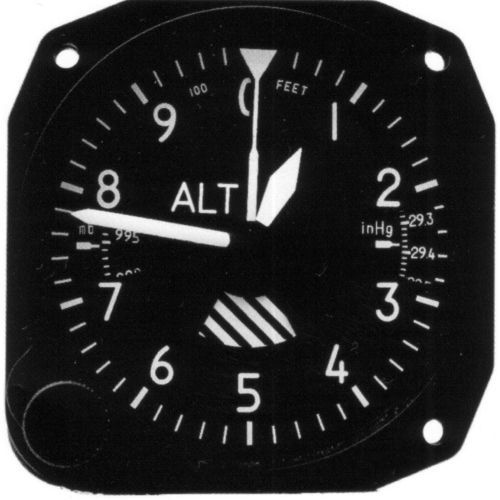
800 ft
500
You are flying at high altitude when your RWR detects a missile launch. The attacking aircraft is an Su-27 using TWS radar mode and has fired an R-77 active radar-guided missile. What defensive actions should you take to defeat the missile? Additionally, why did the Su-27 remain undetected on your RWR until the missile went pitbull (activated its onboard radar seeker)? How does TWS provide an advantage over STT during a BVR engagement?
BE SPECIFIC.
To defend against the R-77, you should first create distance and reduce the missile's energy by turning away from the threat (going cold) or using a crank maneuver. As the missile gets closer, use notching, chaff, and defensive maneuvering to break the missile's radar tracking. Avoid wasting all your energy too early, as you may need it to survive follow-up attacks.
The Su-27 remained difficult to detect because TWS does not require a continuous radar lock like STT. In STT, the radar focuses on one target and continuously tracks it, which usually gives the target a clear radar warning. TWS allows the Flanker to track and launch missiles while still scanning multiple targets, making the engagement less obvious to the defender.
The R-77 became visible on the RWR when it went pitbull because its own active radar seeker turned on and began transmitting. At that point, the missile was no longer relying only on the Su-27's radar guidance, meaning it became an independent radar threat much closer to the target.
TWS advantage over STT:
TWS allows the Su-27 to maintain situational awareness, track targets, and launch missiles while giving the enemy fewer warnings. STT provides a stronger, more precise lock but exposes the attacker by giving the target a clear radar warning.
500
What aircraft uses the NATO callsign "Blackjack"?
Tu-160