Ask the Ancestors
Cells at Work
Ew a Germ!!!
Review Wars
100
Scientist use phylogenies to map out the genetic similarities and evolution of species. According to the phylogeny below, rodents & rabbits are more closely related to ________.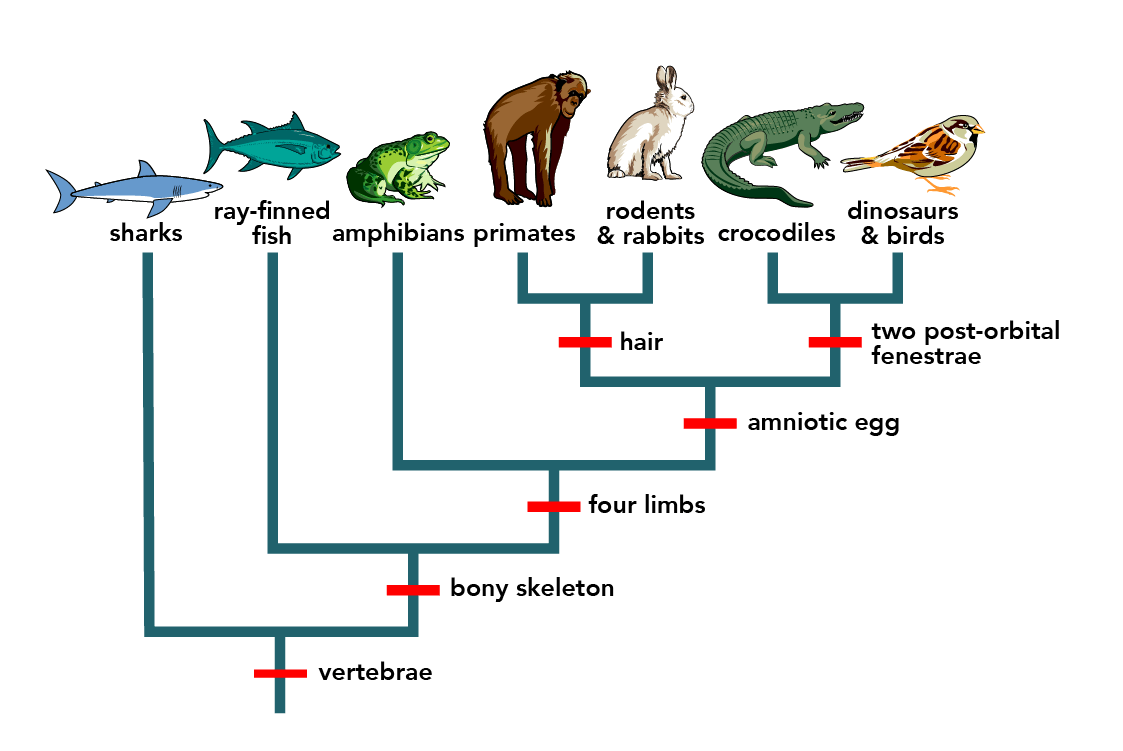
primates
100
_____ ______ cells are a specialized cell that targets other cells that have been infected by viral DNA.
White blood cells
100
Just like bacteria, viruses have no ________.
organelles
100
A limiting factor can potentially help us determine the ________ _________ of organisms in an ecosystem. This, essentially, is the number of individuals a system can hold or support.
carrying capacity
200
Polar bears and brown bears have a closer common ancestor than brown bears and black bears. This raises questions since polar bears do not look similar to brown bears. Scientist identify the separation of species caused by selection pressures as ________.
speciation
200
Cell replication is important to the body and is needed for growth and repair. Before cells can duplicate (mitosis) they must first copy their DNA during the ____ _______ of the cell cycle.
S phase
200
One difference between viruses and bacteria is that viruses are non-living and bacteria is living. This is because bacteria can reproduce asexually but viruses need a ______ ______ in order to reproduce.
host cell
200
Natural selection is a process in which organisms with favorable traits survive and reproduce. These traits are not developed. Instead, ________ can happen in the DNA that produce new traits within a genotype that can be favorable to new selective pressures.
mutations
300
During natural selection organisms with favorable traits are the ones that survive and reproduce.
True or False:
Organisms can develop favorable traits- that are not preexisting in the genome- as they are needed for their environment.
False, favorable traits should already be in the genome. When selective pressures are introduced, organisms with the trait are able to survive and reproduce while those without die off.
300
Your immune system is known to have three lines of defense when introduced to a pathogen. The third line of defense is known to be ________, because the immune system targets the pathogen and destroys it.
specific
300
Tim Xiao is sick with a virus that is in desperate need of a new host cell. Tim doesn't stay home for the day because he's fearful of missing Biology Leap. He goes to his first class and sneezes but forgets to cover his nose and mouth. The virus then spreads to another student where it finally has found it's host cell. The virus Tim passed on is considered to be a __________ disease.
communicable
300
Photosynthesis is a process that is important for understanding the flow of energy from producers to consumers. What is the chemical equation for photosynthesis?
Sunlight + CO2 + H2O >> O2 + C6H12O6
400
When researching common ancestry scientist look at multiple factors that can explain where organisms evolved from. One of these factors include anatomical structure. When discussing anatomical structure organisms that share the same structure and function but are not tied to the same common ancestor are considered to be __________.
Analogous
400
When a pathogen is found in the body white blood cells go through a process of targeting and destroying a pathogen.
True or False:
Antibodies are able to destroy pathogens (antigens) on their own.
False, antibodies are only signals. The "killer cell" then goes in and destroys the antigen after knowing it's target.
400
Through horizontal gene transfer bacteriophages can penetrate bacteria and give them their DNA. During the lysogenic cycle this DNA becomes apart of the bacteria's genome. Bacteria go through _______ _______ which causes the virus' DNA to be replicated and passed on.
binary fission
400
Genes provide the instructions for making proteins that determine an organism’s characteristics. In order to be expressed genes must go through the process of protein synthesis. Describe the process of protein synthesis in order from transcription to translation.
DNA is transcribed into RNA. RNA goes from the nucleus to the ribosome. In the ribosome RNA is translated into proteins.
500
DNA _______ is important when it comes to evolution. Without it, favorable genes cannot be copied and the mistakes that happen during this process to create favorable traits would not exist.
replication
500
Historically, vaccines have decreased the number of virus cases once introduced. What is our immune system's response when vaccines introduce weakened versions of a virus to our body?
The immune system produces antibodies to fight back.
500
In the a case of viral replication, bacteriophages (virus) can perform horizontal gene transfer that makes bacteria pathogenic. The ________ cycle is when viruses acts as a parasite; bursting out of the bacterial cell after replication to release more bacteriophages.
lytic
500
The structure of DNA is described as a double helix that includes a sugar phosphate backbone. When it comes to understanding DNA structure, it’s important to know the difference between nitrogenous bases and nucleotides. Explain the difference between the two.
A nitrogenous base includes adenine, thymine, guanine, and cytosine. Nucleotides include the sugar and phosphate groups with the nitrogenous base attached.