Charles Darwin might be on to something...
He got an evolutionary advantage!
Why do my genes very?
Beware of the Invasion
Review Wars
100
The trait that helps an organism survive and reproduce in its environment is called this.
adaptation
100
Scientist use phylogenies to map out the genetic similarities and evolution of species. According to the phylogeny below, rodents & rabbits are more closely related to ________.
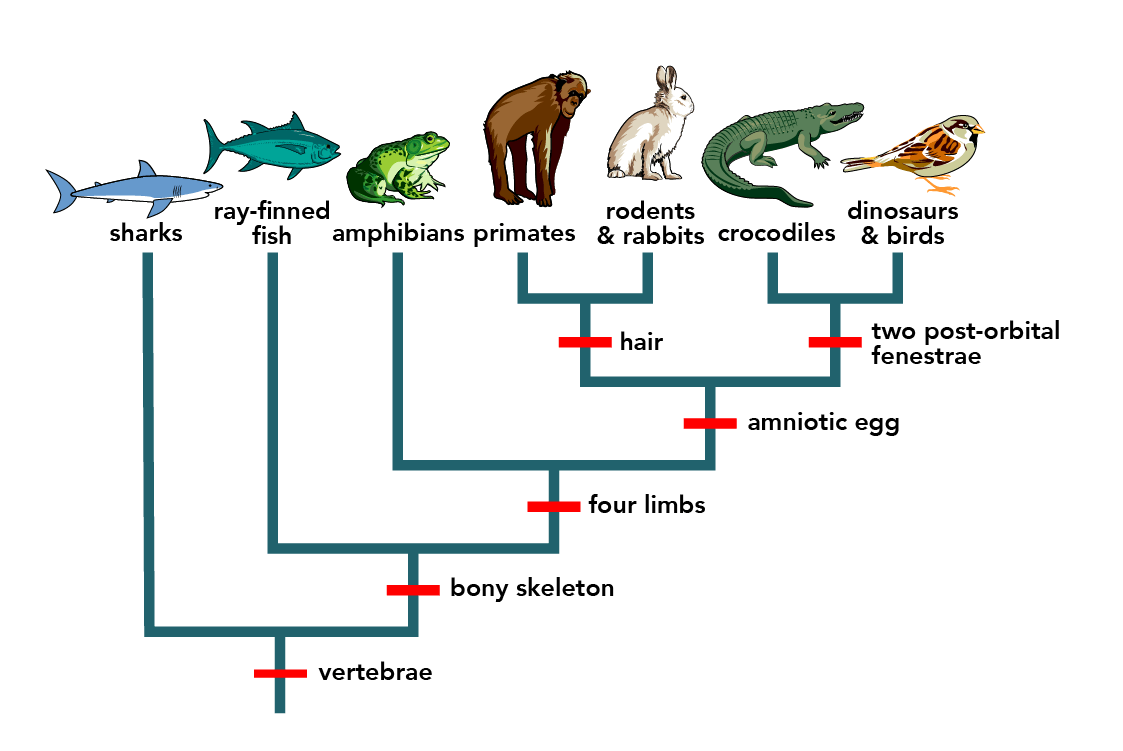
primates
100
Genetic variation is what makes up the diversity of a population's genetic makeup. Genetic variation arises in two ways. One way is during DNA replication. During replication, DNA can _______ and change an original gene sequence to one that codes for another gene.
mutate
100
List three types of pathogens
Bonus: What is a pathogen?
Bacteria, virus, fungus, etc
100
A limiting factor can potentially help us determine the ________ _________ of organisms in an ecosystem. This, essentially, is the number of individuals a system can hold or support.
carrying capacity
100
Organisms cannot develop traits they must already be in a population's ________.
genome
100
____ is the strongest evidence of evolution.
DNA
100
The other way genetic variation can arise is through _______ ________. During meiosis parent's existing genes can rearrange themselves creating new variations of genes in their offspring.
sexual reproduction
100
Viruses are parasitic, in that they require a host cell in order to go through the process of reproduction. When the influenza virus attaches itself to its host, which type of viral reproduction takes place?
lytic
100
DNA replication happens in the ____ _____ of the cell cycle.
S phase
200
____________ is a selection pressure that made it harder for hawksbeard with feathery seeds to survive and reproduce.
Fragmentation
200
Name the four evidence of evolution.
Fossils, Anatomy, Embryos, DNA
200
The rearrangement of chromosomes happens during Prophase 1 of meiosis. This is when chromosomes pair up and begin to _____ _____, exchanging genes from one chromosome to another.
cross over
200
Because the common cold is caused by a ______________, it is useless to try to prevent or cure a cold with antibiotics.
Virus
200
The carbon cycle supports all life on earth. During cellular respiration organisms release _____ that is then used by plants to create sugar.
CO2
300
A population must have high _________ in order to adapt to changes in an environment.
biodiversity or genetic variation
300
Polar bears and brown bears have a closer common ancestor than brown bears and black bears. This raises questions since polar bears do not look similar to brown bears. What is the process called where two species emerge from a common ancestor?
speciation
300
Genes are expressed through _____ _______.
gene expression or protein synthesis
300
B cells and T cells are two types of lymphocytes. B cells mature in the ________ while T cells mature in the _________.
Bone marrow, Thymus
300
Energy in an ecosystem diminishes as it flows from one organism to the next in a food chain. What is the structured diagram called that visually represents how energy decreases at each step from producers to top consumers?
energy pyramid
400
In the case of Darwin’s study on finches he determined that different organisms within one species express different traits due to what their environment requires. Environments introduce ________ ________ that can make it harder or easier for an organism to survive or reproduce.
selection pressures
400
When researching common ancestry scientist look at multiple factors that can explain where organisms evolved from. One of these factors include anatomical structure. When discussing anatomical structure organisms that share the same structure and function but are not tied to the same common ancestor are considered to be __________.
analogous
400
A random change in the DNA that changes one nucleotide base (AGTC) into another.
substitution
400
What is the difference between antibiotics and vaccines?
Antibiotics are used to treat bacterial infections. Antibiotics are NOT used for viruses. Vaccines are used to prevent viral infections.
400
RNA transcribed from the DNA in order to undergo translation in the ribosome.
What is the complementary RNA sequence for the DNA below.
AGCTTTGCCAT
UCGAAACGGUA
500
This scientist suggested that organisms evolve traits because they “need” them. He had a firm belief that if giraffes with short necks needed long necks then they could develop the trait without it already being in the gene pool.
Jean De Lemarck
500
The average lifespan of a wild rabbit is nine years and the average number of offspring over the lifespan is 50. A female rabbit is born with a genetic trait that allows it to avoid predators better than most other rabbits. Predict what will happen to this population overtime.
The life expectancy and the number of Offspring produce will likely increase.
500
During protein synthesis DNA is transcribed into RNA in the ________. The RNA then moves to the ________ where RNA is translated into an amino acid sequence that make up a protein.
nucleus, ribosome
500
The immune response has three lines of Defense describe each line.
1st Barrier:Includes skin, hair, tear ducks and mucus membranes
2nd Inflammatory response: which includes swelling redness and heat that brain white blood cells to the area.
3rd Adaptive response: b cells recognize pathogens by their antigens and tag them to be destroyed by T-cells. The body creates antibodies specific to the antigens that remain in the body.
500
Cellular respiration is the process in which chemical energy from photosynthesis is transformed into ATP that is used to power cellular processes. What is the chemical equation for cellular respiration?
C6H12O6 + O2 >> Energy + CO2 + H2O