Cognition
Managing Your Symptoms After Brain Changes
Symptoms after brain injury
100
Initiation, planning, judgement, flexibility, and self-awareness are examples of ______
A. Types of Attention
B. Executive functioning
C. Emotional management
B. Executive functioning
100
Managing your symptoms is critical for recovery after brain changes. Pacing and Energy Management can help control your symptoms so that your brain can recover and you can get back to life.
Recovery works best when you stay below your symptom threshold—the point where symptoms noticeably worsen.
Which statement is FALSE
A. It also does not help to stop all activity for long periods.
B. Staying below your symptom threshold gives your brain the best environment to heal and adapt.
C. It helps to "push through" symptoms no matter how uncomfortable it is.
D. Progress happens gradually—like turning a dial up or down, not flipping a switch. You will learn to be intentional about choosing ways to dial up or dial down, in response to your symptoms.
FALSE: It helps to "push through" symptoms no matter how uncomfortable it is.
It DOES NOT help to “push through” symptoms. You will use Pacing and Energy Management strategies to stay below your symptom threshold.
100
Brain injuries, including concussions, commonly cause vision changes (in 50-90% of cases) because a large portion of the brain processes visual data.
What are some common symptoms related to changes in vision...
Common symptoms include blurred vision, double vision, light sensitivity, difficulty focusing, and reading issues.
200
The ability to problem-solve is necessary for participating successfully in life. Changes in the ability to problem-solve and reason are a common effect of brain injury. Each person is different.
How could problems in problem-solving affect your safety and performance w/ ADLS?
Difficulty recognizing a problem
Example: Not recognizing when you steer wheelchair into the wall
Difficulty figuring out a solution for a problem
Example: Not knowing what to do when a ride doesn’t show up on time
Difficulty managing time or money
Example: Giving money away in patterns different than before injury
Difficulty making safe decisions
Example: Using power tools when you’ve lost sensation in 1 arm
Difficulty drawing conclusions
Example: Not recognizing that the mail might be late due to a snow day
Difficulty understanding abstract ideas
Example: Not understanding the explanation of new payroll process
200
Brain changes (concussion, stroke, or brain injury) can affect energy levels. Thinking about how you use your energy—and learning ways to manage it—can support recovery and help you do the activities that matter to you.
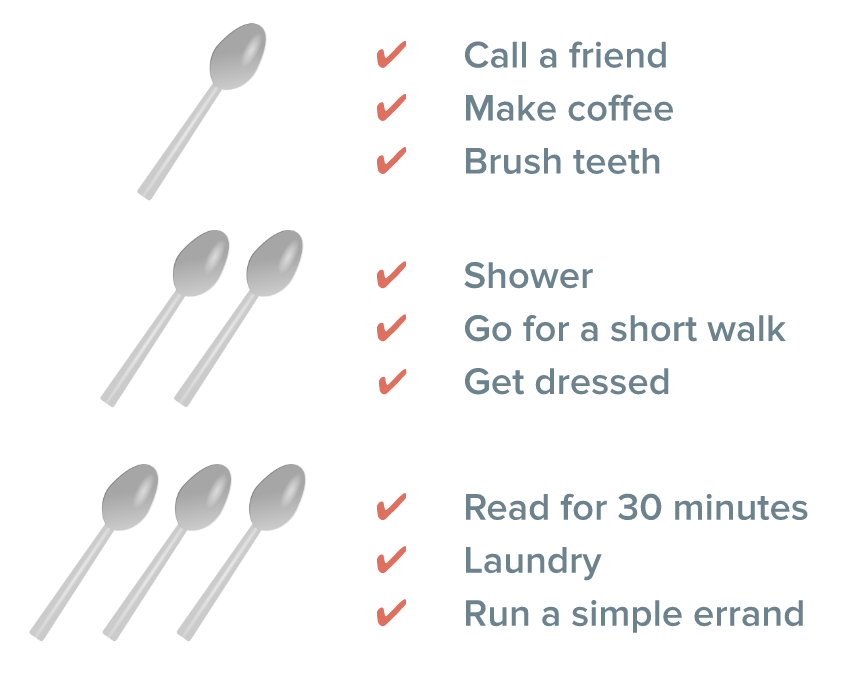
Imagine that each day you start with a set number of spoons, which represent your energy. Each activity you do uses one or more spoons. People without brain changes often have many spoons and don’t need to plan how they use them. After brain injury, the number of spoons may be much lower, so planning and prioritizing become important.
Physical, emotional, and cognitive energy may be spent. Give an example of each type of energy expenditure.
200
Brain injury can affect many parts of life, including sleep. Give some examples of how brain injury might impact sleep?
Difficulty falling asleep or staying asleepSleeping too muchUnrefreshing sleepInsufficient number of hours of sleep despite adequate opportunityHaving at least one daytime problem such as fatigue, sleepiness, problems with mood, concentration, accidents at work or while driving, etc. due to poor sleep.
Your ability to get good, quality sleep can affect many other parts of your life, including energy, mood, and thinking. The habits or practices that support good sleep are called “Sleep Hygiene.” Sleep Hygiene can be addressed with your medical team, and recommendations may include:
Adjusting your sleep environment Adjusting your sleep behaviorsChanging behaviors to support your Sleep-Wake cycleShort-term medication considerations
300
A distraction is anything that pulls your attention away from the task you are trying to do. Distractions can come from inside your body or mind (internal) or from your environment (external).
Name 1 INTERNAL AND 1 EXTERNAL distraction
Examples of internal distractions:
Pain/Hunger / Thirst/ Fatigue/ Emotions / Worries
Examples of external distractions:
Background noises or nearby conversation; Nearby movement or activity, Technology (phone, TV, smart speakers like Alexa); Room temperature
Everyone experiences distractions, especially after a brain injury. The first step to managing distractions is noticing what affects you. This is an important thinking skill called self-awareness.
300
What re some lifestyle changes that can help with your brain injury recovery?
Sleep, healthy eating, managing stress
300
Brain injury can affect many things, including how someone is able to participate in conversation. These changes can be common after traumatic brain injury and mild traumatic brain injury (mTBI) / concussion.
Give some examples of how conversation can be affected?
Talking more than before injury
Talking less than before injury
Sharing too much
Sharing too little
Repeating things in conversation
Hard to follow in conversation
Difficulty getting to the point
Difficulty keeping a conversation going with others
Difficulty talking about topics that others bring up
Rude or embarrassing comments in conversation
Using the wrong words in conversation
400
______ means thinking about your thinking. It helps you notice how you’re doing, catch mistakes, and adjust what you’re doing to be more successful.
Changes in this skill are common after a brain injury or stroke. You may notice it’s harder to plan, stay on track, or recognize when something isn’t working.
A. Goal Management
B. Metacognition
C. Stress Management
D. Strength training
B. Metacognition
What is Goal Management Training and Metacognitive Strategy Instruction?
Metacognitive Strategy Instruction (MSI) is a process where the SLP directly instructs a Person to think about their own thinking in order to improve performance in an activity or task. This process can be applied to endless functional scenarios that are important to the person with acquired brain injury. A specific type of MSI is Goal Management Training, which will be addressed through the Goal-Plan-Do-Review process in this packet.
400
What are some examples of INT or EXT strategies that can help with memory.
alarm, notebook, calendar, repetition, etc
400
Emotional changes are common after a concussion / mTBI. It can be helpful to understand that these changes are part of the mTBI, and can be expected to improve over time.
Frequently Reported Mood and Behavior Symptoms after mTBI. Give some examples....
Frequently Reported Mood and Behavior Symptoms after mTBI:
Depressed Mood
Anxiety
Irritability
Agitation
Crying more frequently
Poor Motivation
Social Withdrawal
Interpersonal Difficulties
500
________ is the ability to use, store, and retrieve information. Changes in this are a common effect of brain injury.
Memory
BONUS (DOUBLE POINTS): Name at least 1 activity that could be affected by memory.
500
What are some strategies that can help when you are having difficulty focusing on a task?
- take notes
- take a break
- reduce distractions
- talk out loud
500
Exercise Principles and Swallowing Therapy Swallowing therapy incorporates the Principles of Neuroplasticity, Exercise Principles, and the Principles of Motor Learning. These principles support a customized treatment plan for each client. Swallowing therapy should adapt and change over time in order to continue to challenge clients as they improve. Instead of a one-size-fits-all approach, clients are given specific instructions about what exercises to complete, how many repetitions to do, and how often. Muscles can be changed or conditioned based on the exercise or use of the muscle. This can result in changes such as: ✔ Improved coordination ✔ Improved force or strength ✔ Improved efficiency ✔ Improved speed When muscles aren’t used, deconditioning happens. Dysphagia therapy involves using exercise principles to improve the muscles and function for swallowing.
What are some signs of dyshagia?
- coughing
-wet voice
- choking
- difficulty breathing