Equilibrium Systems
Accelerating Systems
COM & Gravity
Circular Motion
100
A spring (spring constant k = 7.0 N/m) is attached to a wall and connected to a block of mass M = 3.0 kg. The coefficient of static friction between the block and the floor is μs = 0.34. The block is gradually pulled to the right, stretching the spring by a distance xmax relative to its unstretched length, until it is just about to slip. Find the distance xmax by which the spring can be stretched while keeping the block in equilibrium.
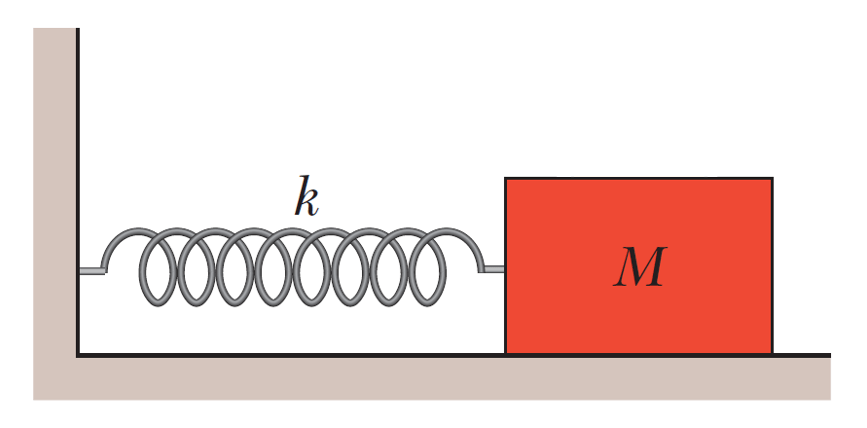
xmax = 1.4 m
100
A 4.10 kg block is pushed along a floor by a constant applied force that is horizontal and has a magnitude of 40.0 N. The figure gives the block’s speed v versus time t as the block moves along an x-axis on the floor. The scale of the figure’s vertical axis is set by vs = 5.0 m/s. What is the coefficient of kinetic friction between the block and the floor?
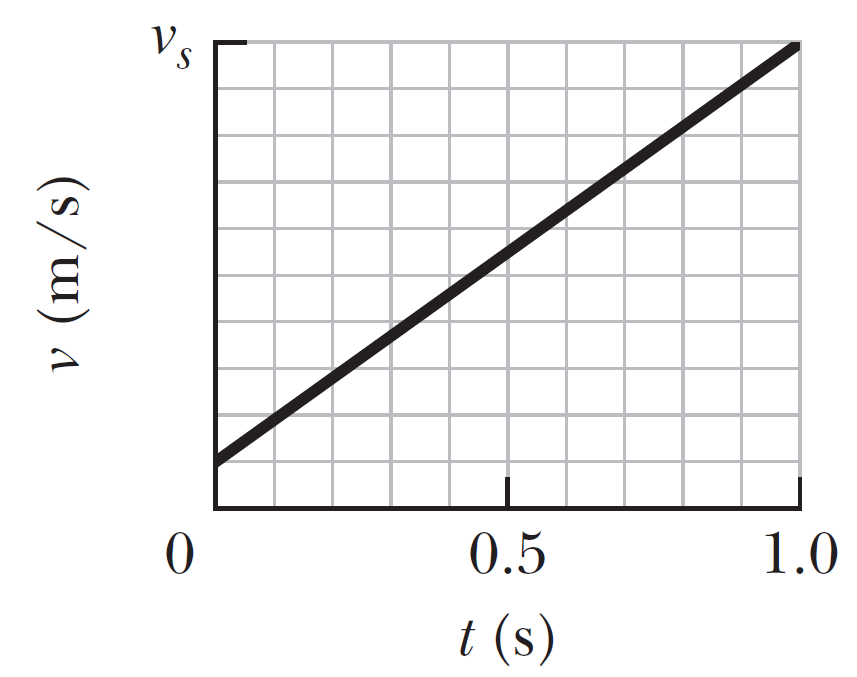
0.54
100
The figure shows a three-particle system, with masses m1 = 3.0 kg, m2 = 4.0 kg, and m3 = 8.0 kg. The scales on the axes are set by xs = 2.0 m and ys = 2.0 m. What are the x-coordinate and the y-coordinate of the system’s center of mass?
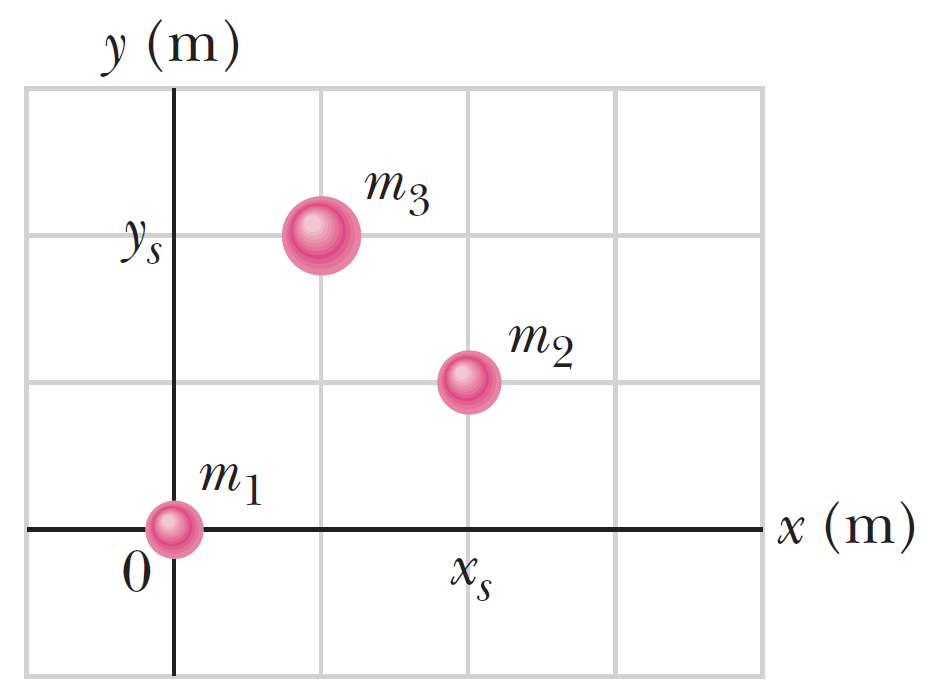
x = 1.07 m, y = 1.33 m
100
A space station of radius R = 975 m needs to generate artificial gravity for its inhabitants. If the astronauts are to experience an apparent weight equal to their weight on Earth, what should the rotation period T of the space station be?
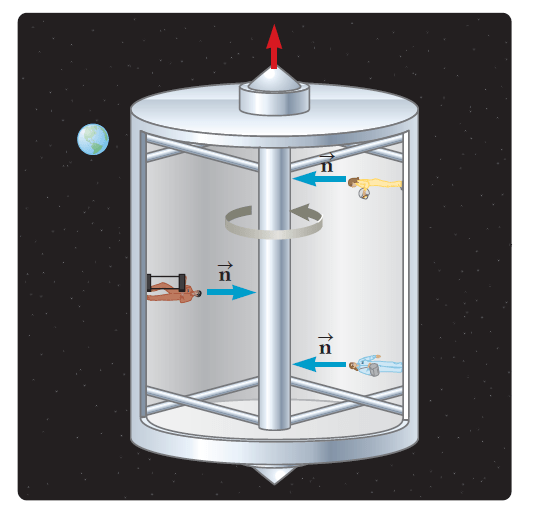
T = 63 seconds
200
The terminal speed of a sky diver is 160 km/h in the spread eagle position and 310 km/h in the nosedive position. Assuming that the diver’s drag coefficient C does not change from one position to the other, find the ratio of the effective cross-sectional area A in the slower position to that in the faster position.
Aslower/Afaster = 3.8
200
Elevator cabs A and B are connected by a short cable and can be pulled upward or lowered by the cable above Cab A. Cab A has mass mA = 1700 kg; Cab B has mass mB =1300 kg. A box of catnip of mass mC = 12.0 kg lies on the floor of Cab A. The tension in the cable connecting the cabs is T = 1.91 × 10⁴ N. What is the magnitude of the normal force on the box from the floor?
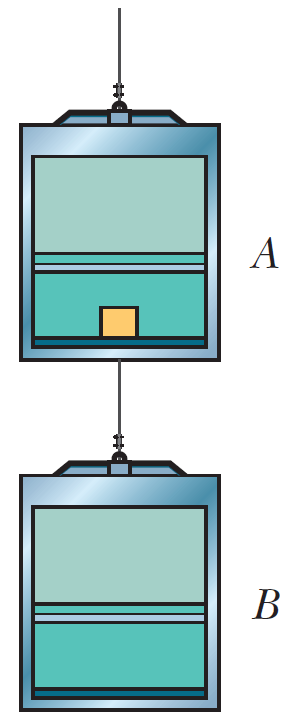
FN = 176 N
200
Use the data from the table to find the point x = d between Earth (mass ME) and the Sun (mass MS) [with the Earth at coordinate x = 0 and the Sun at coordinate x = D] at which an object can be placed so that the net gravitational force exerted by Earth and the Sun on that object is zero. Find the algebraic expression first before plugging in the numbers.
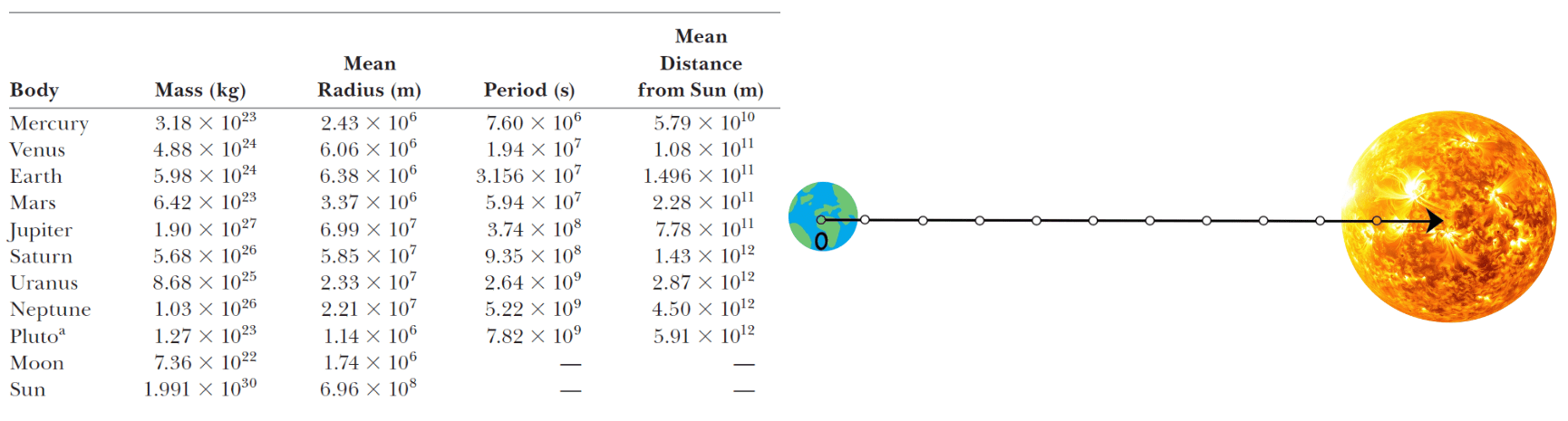
d = 2.59 X 10⁸ m (this is called the first Lagrangian point, L1).
200
The figure depicts an overhead view of a car’s path as the car travels toward a wall. The driver begins to turn when the distance to the wall is d = 207 m. He barely manages to keep the car going in a circle at a constant speed of v = 35 m/s without drifting, and the car narrowly avoids the crash before driving parallel to the wall. What is the coefficient of static friction μs between the tires and the road?
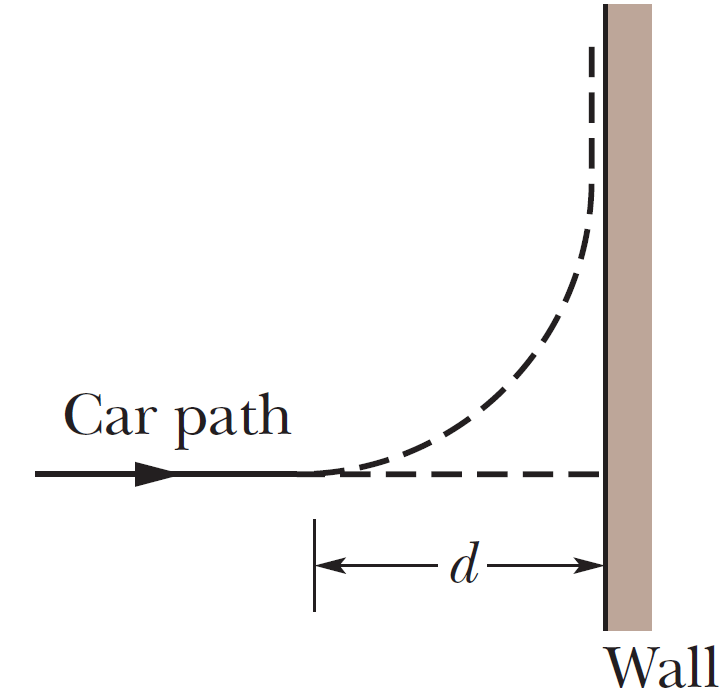
μs = 0.60
300
A woman at an airport is towing her 20.0-kg suitcase at constant speed by pulling on a strap at an angle θ above the horizontal. She pulls on the strap with a 35.0-N force, and the friction force on the suitcase is 20.0 N. What is the coefficient of kinetic friction μk? (hint: find θ first).
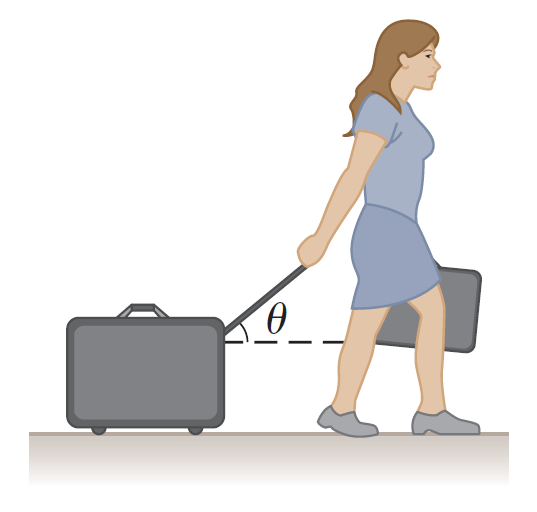
μk = 0.12
300
The two blocks (m = 16 kg and M = 88 kg) in the figure are not attached to each other. The coefficient of static friction between the blocks is μs = 0.38, but the surface beneath the larger block is frictionless. What is the minimum magnitude of the horizontal force F required to keep the smaller block from slipping down the larger block?
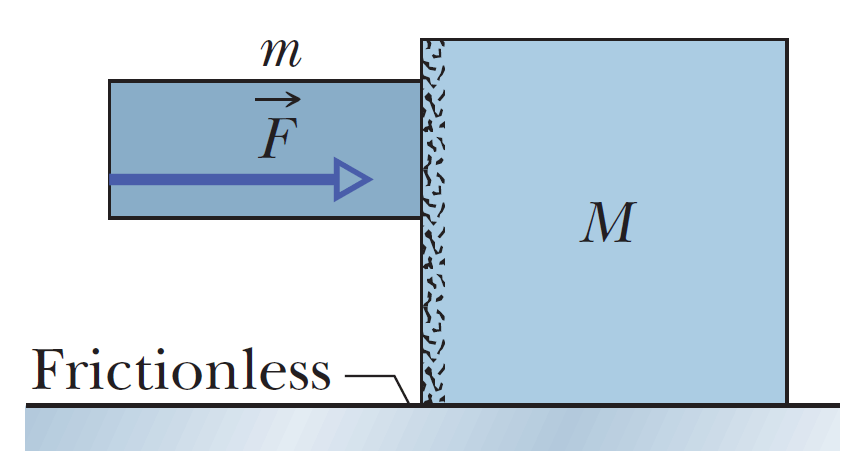
F = 488 N
300
Two satellites are in circular orbits around the Earth. Satellite A is at an altitude equal to the Earth’s radius, while satellite B is at an altitude equal to twice the Earth’s radius. What is the ratio of their periods, TB/TA?
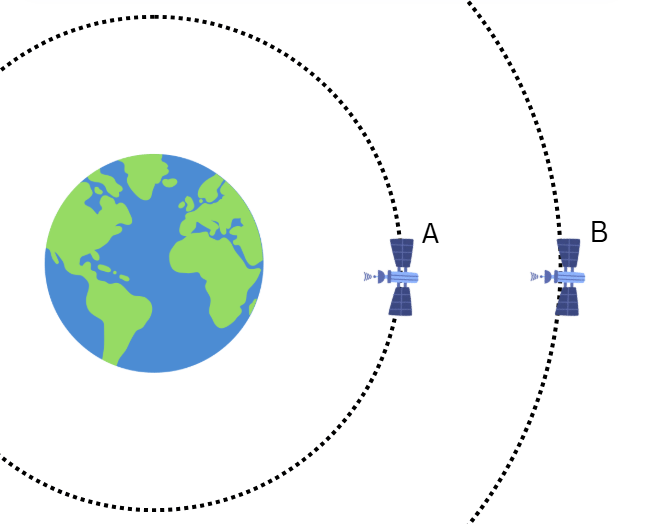
T_B / T_A = (3/2)^(3/2)
300
The figure shows a conical pendulum in which the bob moves in a horizontal circle at a constant speed. The bob has mass m = 0.040 kg, the string has length L = 0.90 m, and the angle between the string and the vertical is θ = 30°. What is the period of motion?
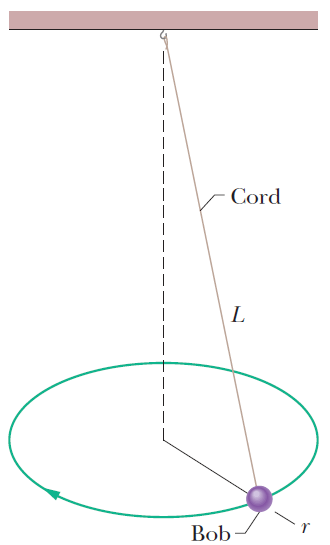
T = 1.8 sec
400
Block B weighs 711 N. The coefficient of static friction between block and table is 0.25; angle θ is 30°; assume that the cord between B and the knot is horizontal. Find the maximum weight of block A for which the system will be stationary.
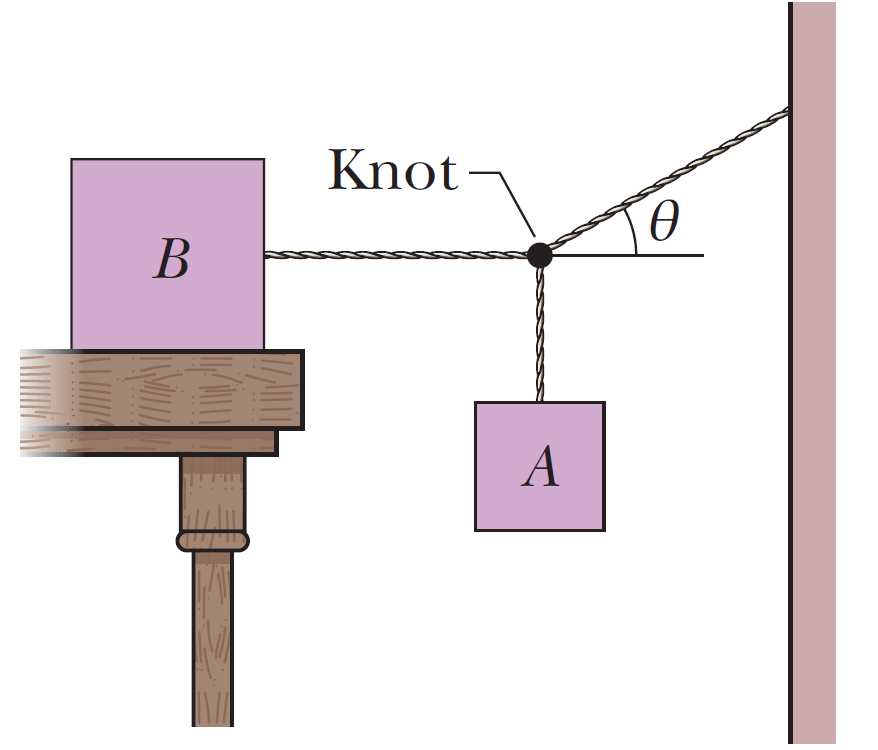
WA = 103 N
400
Block A (mass mA = 2.0 kg) is positioned on a flat tabletop and connected to Block B by a string running over a frictionless, massless pulley. The coefficient of kinetic friction between Block A and the table is μk = 0.25. Block C (mass mC = 1.0 kg) is then placed on top of Block A. The maximum mass Block B can have without Block C slipping is mB-max = 2.5 kg. Find the coefficient of static friction μs between Block A and Block C.
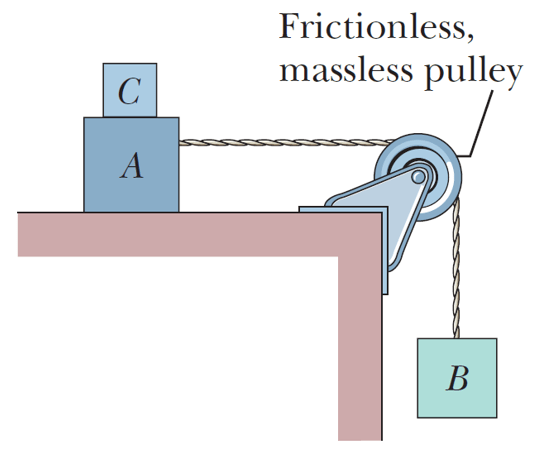
μs = 0.32
400
A synchronous satellite, which always remains above the same point on a planet’s equator, is put in circular orbit around Jupiter to study that planet’s famous red spot. Jupiter rotates once every 9.84 h. Use the data of the table below to find the altitude of the satellite.
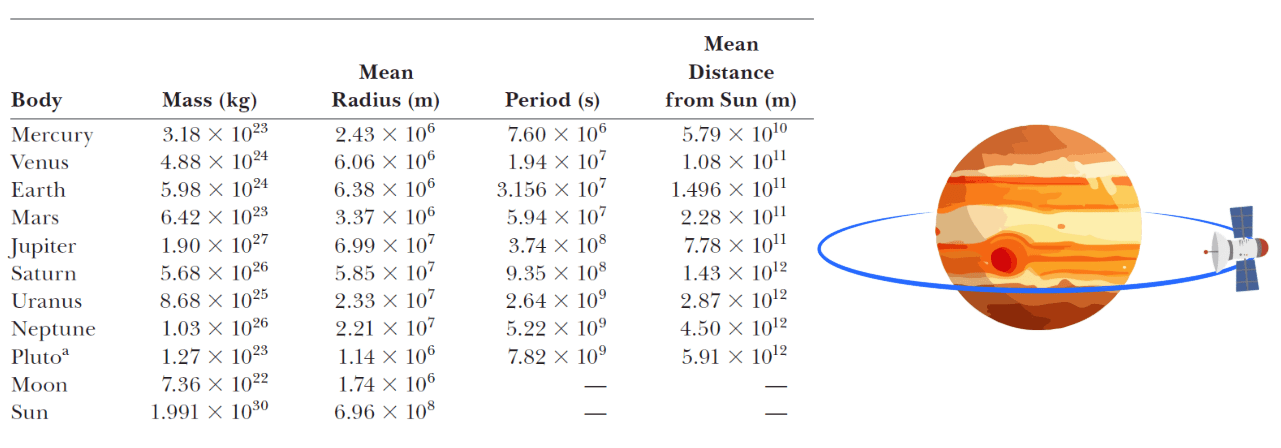
h = 8.8 X 10⁷ m
400
In a home laundry dryer, a cylindrical tub containing wet clothes is rotated steadily about a horizontal axis. So that the clothes will dry uniformly, they are made to tumble. The rate of rotation of the smooth-walled tub is chosen so that a small piece of cloth will lose contact with the tub when the cloth is at an angle of θ = 68.0° above the horizontal. If the radius of the tub is r = 0.330 m, what rate of revolution is needed in revolutions per second?
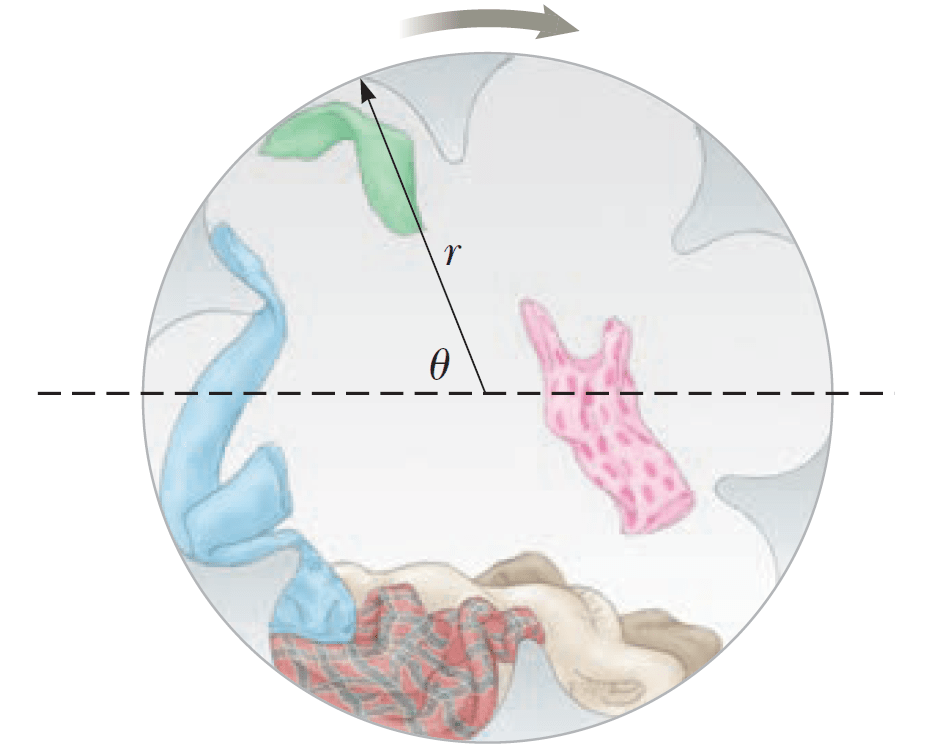
f = 0.84 rev/s