solids, liquids, and gases, metals, nonmetals, metalloids
pure substances and mixtures
Relative Density
Formation of a New Substance
Net Force & Forces on Objects
Newton’s Third Law of Motion
Kinetic and Potential Energies
Energy Conservation and Transformations
Transverse and Longitudinal Waves
Earth’s Tilt and Seasons
Ocean Tides
Ocean Tides
Spheres and Layers of Earth
Rock Cycle and Classification
Resource Management
100
- Metalloids are unique elements because they–
- are not found on the Periodic Table of Elements.
- do not have physical properties.
- do not exist naturally; they are human-made.
- have physical properties of both metals and nonmetals.
- have physical properties of both metals and nonmetals.
100
How can you distinguish between pure substances and mixtures?
- Pure substances can be separated into their parts while mixtures cannot be separated.
- Pure substances are categorized as homogeneous or heterogeneous substances while mixtures are categorized as compounds or elements.
- Pure substances cannot be separated into their parts while mixtures can be separated.
- Pure substances are categorized as homogeneous or element substances while mixtures are categorized as compounds or heterogeneous.
- Pure substances cannot be separated into their parts while mixtures can be separated.
100
Water has a density of 1.0 g/mL. An object with a density of 1.4 g/mL is placed into the water. Which statement describes what happens when the object is placed in the water?
- The object sinks because it is denser.
- The object sinks because it is less dense.
- The object floats because it is denser.
- The object floats because it is less dense.
- The object sinks because it is denser.
100
Which of the following changes would be evidence of a new substance being formed in a chemical reaction?
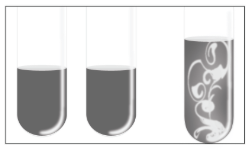
- Two solids are mixed that can be easily separated.
- Two liquids are mixed, and a yellow solid begins to form.
- Two clear liquids are mixed, and the new substance is clear.
- Two liquids are mixed, and the temperature stays the same.
- Two liquids are mixed, and a yellow solid begins to form.
100
Which of the following actions would NOT make the wagon move horizontally or vertically?
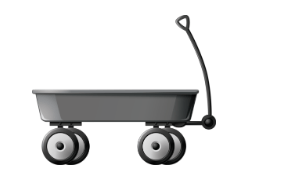
- Pull on the wagon handle.
- Push on the wagon from the right.
- Sit in the wagon.
- Roll the wagon down a hill.
- Sit in the wagon.
100
According to Newton’s third law, if someone jumps off a skateboard, then the skateboard will roll backward because–
- the mass of the skateboard is the same as the mass of the person who jumps off.
- the pull of gravity on the person is the same as it is on the skateboard, regardless of size.
- the air resistance on the person is great and the friction on the skateboard is small.
- for the force that sends the person forward, there is an equal force pushing back on the skateboard.
for the force that sends the person forward, there is an equal force pushing back on the skateboard.
100
Two friends went to the park to go on the swings. As the swings went back and forth, what happened to the total amount of energy?
- The amount of potential and kinetic energy decreased.
- The amount of potential energy increased while the kinetic energy decreased.
- The amount of potential energy decreased while the kinetic energy decreased.
- The total amount of energy stayed the same.
- The total amount of energy stayed the same.
100
- In an outdoor plant, the process of photosynthesis converts carbon dioxide and water to glucose and oxygen. How is energy conserved within this system during this process?
- Thermal energy from the Sun transforms into light energy that is given off by the plant.
- Light is transformed into chemical and heat energy as the plant gets warmer in the sunlight.
- Chemical energy is transformed into mechanical energy as the plant grows.
- Radiant or light energy is transformed into chemical energy.
- Radiant or light energy is transformed into chemical energy.
100
How is energy transferred through longitudinal waves?
- Particles move side to side, away from the starting point.
- Particles move perpendicular to the wave motion.
- Particles must be transmitted through a vacuum.
- Particles move parallel to the wave motion.
- Particles move parallel to the wave motion.
100
During a low tide, students noticed a first quarter moon in the sky. What Moon phase occurs after a first quarter moon?
- Full moon
- New moon
- Third quarter moon
- Waning gibbous
- Full moon
100
- Rocks near a river have water flowing over them. Over time, this water wears down the rocks and creates smooth edges. What two spheres of Earth are involved in this interaction? What are their components?
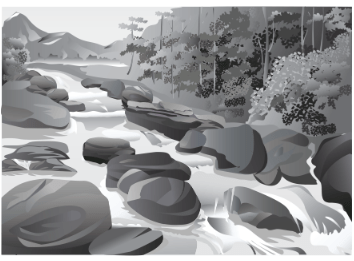
- Biosphere (algae on the rocks) and hydrosphere (water in the river)
- Atmosphere (air dissolved in the water) and hydrosphere (water in the river)
- Hydrosphere (water in the river) and geosphere (rocks)
- Atmosphere (air dissolved in the water) and geosphere (rocks)
- Hydrosphere (water in the river) and geosphere (rocks)
100
What are rocks classified by?
- Their age
- Their texture
- Their density
- Their process of formation
Their process of formation
100
A student is making a poster to educate their classmates on ways to use efficiency to conserve water resources. Which strategy should they include on the poster?
- Run your automatic dishwasher half-full of dishes as often as you can.
- Take longer showers to get cleaner.
- Turn off the water while you brush your teeth.
- Let tap water run to cool it off before drinking.
- Turn off the water while you brush your teeth.
200
- Liquids and gases–
- have the same density.
- take the shapes of their containers.
- both have definite shapes.
- are denser than water.
- take the shapes of their containers.
200
A student made trail mix to take on a hiking trip. They decided to add peanuts, chocolate pieces, cereal, and popcorn to it. Which of the following is true about the trail mix?
- The trail mix is an example of a pure substance.
- The trail mix is an example of a heterogeneous mixture.
- The trail mix is an example of a homogeneous mixture.
- The trail mix is an example of a solution.
- The trail mix is an example of a heterogeneous mixture.
200
Using the information in the chart below, determine which statement is true.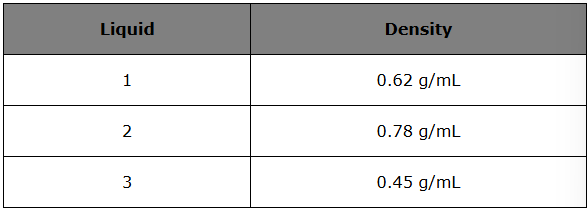
- An object with a density of 0.58 g/mL would sink in liquid 3 but float in liquid 1.
- An object with a density of 0.58 g/mL would sink in liquid 1 but float in liquid
- An object with a density of 0.58 g/mL would sink in liquid 2 but float in liquid 1.
- An object with a density of 0.58 g/mL would sink in liquid 1 but float in liquid 2.
- An object with a density of 0.58 g/mL would sink in liquid 3 but float in liquid 1.
200
What typically happens to the thermal energy in a substance as a new substance is formed in a reaction?
- The new substance may give off or absorb heat, making the substance hotter or colder.
- The thermal energy combines with matter to combust.
- There is no change in thermal energy; the temperature of the substance remains the same.
- Thermal energy must be added to the reactants to make the new substance form.
- The new substance may give off or absorb heat, making the substance hotter or colder.
200
- Gravity and magnetism are alike because they–
- are both noncontact forces that act on objects from a distance to affect their motion.
- are both contact forces that only act by touching an object.
- oppose each other and sometimes balance each other out.
- work in different directions by touching an object to affect its motion.
- are both noncontact forces that act on objects from a distance to affect their motion.
200
- Newton’s third law of motion states that–
- if two objects receive the same amount of force, then the object with the larger mass will travel slower than the object with the smaller mass.
- for every action force, there is an equal and opposite reaction force.
- a body at rest remains at rest unless it is acted on by a force.
- a body in motion stays in motion unless it is acted on by a force.
- for every action force, there is an equal and opposite reaction force.
200
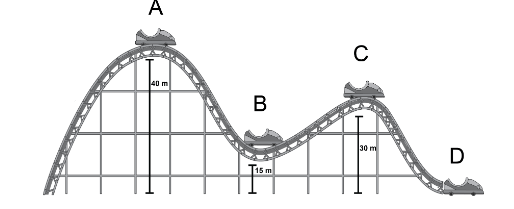
- An illustration of a rollercoaster is shown below . At which point in the roller coaster’s journey along the track does it have the greatest gravitational potential energy and the least kinetic energy?
- Point A
- Point B
- Point C
- Point D
- Point A
200
- What types of energy transformations occur in a battery-operated flashlight?
- Chemical energy light energy electrical energy
- Chemical energy electrical energy light energy
- Light energy chemical energy electrical energy
- Electrical energy chemical energy light energy
- Chemical energy electrical energy light energy
200
Energy travels through objects in a predictable pattern. A transverse wave has a pattern that is similar to which of the following objects?
I. Waves in water
II. Radio waves
III. Visible light waves
IV. Waves created by the motion of tectonic plate movement
- I only
- I and II only
- I and III only
- I, II, III, and IV
- I, II, III, and IV
200
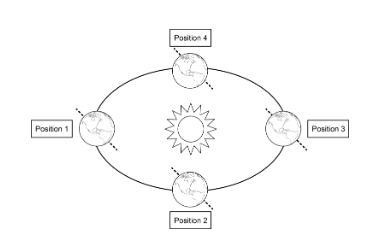
In the illustration below, what position shows the southern hemisphere experiencing spring?
- Position 1
- Position 2
- Position 3
- Position 4
- Position 4
200
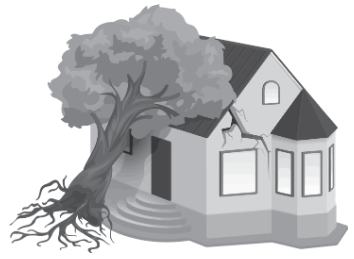
- A dangerous windstorm sweeps across the land and uproots trees. It disturbs the ground in the area as well. What three spheres are involved in this interaction?
- Atmosphere, biosphere, and geosphere
- Atmosphere, hydrosphere, and geosphere
- Biosphere, geosphere, and hydrosphere
- Atmosphere, biosphere, and hydrosphere
- Atmosphere, biosphere, and geosphere
200
Rocks that form from exposure to extreme heat and pressure are classified as–
- sedimentary.
- metamorphic.
- igneous.
- crystals
- metamorphic.
200
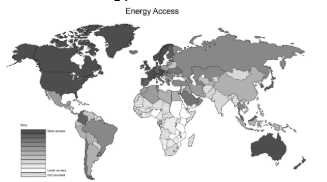
- Reducing global energy poverty would mean ensuring that cities across the globe have access to energy. Which of the following describes a way to manage resources and increase the number of people who have access to energy?
- Build electric wires in all cities, and give people below the poverty line free energy.
- Provide incentives for people in rural areas to move to larger cities, where energy is more accessible.
- If people don’t have access to energy, then give them alternatives, such as coal-burning stoves.
- Research and use affordable modern energy sources that are best suited for the region.
- Research and use affordable modern energy sources that are best suited for the region.
300
- Jasmine tests an element in a lab to determine its identity. She finds that it is dull, it is brittle, and it does not conduct electricity. What type of element does she most likely have?
- A metal
- A nonmetal
- A metalloid
- A compound
- A nonmetal
300
- Which of the following examples is NOT a pure substance?
- Hydrogen
- Water
- Carbon
- Lemonade
- Lemonade
300
- When an object floats in a liquid, it–
- has a density that is similar to that of the liquid.
- is denser than the liquid.
- is less dense than the liquid.
- has the same density as the liquid.
- is less dense than the liquid.
300
- Which of the following best describes a precipitate?
- A liquid changes color and bubbles form when thermal energy is added.
- A gas is produced by a chemical reaction when two substances are combined.
- A solid dissolves into a liquid, and the temperature increases.
- A solid forms out of a solution of two liquids that are mixed together
- A solid forms out of a solution of two liquids that are mixed together
300
- Using this diagram, how would you calculate net force to determine the strength of the missing force if the horizontal forces are balanced?
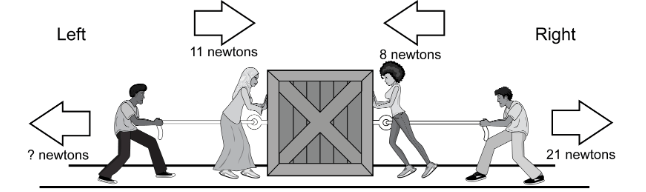
- Add 8 and 21, and then add 11.
- Add 11 and 21, and then subtract 8.
- Add 8 and 11, and then add 21.
- Subtract 8 from 21, and then subtract 11.
- Add 11 and 21, and then subtract 8.
300
Jalen made a chart of observations to identify which objects have balanced forces acting on them and which have unbalanced forces acting on them. Using the data that Jalen collected, what is the best conclusion about the observations?
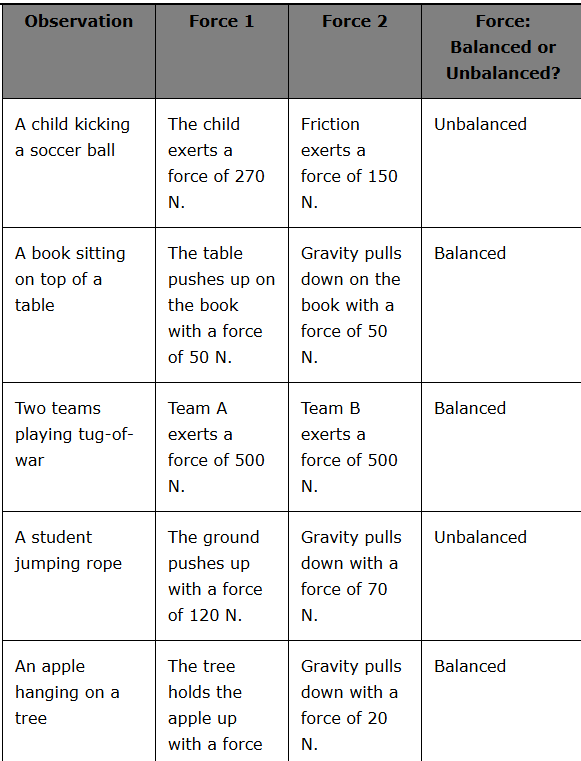
- When the force on an object is equal, there is motion; when the force is unequal, the object is stationary.
- When the force on an object is equal, there is no motion; when the force is unequal, motion occurs.
- When the force on an object is both equal and unequal, motion does not occur because there is no friction.
- When the force on an object is both equal and unequal, motion occurs because of friction.
- When the force on an object is equal, there is no motion; when the force is unequal, motion occurs.
300
For a slingshot to work, you must pull back the rubber band and then release it. As you release it, the object that you placed on the rubber band propels forward. The data table below shows three trials of a student using a slingshot. Based on the table, what observations can be made about the elastic potential energy and the kinetic energy?
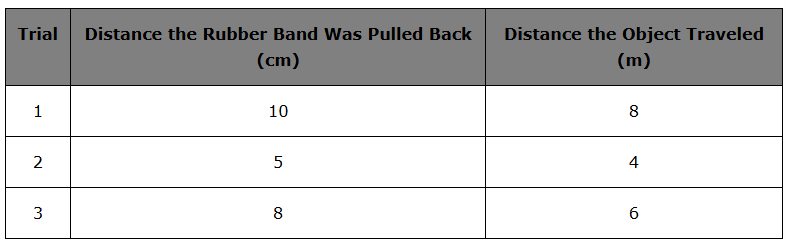
- As the elastic potential energy increases, the kinetic energy increases.
- As the elastic potential energy increases, the kinetic energy decreases.
- As the elastic potential energy decreases, the kinetic energy decreases.
- As the elastic potential energy decreases, the kinetic energy increases.
- As the elastic potential energy increases, the kinetic energy increases.
300
What is the most accurate description of the energy conservation and transformations that are taking place in the roller coaster below?
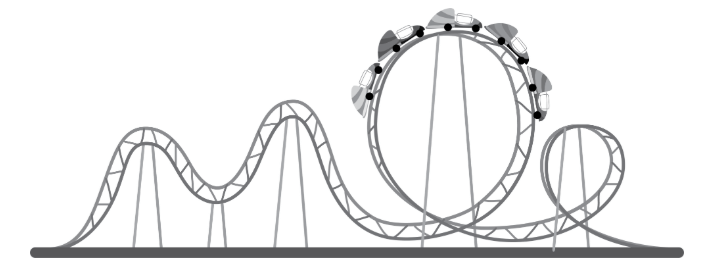
- The roller coaster never has any potential energy because it is always moving.
- Potential energy is converted to kinetic energy and back again throughout the ride.
- The amount of potential energy is always equal to the amount of kinetic energy throughout the ride.
- The roller coaster has more total energy at the bottom of the track because more kinetic energy has been created.
- Potential energy is converted to kinetic energy and back again throughout the ride.
300
- How is energy transferred through transverse waves?
- Movement of particles perpendicular to the direction of the wave
- Giving off light in the direction of the wave
- Giving off sound in the direction of the wave
- Movement of particles parallel to the direction of the wave
- Movement of particles perpendicular to the direction of the wave
300
- Which of the following statements regarding the schedule of high and low tides is correct?
- In a 48-hour period, a geographic location can expect one high tide and two low tides.
- In a 28-day period, a geographic location can expect two high tides and two low tides.
- In a seven-day period, a geographic location can expect one high tide and two low tides.
- In a 24-hour period, a geographic location can expect two high tides and two low tides.
- In a 24-hour period, a geographic location can expect two high tides and two low tides.
300
Aarohi wants to make a model of Earth’s layers for science class. Which of the following represents the best materials to use for two of the layers?
- A layer of peanut butter for the solid inner core and a steel ball for the crust
- A hollow tennis ball for the inner core and a layer of peanut butter for the liquid mantle
- A steel ball for the dense, solid inner core and a hollow tennis ball for the outer core
- A steel ball for the dense, solid inner core and a foam ball for the less dense mantle
- A steel ball for the dense, solid inner core and a foam ball for the less dense mantle
300
- How is sedimentary rock formed?
- Lava cools and hardens.
- Extreme heat and pressure solidify the layers.
- Sediment is melted.
- Pieces are deposited, compacted, and cemented.
- Pieces are deposited, compacted, and cemented.
300
- What is malnutrition?
- The condition of processing the appropriate amount and types of nutrients that the body needs to function
- Having limited or no access to modern energy resources
- The condition of not processing the appropriate amount and types of nutrients that the body needs to function
- Having unlimited access to modern energy resources
- The condition of not processing the appropriate amount and types of nutrients that the body needs to function
400
- Matter can be divided into tiny particles called–
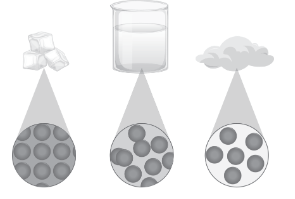
- liquids, which are made of large particles.
- compounds, which are denser than water.
- solids, which have a fixed mass.
- atoms, which are too small to be seen and have energy.
- atoms, which are too small to be seen and have energy.
400
What title best describes the table below?
- Characteristics of Pure Substances
- Characteristics of Elements
- Characteristics of Homogeneous Mixtures
- Characteristics of Heterogeneous Mixtures
- Characteristics of Homogeneous Mixtures
400
Which statement describes the objects in the water below?
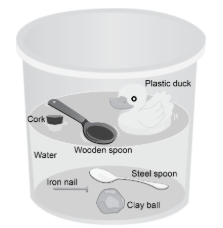
- The plastic duck is denser than the clay ball.
- The clay ball is denser than the wooden spoon.
- The iron nail is less dense than the cork.
- The steel spoon is less dense than the plastic duck.
- The clay ball is denser than the wooden spoon.
400
Which of the following describes how to identify the formation of a new substance when vinegar and baking soda combine?
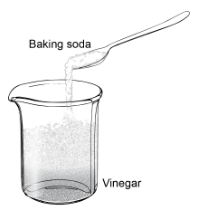
- The vinegar looks cloudy and white.
- The baking soda dissolves.
- Bubbles form at the top of the substance.
- The temperature stays the same after the reactants are mixed.
- Bubbles form at the top of the substance.
400
- How would you describe the forces at work on the vase below?
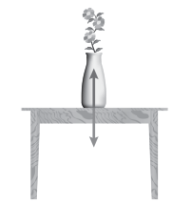
- The force of gravity is stronger than the normal force.
- The normal force is stronger than the force of gravity.
- There are no forces acting on the vase because it is at rest. Forces are only at work if an object is moving.
- The force of gravity is pulling down on the vase, but it is balanced by the normal force pushing upward. The object is at rest because the forces are balanced.
- The force of gravity is pulling down on the vase, but it is balanced by the normal force pushing upward. The object is at rest because the forces are balanced.
400
The nozzle of a rocket is pointed downward so that as fuel is ignited, the exhaust pushes downward. Why is this arrangement necessary for a rocket to function properly?
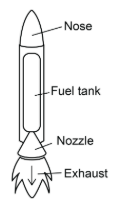 The rocket is protected from the heat of the exhaust.
- Burned fuel can be collected on the ground.
- As fuel is combusted, the rocket pushes the gases backward and the gases push the rocket forward.
- This allows the rocket to be steered properly.
- As fuel is combusted, the rocket pushes the gases backward and the gases push the rocket forward.
400
A textbook is placed on a desk, but then it is bumped off and falls to the floor. Which of the following correctly describes the potential and kinetic energy involved in this scenario?
- The book has the greatest amount of potential and kinetic energy when it is on the desk.
- The book has the least amount of potential and kinetic energy when it is on the desk.
- The book has the greatest amount of potential energy and the least amount of kinetic energy when it is on the desk.
- The book has the least amount of potential energy and the greatest amount of kinetic energy when it is on the desk.
- The book has the greatest amount of potential energy and the least amount of kinetic energy when it is on the desk.
400
- Which statement best describes how energy is transformed, transferred, and conserved in an ocean food web?
- The total amount of energy in the food web changes as consumers eat producers and then conduct life activities.
- Energy is not conserved in an ocean food web because mechanical energy is released from the system as plant-eating fish swim around.
- Radiant energy is converted to chemical energy in plants, and then that chemical energy is transferred to the fish that eat the plants.
- There is less total energy in the system available to higher-level consumers, such as sharks, because other organisms release it through life activities.
- Radiant energy is converted to chemical energy in plants, and then that chemical energy is transferred to the fish that eat the plants.
400
- What type of wave is demonstrated in the model below? How is energy transferred through it?
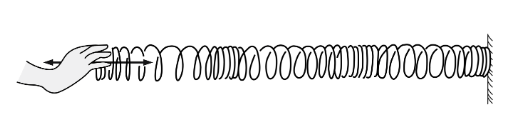
- Transverse wave; energy travels in the same direction, and particles vibrate.
- Transverse wave; energy travels up and down in the direction of the wave.
- Longitudinal wave; energy travels in the same direction, and particles vibrate.
- Longitudinal wave; energy travels up and down in the direction of the wave.
- Longitudinal wave; energy travels in the same direction, and particles vibrate.
400
- The axis on which Earth now rotates is tilted at an angle. If the axis changed so that it was perfectly upright, which change would be expected on Earth?
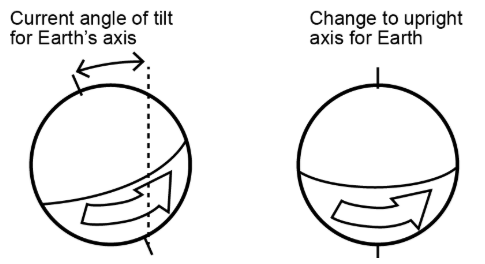
- There would no longer be periods of light and darkness.
- It would always be winter in the southern hemisphere.
- For every season, the length of daylight would be shorter.
- There would not be the same pattern of seasonal changes in weather
- There would not be the same pattern of seasonal changes in weather
400
Which of the following scenarios best represents the interaction of the atmosphere with the hydrosphere?
- A seabird breathes air while in flight.
- A group of people plants coastal plants near a beach to minimize dune erosion.
- A storm surge erodes sand from a beach during strong winds.
- Ocean water evaporates and condenses into clouds in the water cycle.
- Ocean water evaporates and condenses into clouds in the water cycle.
400
- The table below shows the characteristics of a certain type of rock. Based on the information in the table, what type of rock is being described?

- Sedimentary
- Metamorphic
- Igneous
- Geod
- Igneous
400
Which of the following is NOT a way that technology can be used to manage natural resources, like air and water?
- A website that shows the location of currently burning forest fires
- An app that helps wildlife rangers track illegal entry into parks and protected areas that are subject to overfishing
- A city monitoring and predicting air pollution levels before they rise and asking residents to walk or bike to work as much as they can on certain days to reduce emissions
- Sensors in natural areas that help residents track changes to air and water quality in real time
- A website that shows the location of currently burning forest fires
500
Where are most of the rare Earth elements located on the Periodic Table of Elements?
- The first three rows at the top
- One of the rows at the bottom
- On the left side and in the middle
- The last six columns on the right
- One of the rows at the bottom
500
- Students made two mixtures. Mixture 1 was made by mixing salt into water. Mixture 2 was made by mixing iron filings into sand. Which of the following statements is true for both mixtures?

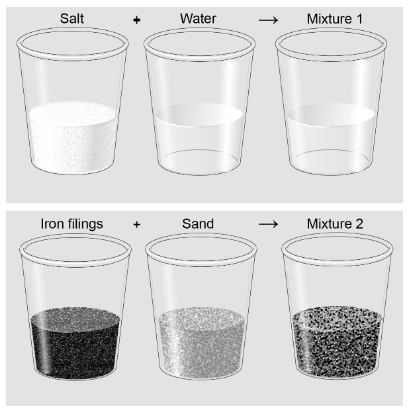
- Both mixtures can be separated by pouring them through a filter.
- Both mixtures can be separated into their original ingredients.
- Both mixtures can be separated using the property of magnetism.
- Both mixtures can be separated into a liquid and a solid.
Both mixtures can be separated into their original ingredients.
500
- Of the substances listed below, which has the least density?
- Substance 1: 1.25 g/mL
- Substance 2: 0.76 g/mL
- Substance 3: 1.02 g/mL
- Substance 4: 0.88 g/mL
- Substance 2: 0.76 g/mL
500
- Students combine several substances in a science lab. Which of the following results could indicate the formation of a new substance?
- Red and blue paint are combined to form purple paint.
- A student heats a substance on a hot plate, and the temperature changes.
- Rust forms, the mixture gets warmer, and bubbles are released.
- There is no change in the color or state of matter
- Rust forms, the mixture gets warmer, and bubbles are released.
500
- This person is parachuting toward the ground at a constant speed. Describe the net force that is acting on this person.
- The force of gravity must be acting with a strength of 300 N, making the forces balanced.
- The force of gravity must be <300 N, making the vertical forces unbalanced.
- The force of gravity must be >300 N, making the vertical forces unbalanced.
- The force of gravity must act with a strength of 0 N, making the vertical forces balanced.
- The force of gravity must be acting with a strength of 300 N, making the forces balanced.
500
- Every Saturday morning, Jada plays tennis with her stepsister. Jada’s racket experiences a force of 25 N as it hits the ball. What is true about the force that the ball will experience?
- The ball will experience 25 N of force.
- The ball will experience 50 N of force.
- The ball will experience 10 N of force.
- The ball will not experience any forces.
- The ball will experience 25 N of force.
500
- Which of the following does NOT correctly pair a source of chemical energy with the kinetic energy that it is transformed into?
- Food → animal running
- Fuel → plane flying
- Batteries → toy car moving
- Spring → pop-up toy jumping
- Spring → pop-up toy jumping
500
Ishaan built a simple circuit in science class. He knows that energy transforms within this system. Which of the following statements best describes the energy conservation and transformation in this electric circuit?

- Chemical energy in the batteries is transformed into light and heat energy but does not leave the system.
- Chemical energy leaves the batteries and transforms into light and heat energy, and then it is released from the system.
- Electrical energy travels from the light bulb to the batteries, where it is stored within the system.
- Heat and light energy leave the system but are replaced when the batteries are changed.
- Chemical energy in the batteries is transformed into light and heat energy but does not leave the system.
500
- What kind of wave is represented in the image below?
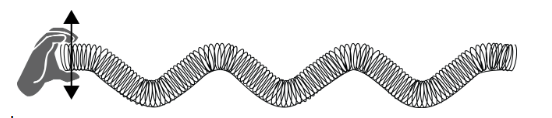
- Longitudinal wave
- Transverse wave
- Ultraviolet wave
- Radio wave
- Transverse wave
500
- During which two Moon phases would you experience higher-than-average tides?
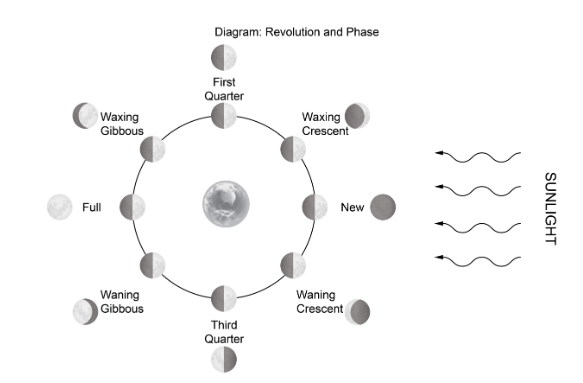
- First quarter moon and third quarter moon
- Full moon and new moon
- First quarter moon and full moon
- Third quarter moon and new moon
- Full moon and new moon
500
- Which of the following is the most appropriate to model Earth’s crust (i.e., its properties most closely resemble the characteristics of this layer)?

- A flexible layer of modeling clay that bends
- A thick, foam ball that has the most mass of all the materials
- A brittle graham cracker
- A pile of dirt
- A brittle graham cracker
500
- The rock cycle shows how rocks can change from one form into another. What process needs to occur for a sedimentary rock to turn into sediments?
- The sedimentary rock is exposed to heat and pressure.
- The sedimentary rock is weathered and eroded.
- The sedimentary rock melts, cools, and hardens.
- The sedimentary rock is compacted and cemented
- The sedimentary rock is weathered and eroded.
500
- Which of the following is a way to conserve resources?
- Keep the water running in the backyard to water plants.
- Plant trees to prevent the erosion of soil in your local area.
- Use only solar panels to provide energy for your home.
- Cut down trees to make room for large neighborhoods.
- Plant trees to prevent the erosion of soil in your local area.