Risky Business,
Delegation and Prioritization
Delegation and Prioritization
You have just received report on your assigned patients on Derenzo. Which of the following patients should be assessed first?
A.The patient 2 days status post bowel resection complaining of 7/10 pain
B.The patient scheduled for a surgical procedure immediately after report
C.The patient complaining of chest pain
D.The patient on fall precautions setting off the bed alarm
C. Who is the patient complaining of chest pain (be sure the fall alarm is being addressed by a colleague).
Your patient admitted with pneumonia and respiratory failure is on an OxyMask at 15 Liters and his O2 sat won't go above 80%. You've called a Rapid Response. While you are waiting for the responders, this is what you can do to raise Mr. Jones's O2 sat.
What is apply a non-rebreather mask.
These are two benefits of successful teamwork in the hospital.
What are (we are looking for 2):
Reduced clinical errors
Improved outcomes for patients
Increased patient satisfaction
Increased staff satisfaction
After ruling out an acute medical condition, this progressive disease seen often in seniors is best managed using nonpharmacological care.
What is Alzheimer’s or related disease with dementia
These are 3 things the nurse should consider before administering IV Lasix to a patient with heart failure.
What are:
Rate of administration
Labs e.g. potassium level, renal function (must have results before giving Lasix)
HR/BP (if low, are they symptomatic, is it their baseline)?
Strict I and O's
Consider Fall Risk/Fall Precautions, need bedside commode?
Is the IV Lasix working? Do they need a continuous infusion?
Post-infusion vital signs, repeat labs
These are the 4 categories that the nurse seeking professional advancement will need points in.
What are:
Nursing Practice
Nursing Knowledge
Nursing Quality
Nursing Leadership
These are: Stage 3 and 4 Pressure Injuries, falls with injuries, Catheter Associated Urinary Tract Infections, and Central Line Associated Bloodstream Infections are examples of these.
What are Serious Reportable Events (SREs)?
This is what you would do first if your patient is admitted with a concern for sepsis.
What is:
Draw 2 sets of blood cultures (prior to the first dose of antibiotics)
These are 2 processes we use in the hospital to effectively communicate information.
What are (we are looking for two):
Huddles
Check Backs
Handoffs
Time Out
SBAR
This confrontational approach forcing people with memory loss to accept current facts is no longer used.
What is Reality Orientation
Your patient is receiving fluid through their double lumen PICC. You go to draw blood from their available lumen without success. These are your next steps.
What are:
Stop the fluid
Attempt to draw blood from the available lumen.
Reposition, change the needleless connector, and pursue Cathflo (alteplase) in both ports if the other interventions are unsuccessful.
These are 3 activities you can do on your unit to earn points for professional advancement.
Peer mentor
Precept
Medical Record Audits
Wound champion
You are doing an initial assessment on Mr. Jones and you note this new finding. These are your next steps.
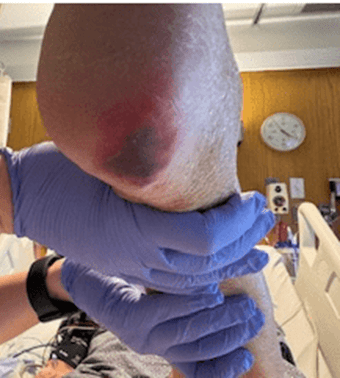
What are:
Offload
Inform provider
Wound Consult
STARS
This is why it is important to trend lactate levels in the setting of sepsis.
What is:
An elevated lactate level (>2) is indicative of compromised organ perfusion
You are charge on a busy Friday evening and the floor is being asked to take several patients from the ED at once. You communicate your safety concerns to the nursing supervisor and you both agree on the solution of having a nurse float to your unit until the admissions are settled. This is an example of which style of conflict resolution?
What is Compromising
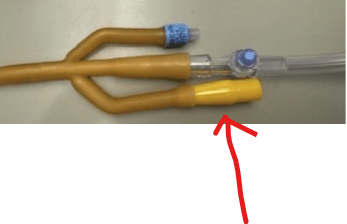
This is one thing that you should never forget when discharging a patient who is going home with a three-way Foley.
It is the beginning of the shift and you and your orientee are caring for a patient who appears pleasantly confused. You ask your orientee if they recall hearing that the patient was confused in report and they respond "No, should we contact the doctor?" In an effort to facilitate your orientee's critical thinking, how might you respond?
What is: ask questions such as "What are some things we should consider before contacting the doctor?" Give them time to answer....
What is the patient's mental status at baseline?
Physical exam - Vital signs? O2 sat? Neuro signs? labs? Is the patient delirious, what is their bCAM?
Infection, new meds....
You are addressing an issue related to safety with your orientee and they are on their phone and ignoring you. After Describing your concerns to your orientee, this is an example how best to address this issue using the next step of the DESC Model of Conflict Resolution.
D - Describe the specific situation or behavior
E - Explain how the situation makes you feel
S - Suggest other alternatives
C - Consequences (can be positive and/or negative)
What is: "It makes me feel like you don't value my feedback when you when you ignore me, especially when addressing safety issues."
D - Describe the specific situation or behavior
E - Explain how the situation makes you feel
S - Suggest other alternatives
C - Consequences (can be positive and/or negative)
These are at least 2 of the 5 Rights of Delegation always to be taken into account by the RN when delegating.
What are (any 2 of these):
Risk task
Right circumstance
Right person
Right direction/communication
Right supervision/evaluation
You are caring for a patient on telemetry that is alarming for Torsades. This is one nursing intervention you can try with the patient prior to a provider intervention.
What is a vagal manuver:
Face in cold water
Bearing down (Valsalva)
Blowing into a syringe
This is the only assumption we should make with respect to conflict management.
What is: everyone working here seeks to provide the best possible care, wants to do their best, and wants to improve.
This how you might respond to your orientee who is concerned that increasing the morphine drip on an actively dying patient will be the cause of their death.
Proper symptom management does not hasten death, it facilitates comfort during the dying process
This is one strategy nurses can use to improve their critical thinking skills (feel free to provide more than one strategy)
What are (we are looking for one):
Use a case-based approach
Practice self-reflection
Develop a questioning mind
Practice self-awareness in the moment
Use a process
You've noticed that your orientee has delayed giving a unit of blood. When you question them about their priorities, they tell you that they want to get their discharge tasks done first so they don't get behind. This is how you would respond.
It is important to prioritize timely medical interventions over other tasks.
In the vast majority of malpractice claims, patients and family members cite this one key factor in their decision to sue.
What is poor communication.
This is what you are expecting the treatment to be for this arrhythmia:
What is external pacing.
These is one of the three primary causes of workplace conflict.
What are 2 of the following: differences, interdependence, and scarce resources.
This is the Gold Standard for relief of dyspnea in the actively dying patient.
Morphine (50% less than what is required for pain management)
Also consider adjunct meds such as benzos for anxiety, steroids, anticholinergics, bronchodilators
And relaxation techniques and positioning
This is an example of what nurses who think critically may ask themselves when they encounter a problem or challenging situation.
What are (we are looking for one):
What do I know about the situation?
How do I know this?
What personal biases do I have that affect this situation?
What options do I have in this situation?
The nightshift is going out for breakfast following a busy night. The preceptor asks their orientee to come along. This is the role the preceptor is demonstrating by asking their orientee to join.
What is the Socializer