Experiments
Rotation/Revolution
Stars
Moon
100
12. Students in Jahviers’s class measure the time it takes a marble to move down a ramp. What should he and classmates do with their results?
A. compare data with each other
B. vote on who kept the best data
C. independently publish their results
D. change their data to match another student’s data
A. compare data with each other
100
17. Juan decided to use a basketball as a model of Earth. He placed the ball on the floor and then spun it. What was Juan showing with his model of Earth?
A. Earth’s orbit
B. Earth’s phases
C. Earth’s rotation
D. Earth’s revolution
C. Earth’s rotation
100
Go to 1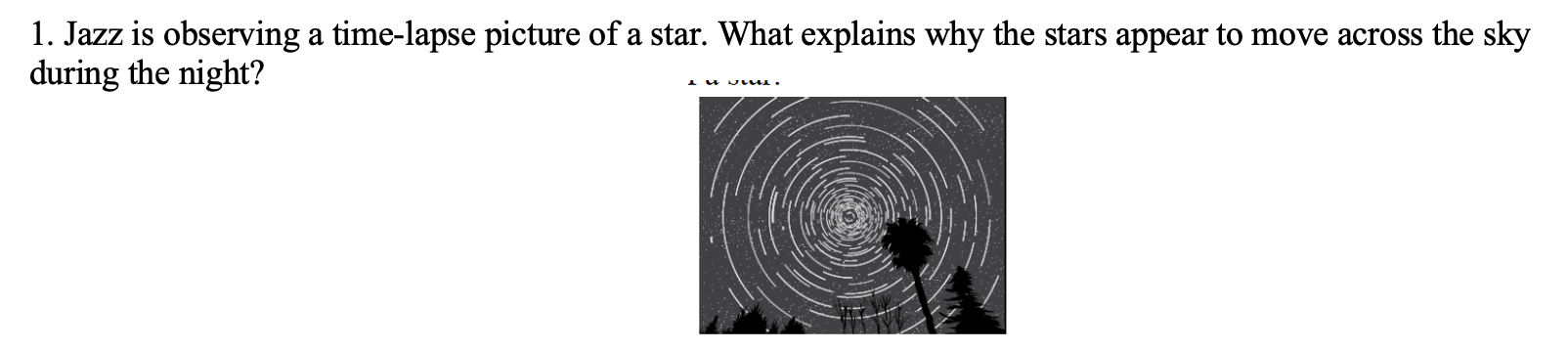
A. the path of the Moon
B. the motion of the stars
C. the rotation of the Earth
D. the revolution of the Earth
C. the rotation of the Earth
100
10. Crystel records the different moon phases she observes. On February 21st, she observed a full moon as shown in the picture below. Which of the following is the next closest date that Crystel would observe the next full moon?
A. March 1st
B. March 7th
C. March 21st
D. March 28th
C. March 21st
200
13. Mrs. Ruiz wants to show her students how the Sun, Moon, and Earth move around each other. Which of the following would likely work best? Think about what we do on NearPod!
A. a drawing on the chalkboard
B. a spoken descriptions of the movements
C. a 2D model with pictures on a display board
D. a 3D computer model that shows the movements
D. a 3D computer model that shows the movements
200
7. Earth moves through space by spinning on its axis and by orbiting the Sun. What will happen between January 1, 2021 and January 1, 2022?
A. Earth will complete 1 rotation.
B. Earth will complete 12 rotations.
C. Earth will complete 1 revolution.
D. Earth will complete 365 revolutions.
C. Earth will complete 1 revolution.
200
8. In the summer, Julian can see his favorite pattern of stars. When he observes the night sky six months later, he can’t see his favorite stars. Which of the following is the reason Julian’s favorite pattern of stars is only visible at night in the summer, but not during other seasons?
A. Earth rotates on its axis.
B. Earth rotates around the Sun.
C. Earth revolves around the Sun.
D. Earth revolves around the Moon.
C. Earth revolves around the Sun.
200
2. As Dirceu looks outside his window in the living room, he notices a first quarter Moon. How long will it be before he sees another first quarter Moon?
A. about one day
B. about one year
C. about one week
D. about one month
D. about one month
300
11. Mrs. Ruiz was discussing the Earth’s rotation and revolution with her class. She presented a fictional scenario where the Earth changed its position, and it started to take longer to travel around the Sun than it does now. Which of these statements would be true in this scenario?
A. A day would be longer than 24 hours.
B. A day would be shorter than 24 hours.
C. A year would be longer than 365 days.
D. A year would be shorter than 365 days.
C. A year would be longer than 365 days.
300
6. Madelynn learned that Earth rotates on its axis. What evidence supports the theory that Earth is rotating on its axis?
A. There is a day and a night.
B. There are 365 days in a year.
C. There are four phases of the Moon.
D. There are different seasons of the year.
A. There is a day and a night.
300
3. Destiny is comparing two models of the night sky drawn by her classmates throughout the year. One model was drawn in the spring, and one was drawn in the winter. Destiny observes that the models have different patterns of stars drawn on them. Which best explains the reason for this?
A. One student made a mistake.
B. Stars constantly move to create new patterns.
C. Visible patterns of stars change with the seasons.
D. Different people see different patterns in the sky.
C. Visible patterns of stars change with the seasons.
300
9. Barbara enjoys viewing the Moon every night in his backyard. She observes that it seems to change appearance every week. Which sentence best explains why this happens?
A. The Moon moves between Earth and the Sun.
B. The Moon rotates only once in about a month.
C. The same side of the Moon always faces Earth.
D. The amount of lighted part of the Moon that faces Earth changes.
D. The amount of lighted part of the Moon that faces Earth changes.
400
14. Geileen wants to show Franjely what happens during one Earth day. Geileen holds a small globe representing Earth, and Franjely holds a large ball representing the Sun What should Geileen do to show Franjely what happens during one Earth day?
A. Geileen should move the globe in one complete circle around Franjely.
B. Geileen should move the globe toward Franjely and then away from her.
C. Geileen should slowly lift the globe above her head and then lower it.
D. Geileen should slowly spin the globe one complete time about its axis.
D. Geileen should slowly spin the globe one complete time about its axis.
400
15. Which of these is a result of the spinning of Earth on its axis?
A. The length of the year.
B. The change from spring to summer.
C. The motion caused by Earth’s revolution.
D. The apparent motion of the Sun in the sky.
D. The apparent motion of the Sun in the sky.
400
5. Around seven o’clock one evening, Zaire saw a pattern of stars in the night sky. Hours later, he went outside to show his parents that same pattern of stars. What would the pattern of stars look like?
A. The pattern of stars would appear to be in the same place in the sky.
B. The pattern would be smaller because the stars moved closer together.
C. The pattern of stars would appear to have moved together across the sky.
D. The pattern would change because each star would have moved in a different direction.
C. The pattern of stars would appear to have moved together across the sky.
500
4. Earth spins at a very constant and regular speed. It rotates at close to 1,000 miles per hour at the equator. How long does it take Earth to make one complete rotation?
A. 28 days
B. 12 hours
C. 24 hours
D. 365 days
C. 24 hours