Enzymes
CAC/Oxidative phosphorylation
Glycolysis/Fermentation
Photosythesis
Random
100
Name at least 2 factors that effect enzymes?
Enzyme/substrate concentration
temperature
pH
inactive forms
Inhibitors
Irreversibe
compartmentalization
100
List the locations of pyruvate oxidation, CAC, and ETC/ATP synthase
Pyruvate oxidation: matrix
CAC: matrix
ETC/ATP synthase: Along Inner membrane
100
True or false: Glycolysis requires oxygen to be present in order to function
Flase
100
What are the two different pathways in Photosynthesis called?
Light-dependent reactions and light-independent reactions.
100
How is water used in photosynthesis? What does it produce as a waste product?
Used to replace low-energy electrons
Produces O2 as a waste product
200
Define the following terms:
- kinase
- phosphatase
- phosphorylation
- dephosphorylation
- kinase: type of enzyme that adds phosphate
- phosphatase: type of enzyme that removes phosphate
- phosphorylation: process of adding a phosphate
- dephosphorylation: process of removing a phosphate
200
If 5 glucose molecules enter glycolysis, how many acetyl-coA’s would enter the citric acid cycle? What would be your total end products of the citric acid cycle?
10 Acetyl-Coa
End products of CAC:
30 NADH,10 FADH2,10 ATP, 20 CO2
200
During fermentation, what is the key molecule that is being reproduced for glycolysis to run?
NAD+
200
What specific molecule does chlorophyll have at its center? Also, how does chlorophyll a and chlorophyll b differ?
- contains Mg
- Chlorophyll a has a CH3 group
- Chlorophyll b has a CHO group
200
NADH + H+ → NAD+ + H+
FAD+ + H+ → FADH2 + H+
Label which is being oxidize and which is being reduced
Oxidized: NADH
Reduced: FADH2
300
Define the different types of cell signaling
Local signaling:
Paracrine: Acts on cells near by by secreting molecules of a local regulator
Synaptic:Nerve cell releases neurotransmitter into synapse, which stimulates target cell like a muscle or nerve cell
Long distance:
Endocrine: Hormones. Endocrine cells secrete hormones into body fluids, like blood. Reach most body cells but only bind to/affect some cells
300
What happens to the CO2 that is produced during cellular respiration? Since O2 is required for much of the processes in cellular respiration, how does it enter the cell?
CO2 diffuses out and O2 diffuses in
300
Where does Glycolysis occur in the cell/how does glucose enter the cell?
Glucose enters through a glucose permease carrier protein, and glycolysis occurs in the cytosol of the cell.
300
Where is ATP and NADPH produced in photosynthesis? Where do the light-dependent reactions and light-independent reactions occur?
ATP/NADPH: stroma
light-dependent rxn: along thylakoid membrane
light-independent rxn: stroma
300
Explain the difference between C4 and CAM pathways
C4: are in environments that have low CO2. Will employ a spatial separation of capturing CO2 and using CO2 (Calvin cycle).
CAM: are in environments that have extreme temperatures. Will close their stomata during the day to save water( will perform the Calvin cycle at this time), and open them at night to capture the CO2.
400
Describe the difference between competitive and non-competitive inhibitors. Describe how Allosteric regulation works.
Competitive: inhibitor will bind to active site
non-competitive: inhibitor binds to another site
Allosteric regulation: type of non-competitive. can either activate or inactivate and enzyme by binding to the allosteric site. results in a shape change in the enzyme.
400
If 2 glucose molecules enter cellular respiration, what would be the total amount of NADH and FADH2 that will enter oxidative phosphorylation?
20 NADH
4 FADH2
400
Why is there an energy investment phase and a energy pay off phase in glycolysis?
You have to use 2 ATP at the beginning of the cycle to break down glucose. You then are able to make 4 ATP during the energy pay off phase.
400
Draw the Calvin cycle. Should include key products produced per one cycle, the key enzyme that is used at the start of the cycle, and the key 5 carbon molecule that is reproduced at the end of the cycle.
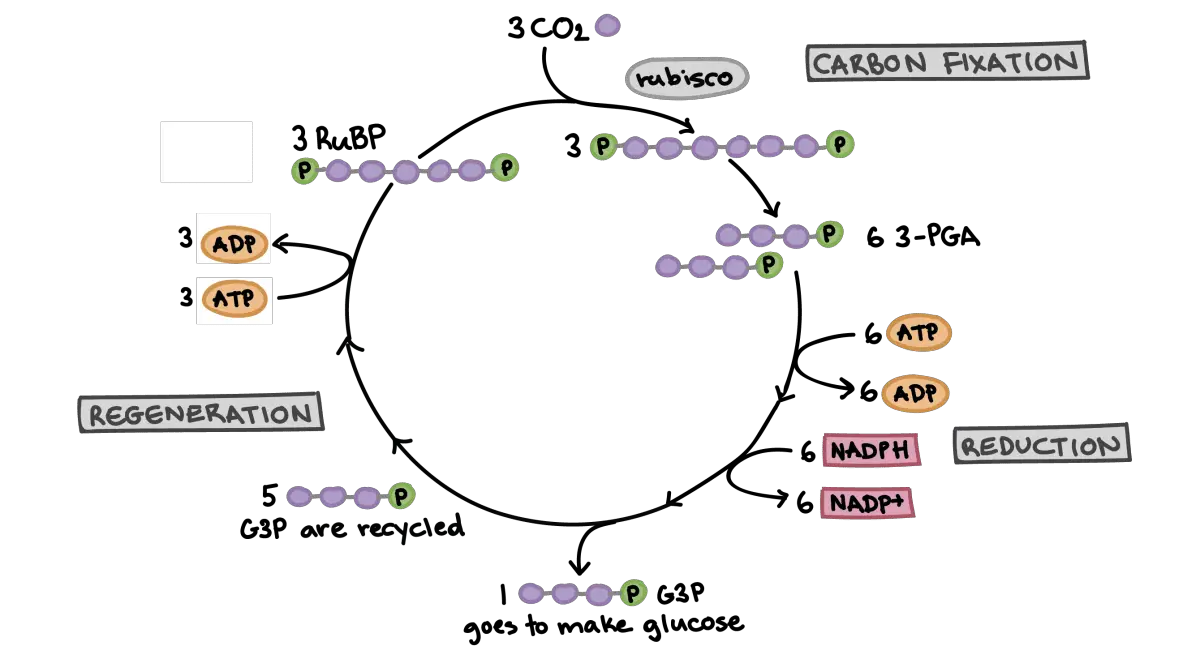
400
Explain the two forms of Irreversible Enzyme inhibition
- cell will not do itself
Substrate mimic: a molecule that mimic the substrate will get stuck in the active site covalently.
Denaturation of enzyme: can be from multiple different factors, overall it results in the disruption of the bonds within the enzyme.
500
The body uses cAMP, cyclic adenosine monophosphate, as a secondary messenger in essential cellular pathways in order for the body to produce specific hormones and neurotransmitters. During a metabolic pathway, cAMP will bind to PKA to activate it, and in turn, the PKA will phosphorylate other proteins. This allows the appropriate cascade to occur and results in cellular responses. What type of enzyme is PKA?
kinase
500
Explain the concept of oxidative phosphorlyation
NADH and FADH2 will “drop off” electrons, which will go through the different protein complexes. This will allow for a proton gradient to form across the membrane. These protons will re-enter the matrix of the mitochondria by passing through ATP synthase, which will release energy since it is going from a high concentration to a low concentration. This energy allows for ATP to be generated.
500
If 8 glucose molecules entered cellular respiration, what would be the total end products of glycolysis?
Net 16 ATP
16 NADH
16 Pyruvates
500
Draw the basic diagram of photosystem II and I that shows how the light is used, e- flow, use of the electron transport chain. List the main products of this process and where they go to next.
See SI leader
Main products: NADPH and ATP to be used in the Calvin cycle.
500
Draw a cell and, using arrows, show the process of cellular respiration
:max_bytes(150000):strip_icc()/cellular_respiration-8fcc3f1ad3e54a828dabc02146ce4307.jpg)