A
B
C
D
E
100
Multiple Choice
The European red squirrel population is declining due to competition with the North American gray squirrel. Most likely, what will eventually happen to the red squirrel?
- It will move to a different community.
- It will be an ecological equivalent of the gray squirrel.
- It will become extinct.
- It will win its competition with the gray squirrel.
C. It will become extinct.
100
True or False
Niche partitioning is an example of competitive exclusion
True
100
Matching
The movement of individuals into a population from another population
Immigration
100
Mystery Box
Take it or leave it
Lose 100
100
Matching
Way in which individuals of a population are spread in an area or a volume
Population Dispersion
200
Multiple Choice
Which type of organism would be most likely to have a type II survivorship curve?
- one that is preyed upon throughout its life
- one that has high birth and infant mortality rates
- one that preys on small mammals
- one that protects and cares for its young
A. one that is preyed upon throughout its life
200
Matching
Establishment and development of an ecosystem in an area that was previously uninhabited
Primary Succession
200
Multiple Choice
The white-tailed deer and the kangaroo are both large herbivorous mammals that occupy similar niches but live on different continents. They are an example of
- niche partitioning.
- ecological equivalents.
- competitive exclusion.
- competitors.
B. ecological equivalents.
200
Multiple Choice
To measure population density, you must divide the number of individuals living in a defined space by the
- birth and death rates.
- area of the space.
- carrying capacity.
- perimeter of the area.
B. area of the space.
200
Mystery Box
Take it or leave it
Lose 400
300
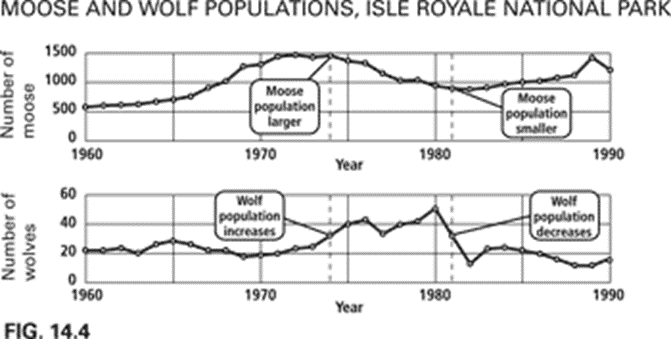
What is the moose population in 1981?
900 moose
300
Multiple Choice
The reestablishment of a damaged ecosystem in an area where the soil is intact is called
- secondary succession.
- primary succession.
- pioneer succession.
- symbiotic succession.
A. secondary succession.
300
Matching
Interspecies interaction in which both organisms benefit from one another
Mutualism
300
Multiple Choice
Hawaii's lush tropical forests arose from a process of
- destruction.
- succession.
- regeneration.
- predation.
B. succession.
300
Multiple Choice
In 1988 several large forest fires occurred in Yellowstone National Park. What process occurred after these fires?
- secondary succession
- symbiotic succession
- primary succession
- pioneer succession
A. secondary succession
400
Matching
Close ecological relationship between two or more organisms of different species that live in direct contact with one another
Symbiosis
400
Multiple Choice
Hawks and foxes compete to eat field mice. This is a form of
- intraspecific predation.
- interspecific competition.
- competitive exclusion.
- random dispersion.
B. interspecific competition.
400
Matching
Aspects of the environment that limit a population’s growth regardless of the density of the population
Density-Independent Limiting Factor
400
Matching
Maximum number of individuals a particular species that the environment can normally and consistently support
Carrying Capacity
400
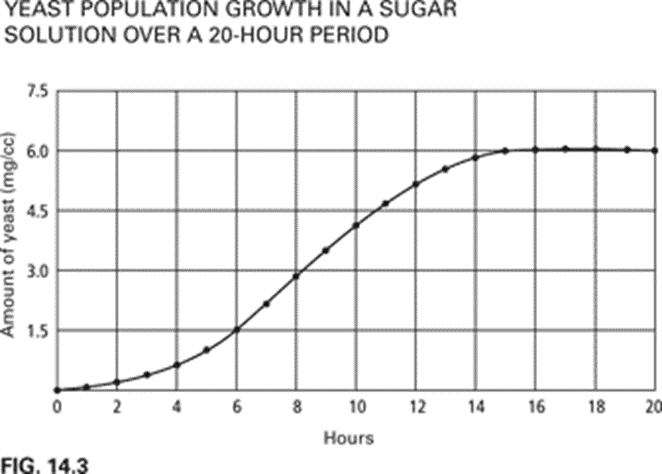 What is the name for the maximum amount of yeast shown in Figure 14.3?
Carrying Capacity
500
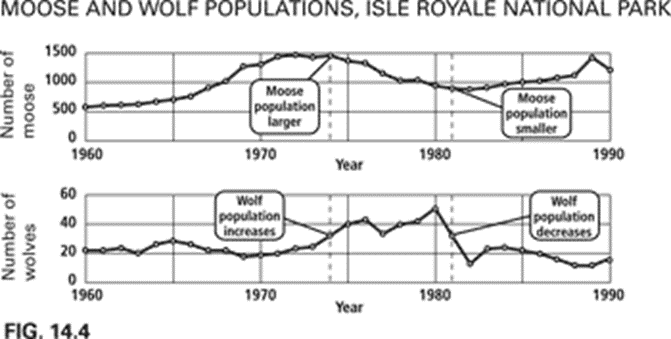 Is the moose population in 1981 relatively high or low?
Relatively Low
500
Multiple Choice
The new island of Surtsey was formed near Iceland by a series of volcanic eruptions. Which of these processes occurred first on Surtsey?
- Volcanic rock broke down into soil.
- A complex ecosystem developed.
- Plants grew on the island.
- Animals moved onto the island.
A. Volcanic rock broke down into soil.
500
Multiple Choice
Fourteen beavers live in a pond with an area of 2 square kilometers. What is the population density of the beavers?
- 14 beavers per square kilometer
- 16 beavers per square kilometer
- 7 beavers per square kilometer
- 28 beavers per square kilometer
C. 7 beavers per square kilometer
500
True or False
Population density is the number of individuals divided by the total population
False
500
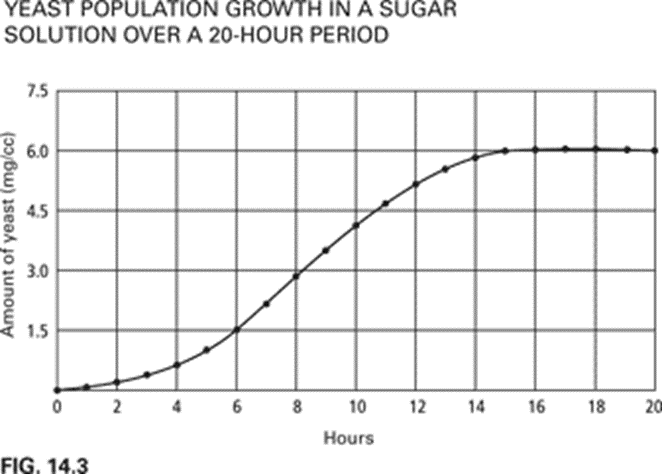 What type of population growth does Figure 14.3 show?
Logistic Growth