B
IO
L
O
GY
100
Human heart cells require a constant release of energy to function continuously. Which structure would be numerous in such cells to meet this demand?
a. Golgi bodies
b. nuclei
c. mitochondria
d. smooth endoplasmic reticulum
c. mitochondria
100
Which process can be a source of genetic variation?
a. copying of chromosomes
b. binary fission
c. mitosis
d. crossing over
d. crossing over
100
At the cellular level, lipids are the primary component of the cell membrane. Which statement would BEST support the argument that the structure of a lipid is related to this function?
a. Lipids contain many nitrogen bonds.
b. Lipids are insoluble.
c. Lipids are constructed to store genetic information.
d. Lipids are composed of amino acids.
b. Lipids are insoluble.
100
Which substance is a product of cellular respiration?
a.ADP
b.glucose
c.oxygen
d.ATP
d.ATP
100
Which statement correctly distinguishes DNA and RNA?
a. DNA contains uracil and RNA does not.
b. DNA contains nitrogenous bases and RNA does not.
c. RNA contains the sugar ribose and DNA does not.
d. RNA is arranged in a double helix and DNA is not.
c. RNA contains the sugar ribose and DNA does not.
200
Mature red blood cells in mammals contain the protein hemoglobin but do not contain a nucleus. The nucleus is lost as the red blood cell matures. Which of the following can be concluded about mammalian red blood cells based on this information?
a. The cells store their DNA in ribosomes.
b. The cells have no functionality once the nucleus is lost.
c. The cells divide by meiosis to produce more red blood cells.
d. The cells perform transcription and translation before the nucleus is lost.
d. The cells perform transcription and translation before the nucleus is lost.
200
Which phase of mitosis is shown in the picture below?
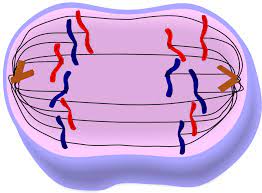
a. metaphase b. telophase c. prophase d. anaphase
d. anaphase
200
Which of the following macromolecules are show in the picture?
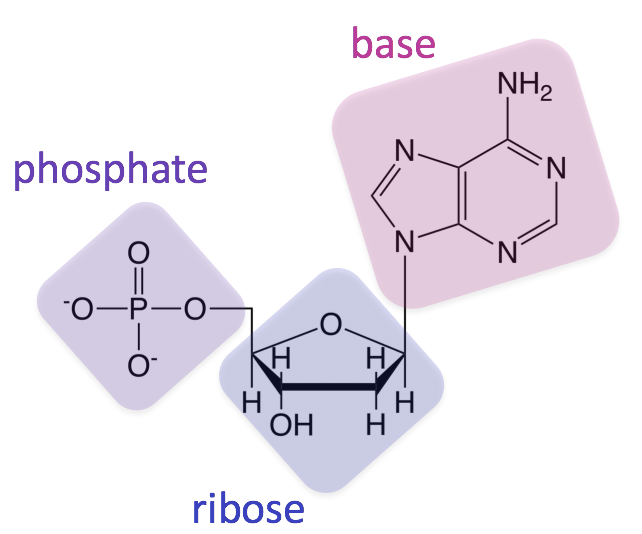
a. lipid
b. carbohydrate
c. protein
d. nucleic acid
d. nucleic acid
200
Which is the correct sequence of events in cellular respiration?
a. electron transport -> Krebs cycle -> glycolysis
b. glycolysis -> Krebs cycle -> electron transport
c. Krebs cycle -> electron transport-> glycolysis
d. Krebs cycle -> glycolysis -> electron transport
b. glycolysis -> Krebs cycle -> electron transport
200
Transcription creates an mRNA molecule using DNA as a template. Where does this process occur in cells of eukaryotes?
a. in the nucleus
b. in the cytoplasm
c. in the ribosomes
d. in the Golgi apparatus
a. in the nucleus
300
Which statement describes ALL prokaryotic and eukaryotic cells?
a. Ribosomes are present in the cytoplasm.
b. Materials are stored in vacuoles.
c. Chloroplasts are used for photosynthesis.
d. Cell walls provide shape and support.
a. Ribosomes are present in the cytoplasm.
300
Which statement describes the products of meiosis I and meiosis II?
A. Meiosis I produces two haploid cells, and meiosis II produces four haploid cells.
B. Meiosis I produces four diploid cells, and meiosis II produces four haploid cells.
C. Meiosis I produces two diploid cells, and meiosis II produces four haploid cells.
D. Meiosis I produces two diploid cells, and meiosis II produces two haploid cells.
C. Meiosis I produces two diploid cells, and meiosis II produces four haploid cells.
300
Which process is an example of facilitated transport?
a. The cell membrane wraps around a large molecule and forms a vesicle that takes the molecule into the cytoplasm.
b. A protein embedded in the cell membrane allows a specific type of protein to move to a region of lower concentration.
c. Waste materials from cellular processes are moved to a region of higher concentration outside the cell.
d. A carrier protein moves water across the cell membrane against the concentration gradient.
b. A protein embedded in the cell membrane allows a specific type of protein to move to a region of lower concentration
300
Students wanted to compare the rate of oxygen production in flowers that were watered daily to the rate of oxygen production in flowers that were not watered. Which question were these students most LIKELY investigating?
a. Do flowers carry out photosynthesis?
b. Does the amount of water a plant receives affect cellular respiration?
c. Is the rate of oxygen production in photosynthesis related to the amount of water a flower receives?
d. Do pea plants carry out cellular respiration?
c. Is the rate of oxygen production in photosynthesis related to the amount of water a flower receives?
300
Which DNA sequence produces an mRNA strand with the sequence AGUACA?
a.CAGTAC
b. GUACAG
c. TCATGT
d. UCAUGU
c. TCATGT
400
Which of the following statements identifies the cell below?
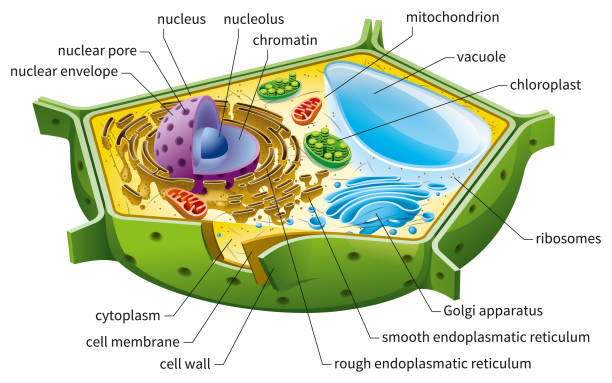
a. This is a plant cell because it contains mitochondria.
b. This is an animal cell because it contains mitochondria.
c. This is a plant cell because it contains a cell wall. d. This is an animal cell because it contains a cell wall.
c. This is a plant cell because it contains a cell wall.
400
Which statement correctly compares the roles of different types of organic molecules in the body?
a. Carbohydrates provide insulation for the body, while nucleic acids provide long-term energy storage.
b. Nucleic acids provide support and structure for the body, while carbohydrates provide insulation.
c. Lipids provide long-term energy storage for the body, while carbohydrates provide quickly available energy.
d. Proteins provide cushioning for organs, while lipids carry the body’s genetic information.
c. Lipids provide long-term energy storage for the body, while carbohydrates provide quickly available energy.
400
Which type of cellular transport requires a cell to use energy?
a. facilitated transport
b. active transport
c. diffusion
d. osmosis
b. active transport
400
Which of the following is a reactant in the chemical reaction of photosynthesis? CHOOSE ALL THAT APPLY!
a.CO2
b. O2
c. C6H12O6
d. H2O
a.CO2
d. H2O
400
What is a mutation?
a. a change in the genetic material of a cell
b. the specific sequence of bases in a molecule of DNA
c. the process by which a molecule of DNA makes a copy of itself
d. the perfect replication of a DNA molecule
a. a change in the genetic material of a cell
500
Which statement correctly describes cells produced through asexual reproduction?
a. They are genetically identical to their parents.
b. They do not grow and divide.
c. They do not contain genetic material.
d. They have a unique set of genetic instructions, unlike their parents.
a. They are genetically identical to their parents.
500
A runner needs a quick boost of energy while running a marathon. Which snack is the BEST option?
a. A hard-boiled egg, because it is rich in amino acids.
b. A hamburger, because fats store long-term energy.
c. An apple, because it contains fructose, a monosaccharide.
d. A piece of cheese, because proteins speed up chemical reactions.
c. An apple, because it contains fructose, a monosaccharide.
500
Which is a way in which exocytosis differs from the pumping of calcium ions against a concentration gradient?
a. Exocytosis is a form of passive transport.
b. Exocytosis does not involve a carrier protein.
c. Exocytosis occurs with the concentration gradient.
d. Exocytosis requires an expenditure of energy by the cell.
b. Exocytosis does not involve a carrier protein.
500
Suppose that a strand of DNA has the following sequence of bases: AAGTTC. What sequence of bases will the complementary strand of DNA have?
a.GGCAAT
b.GGTCCA
c.TTACCG
d.TTCAAG
d.TTCAAG
500
Consider this DNA nucleotide sequence:
ACG GTT CTA GAC
Which mutation will result in a frame shift?
a. substitution of T for the first A in the sequence
b. deletion of GTT from the sequence
c. insertion of C at the start of the sequence
d. substitution of ATA for ACG in the sequence
c. insertion of C at the start of the sequence