DNA
DNA Replication
RNA
Protein Synthesis
Cell Cycle
Genetics
100
What is DNA and where is it located? BE SPECIFIC!
DNA is the genetic material/coding instructions.
Inside the nucleus of Eukaryotic Cells.
Free flowing in the cytoplasm of Prokaryotic Cells.
100
What is DNA replication?
The process of DNA making a copy of itself before cell division.
100
Where is RNA located?
Both inside and outside of the nucleus (in the cytoplasm).
100
What are the monomers of Proteins?
Amino Acids
100
What step of mitosis is this?
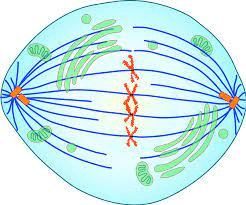
Metaphase- all the chromosomes lined up in the middle.
100
What is probability?
Probability is the likelihood that something will happen.
200
DNA is made up of repeating units called _________.
Nucleotides.
200
Where does DNA replication occur?
In the nucleus of Eukaryotic Cells.
200
RNA is made up of repeating units called ______.
Nucleotides
200
The step going from DNA to RNA in protein synthesis is called _______.
Transcription
200
What type of cells do mitosis?
Nonsex cells
200
True or False.
Homozygous dominant, homozygous recessive and heterozygous are all examples of phenotypes.
FALSE!
300
What are the three parts of a DNA nucleotide? BE SPECIFIC.
Deoxyribose sugar, phosphate group, nitrogen bases.
300
When does DNA replication occur?
In interphase, specifically S Phase.
300
What are the three parts of a RNA nucleotide?
Ribose sugar, phosphate group, nitrogen bases.
300
The step going from RNA to amino acids is called ______.
Translation
300
What are the three parts of interphase and what happens in each of them?
G1- Growth and development
S- DNA replication
G2- Prep for cell division
300
In people, freckles are dominant.
Use a Punnett square to determine allelic combinations among a woman who is heterozygous for freckles and a man who is homozygous recessive.
What is the probability of the offspring having freckles?
50%
400
What are the four nitrogen bases of DNA?
Adenine, Thymine, Cytosine, Guanine.
400
What is the final outcome of DNA replication?
TWO IDENTICAL DAUGHTER STRANDS.
400
What are the four nitrogen bases for RNA?
Adenine, Uracil, Cytosine, Guanine
400
In order to do translation, what do you need to use?
Codon Wheel/Chart
400
What is the difference between the cells created by mitosis and the cells created by meiosis?
Mitosis cells are genetically identical.
Meiosis cells are genetically diverse(different).
400
In sunflowers, fuzzy leaves are dominant over smooth leaves.
Cross a heterozygous sunflower for fuzzy leaves with a sunflower that is heterozygous for fuzzy leaves.
What RATIO of offspring will have fuzzy leaves?
What RATIO of offspring will have smooth leaves?
3/4 fuzzy leaves
1/4 smooth leaves
500
Using the base pairing rules, create the complementary DNA strand for.....
A T C G G C T A A C T G
T A G C C G A T T G A C
500
List the steps of DNA replication, be sure to name the enzymes involved.
1. DNA Helicase unzips the DNA helix.
2. Primase creates the starting line for DNA Polymerase.
3. DNA Polymerase builds the new nucleotides.
4. Ligase comes in to glue the DNA strands together.
FINAL OUTCOME: 2 identical semiconservative daughter cells.
500
What would the messenger RNA strand look like based on this DNA strand?
A T C G G C T A A C T G
U A G C C G A U U G A C
500
Translate the following mRNA into amino acids: AUG-ACA-UUC
Methionine-Threonine-Phenylalanine
500
What is the difference between mitosis, cell division and the cell cycle?
Mitosis is PMAT
Cell division is PMATC
Cell cycle is IPMATC
500
What is the relationship between genotypes, phenotypes and alleles?
Alleles are a variation of traits.
Genotypes are created by alleles.
Phenotypes are the physical representation of genotypes, the combination of alleles.