Genetics
Central Dogma
Evolution
Variety of Life and Ecology
100
If a certain animal's muscle cell has 28 chromosomes, how many chromosomes would that animal's zygote have?
28 (a zygotę is sperm + egg, so it is diploid. the muscle cell is diploid with 28, while sperm and egg are haploid with 14)
100
What are three differences between the structures of RNA and DNA
sugar: ribose vs. deoxyribose
strands: one strand vs. two strands
bases: CGAU vs. CGAT
100
What are the two Hardy-Weinberg equations?
p+q = 1
p^2 + 2pq + q^2 = 1
100
What are the two most important abiotic factors, and why?
water and temperature -- they determine what plants can survive, and therefore what other organisms can survive.
200
What three things occur during prophase?
Chromatin condenses to chromosomes
Centrioles activate and make spindle fibers
Nucleus dissolves
200
Describe each of the four levels of protein structure
Primary - amino acid strand, straight out of translation
Secondary - H bonds cause the formation of loops, alpha helices, beta sheets
Tertiary - polar/nonpolar interactions cause more folding
Quaternary - multiple tertiary structures come together to form large proteins
200
What is disruptive selection? Define it, and give an example.
both extremes of the trait are evolutionarily favored; for example, being very small to hide or very large to fight are advantageous, but being medium-sized is a disadvantage
200
List the taxa in order from broad to specific
domain kingdom phyla class order family genus species
300
You breed two heterozygous organisms. What is the probability (percent chance) of the offspring being homozygous recessive?
25%
300
What are the three types of point mutations, and what happens in each type?
Nonsense - creates a stop codon
Missense - causes a change to one amino acid
Silent- does not change the amino acid
*point mutations are changes to one base of DNA, but when that DNA is transcribed to mRNA, it is read 3 bases at a time (codon)*
*frameshift mutations are insertions and deletions, which cause the whole reading frame of codons to shift*
300
What are the three requirements to be considered members of the same species?
-ability to reproduce/interbreed
-viable offspring
-fertile offspring
300
What is a coelom, and what are two animal phyla that do not have a true coelom?
a body cavity
porifera, cnidarians, flatworms, nematodes (pseudocoelom)
400
What is the purpose of meiosis?
To go from a diploid cell to haploid gametes
400
What are promoters and operators, and what do they do?
Promoters are "landing strips," telling RNA polymerase where to bind
Operators are places for the repressor ("road block") to sit, which blocks transcription of the gene that comes afterwards.
400
What are two differences between natural and artificial selection
-choice in what individuals breed
-choice in what individuals survive/die
-speed
400
What is the difference between the nervous and the endocrine system?
The nervous system sends electrical signals, but the endocrine sends chemical signals.
500
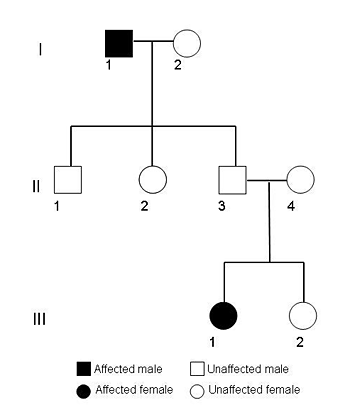 Does this pedigree show an autosomal dominant or autosomal recessive disorder? How do you know?
Autosomal recessive; individuals 3 and 4 do not have the disease, but have a child that does. This means they must be carriers, and dominant disorders do not have carriers.
500
What is the purpose of transcription? What is the purpose of translation? (mention what is used and created in each process)
Transcription uses DNA as a template to make mRNA. Translation uses mRNA and reads it at the ribosome using tRNA in order to build a string of amino acids (polypeptide strand, aka: primary structure of the protein).
500
How is evolution different from an individual adapting (changing acquired traits)?
Evolution requires gene/allele frequencies to change within a population over time.
500
Define the following groups: bacteria, archaea, protist, eukarya
bacteria - true bacteria; prokaryotic
archaea - more "advanced" bacteria that live in extreme environments
protist - single celled eukaryotic organisms; "throwaway category" of eukarya
eukarya - organisms made of eukaryotic cells (includes protists, fungi, plants, animals)