Fossil Record
Evidence of Evolution
Populations Change
Darwin's Theory
Other Ways to Change
100
Fossils of organisms that lived millions of years ago in environments that no longer exist support the idea of this type of change.
What is evolution?
100
This preserved remains or impression of an organism from the past provides direct evidence of common ancestry between species.
What is a fossil?
100
This element of natural selection refers to differences in traits among individuals in a population, often caused by genetic differences.
What is inherited variation (or genetic variation)?
100
Darwin's finches on the Galápagos Islands diverged into multiple species through this process, where different beak shapes were selected for based on available food sources.
What is natural selection (or adaptive radiation)?
100
In a bottleneck event, a population's size is drastically reduced. The surviving individuals have a smaller gene pool due to this mechanism.

What is genetic drift (Bottleneck effect)?
200
A fossil that shows characteristics of two different groups of organisms and provides evidence of the evolutionary link between them is called this.
What is a transitional fossil?
200
The gradual changes observed in fossil sequences of organisms like horses (from small, multi-toed ancestors to large, single-hooved modern horses) provide evidence that species share this.
What is common ancestry?
200
A population of rabbits can produce thousands of offspring, but only a few survive to reproduce. This demonstrates this element of natural selection.
What is the potential to produce more offspring than can survive or overproduction?
200
The process by which one ancestral species splits into two or more distinct species is called this.
What is speciation?
200
The movement of alleles from one population to another through migration is called this, and it can introduce new genetic variation.
What is gene flow?
300
A period of evolutionary stasis in the fossil record shows this type of change—or lack thereof—in a species over time.
What is no change (or stability/stasis)?
300
This field of study examines the geographic distribution of organisms and provides evidence that species with common ancestors dispersed to different locations.
What is biogeography?
300
In a forest with limited food, only the fastest rabbits catch enough prey to survive and reproduce. This demonstrates this element of natural selection.
What is competition for limited resources?
300
Over many generations, natural selection can cause populations to accumulate so many genetic differences that they are considered different species and can no longer do this.
What is interbreed or produce fertile offspring?
300
Random errors during DNA replication create new alleles in a population through this mechanism of evolution.
What is mutation?
400
The patterns of change shown in these graphs
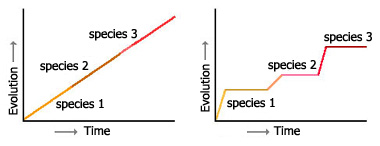
What are gradualism (left) and punctuated equilibrium (right)?
400
The forelimbs of whales, bats, humans, and cats have similar bone structures despite different functions, making them examples of this type of evidence for evolution.
What are homologous structures (or anatomical homologies)?
400
When organisms with beneficial traits produce more surviving offspring than organisms with less beneficial traits, this element of natural selection occurs.
What is differential reproductive success?
400
Darwin's finches on the Galápagos Islands diverged into multiple species through natural selection, where different beak shapes were selected for based on this.
What is the available food source?
400

What is genetic drift (or Founder effect)?
500
The pattern of change in the fossil record shown in this picture
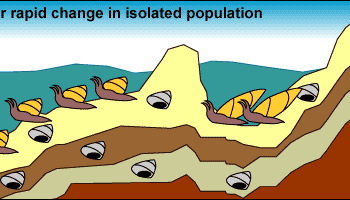
What is punctuated equilibrium?
500
The organism that would be the least related to humans based on the molecular data below.
What is the lamprey?
500
The graph that shows the selective pressure for the darker color

What is Graph C?
500
The reason these two frog species experience speciation is due to this factor.
What are the timing or different mating periods?
500
About 10,000 years ago, two populations of squirrels, the Kaibab squirrel and the Abert's squirrel, were separated from each other. Today, these squirrels are so different that they are unable to interbreed when brought together because this evolutionary process fails to occur.
What is gene flow between the two species (populations)?