Water Properties
Biomolecules
Biochem Basics
Enzymes
Scientific Investigation
100
Which property causes water molecules to stick to each other?
A. Cohesion
B. Adhesion
C. Universal solvent
D. High specific heat
A. Cohesion
100
Which biomolecule is the main source of quick energy for cells?
A. Lipids
B. Proteins
C. Nucleic acids
D. Carbohydrates
D. Carbohydrates
100
Which elements are found in all four major biomolecules?
A. Carbon, hydrogen, oxygen
B. Carbon, hydrogen, oxygen, nitrogen
C. Carbon, hydrogen, oxygen, phosphorus
D. Carbon, oxygen, nitrogen
A. Carbon, hydrogen, oxygen
100
What is the main function of an enzyme?
A. Store genetic information
B. Lower activation energy to speed up chemical reactions
C. Store long-term energy
D. Build cell membranes
B. Lower activation energy to speed up chemical reactions
100
A student investigates how temperature affects enzyme activity.
What is the independent variable?
A. Enzyme activity
B. Temperature
C. Time
D. Amount of enzyme
B. Temperature
200

Which property of water allows the insect to stay on the surface?
A. Universal solvent
B. High specific heat
C. Surface tension
D. Adhesion
C. Surface tension
200
A molecule has the following characteristics:
- Made of nucleotides
- Stores genetic information
Which biomolecule is being described?
A. Carbohydrate
B. Nucleic acid
C. Protein
D. Lipid
B. Nucleic acid
200
Which biomolecule contains phosphorus?
A. Carbohydrates
B. Lipids
C. Nucleic acids
D. Proteins
C. Nucleic acids
200

According to the diagram, which statement is true?
A. The enzyme is used up during the reaction.
B. The products become part of the enzyme.
C. The enzyme can be reused after the reaction.
D. The substrate can bind anywhere on the enzyme.
C. The enzyme can be reused after the reaction.
200
A student wants to test how different pH levels affect catalase activity.
Which variable should be kept constant?
A. pH
B. Amount of catalase
C. Reaction rate
D. Independent variable
B. Amount of catalase
300
A lake freezes during winter, but fish survive beneath the ice. Which statement best explains why?
A. Ice is denser than liquid water.
B. Ice floats because it is less dense than liquid water.
C. Water absorbs oxygen from ice.
D. Frozen water has a higher temperature than liquid water.
B. Ice floats because it is less dense than liquid water.
300
Which statement correctly compares carbohydrates and lipids?
A. Both are made of amino acids.
B. Carbohydrates store long-term energy, while lipids provide quick energy.
C. Carbohydrates provide quick energy, while lipids store long-term energy.
D. Both are the main component of cell membranes.
C. Carbohydrates provide quick energy, while lipids store long-term energy.
300
A student is building a protein.
Which monomer should the student use?
A. Fatty acids
B. Nucleotides
C. Monosaccharides
D. Amino acids
D. Amino acids
300
An enzyme was heated to 95°C. After cooling, the enzyme no longer worked. Why?
A. The enzyme ran out of energy.
B. The substrate disappeared.
C. The enzyme changed into a lipid.
D. The enzyme lost its shape and could no longer bind to the substrate.
D. The enzyme lost its shape and could no longer bind to the substrate.
300
A student collected the following data.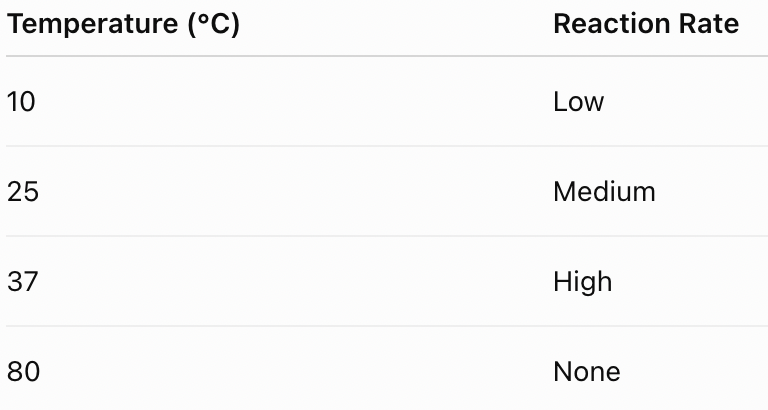
Which conclusion is best supported by the data?
A. Enzymes work best at all temperatures.
B. Higher temperatures always increase enzyme activity.
C. Enzyme activity increases to an optimum temperature and then decreases.
D. Temperature does not affect enzyme activity.
C. Enzyme activity increases to an optimum temperature and then decreases.
400
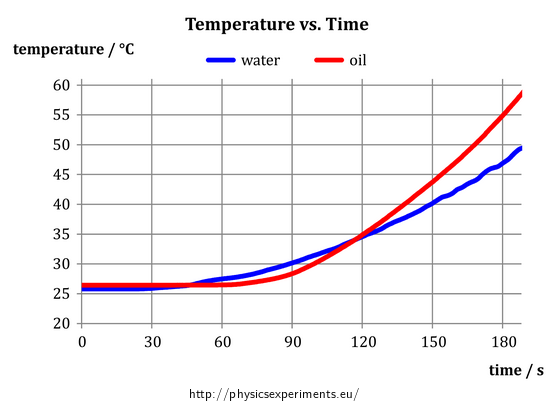
Which property of water is demonstrated by the graph?
A. Cohesion
B. Universal solvent
C. Surface tension
D. High specific heat
D. High specific heat
400
A scientist discovers a molecule with these characteristics:
- Made of amino acids
- Folds into a specific shape
- Speeds up chemical reactions in cells
Which conclusion is most likely correct?
A. The molecule is a protein.
B. The molecule is a nucleic acid.
C. The molecule is a carbohydrate.
D. The molecule is a lipid.
A. The molecule is a protein.
400
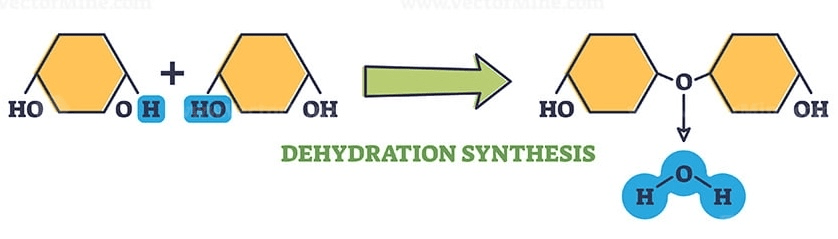
What happens during dehydration synthesis?
A. Water is added to break apart a polymer.
B. Water is removed to join monomers together.
C. Enzymes are broken into monomers.
D. ATP is stored inside a polymer.
B. Water is removed to join monomers together.
400
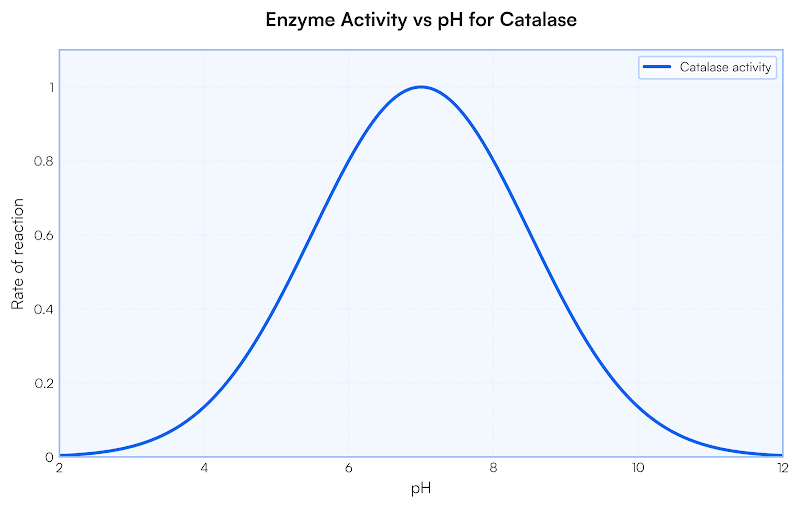
Based on the graph, which conclusion is best supported?
A. Enzymes work equally well at all pH values.
B. Changing the pH can affect the activity of an enzyme.
C. Higher pH always increases enzyme activity.
D. Enzymes only work in acidic environments.
B. Changing the pH can affect the activity of an enzyme.
400
A student investigates whether enzyme concentration affects reaction rate.
The student changes the enzyme concentration and the temperature during the same experiment.
Why is this a poor experimental design?
A. The dependent variable was measured incorrectly.
B. More than one variable was changed.
C. The enzyme should have been replaced with a lipid.
D. The reaction should have been done without a substrate.
B. More than one variable was changed.
500
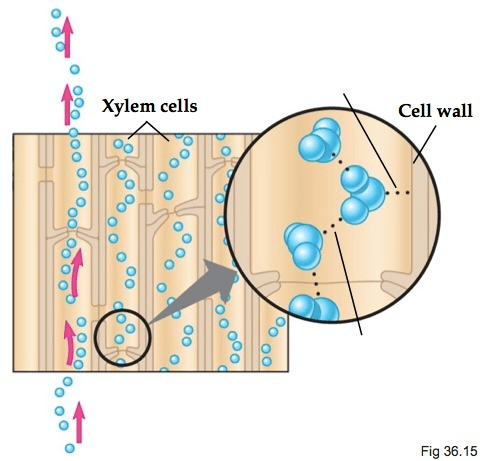
Which statement best explains how water moves through the plant?
A. Water molecules dissolve the xylem walls.
B. Cohesion between water molecules and adhesion to the xylem walls pull water upward.
C. Surface tension forces water through the stem.
D. Ice formation pushes water toward the leaves.
B. Cohesion between water molecules and adhesion to the xylem walls pull water upward.
500
A student examines four unknown biomolecules.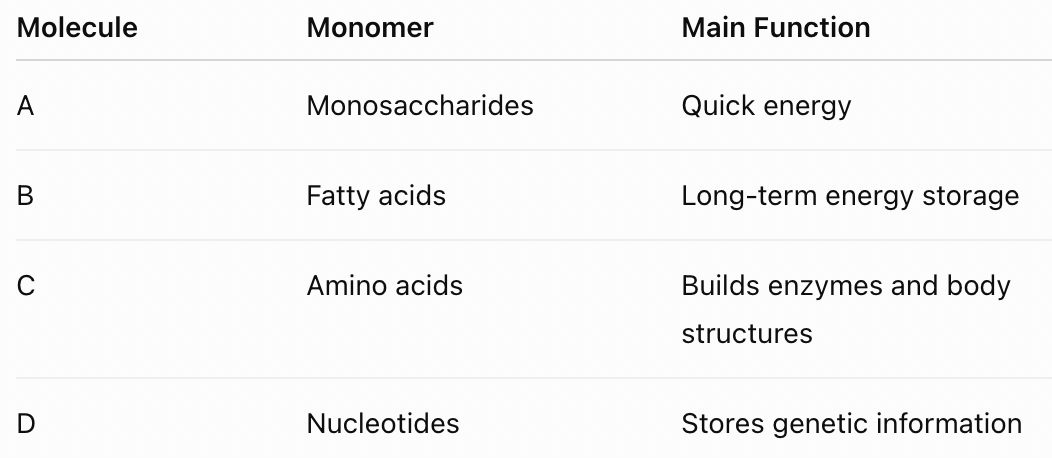
Which molecule would most likely be found in large amounts in muscle tissue?
A. Molecule A
B. Molecule B
C. Molecule C
D. Molecule D
C. Molecule C
500
A scientist discovers a molecule with the following characteristics:
- Contains carbon, hydrogen, oxygen, nitrogen, and phosphorus
- Built from nucleotides
- Stores genetic information
Which biomolecule is being described?
A. Protein
B. Lipid
C. Nucleic acid
D. Carbohydrate
C. Nucleic acid
500
A scientist tested an enzyme at four temperatures.
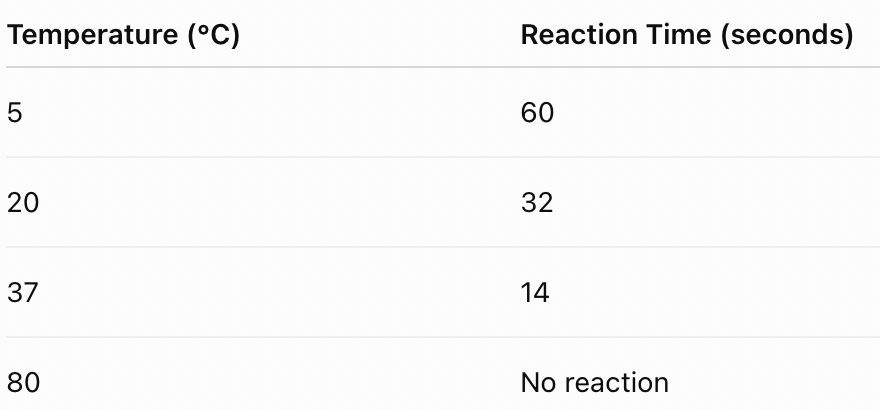
Which statement best explains the results?
A. The enzyme worked best at low temperatures.
B. The substrate was completely used up at 80°C.
C. The enzyme was denatured at 80°C, preventing the reaction.
D. The enzyme produced too much activation energy at 80°C.
C. The enzyme was denatured at 80°C, preventing the reaction.
500
A student wants to investigate how pH affects enzyme activity.
Which experimental setup would produce the most reliable results?
A. Test one pH with one trial.
B. Test several pH levels while keeping temperature and enzyme concentration constant and perform multiple trials.
C. Change both pH and temperature for each trial.
D. Use a different enzyme for every pH tested.
B. Test several pH levels while keeping temperature and enzyme concentration constant and perform multiple trials.