Category 1
Category 2
Category 3
Category 4
Category 5
100
Which statement is true:
A: Lift force acts parallel to the flow of air/water
B: Drag force acts perpendicular to the flow of air/water
C: For an object to float, it needs to displace an amount of water that weighs less than itself
D: To reduce the impact of drag, swimmers use skills such as streamlining
D: To reduce the impact of drag, swimmers use skills such as streamlining
100
What best describes the term ‘balance’ ?
A: Balance is your ability to control your body with movement against gravity.
B: Balance is your ability to control your body after movement and return it a desired position after being disturbed.
C: Balance is your ability to control your body without movement against gravity.
C: Balance is your ability to control your body without movement against gravity.
100
What best describes centre of gravity?
A: A point where the combined mass of a body seems to be concentrated, it can lie within or outside of an object or person, changing body position affects centre of gravity.
B: Lowering centre of gravity increases stability, it can only lie within an object or person, changing body position affects centre of gravity.
C: A point where the combined mass of a body seems to be concentrated, it can only lie within an object or person, changing body position does not affect centre of gravity.
A: A point where the combined mass of a body seems to be concentrated, it can lie within or outside of an object or person, changing body position affects centre of gravity.
100
To improve stability the line of gravity should:
A: Be short in length and fall within the base of support
B: Be long in length and fall within the base of support
C: Be short in length and fall outside the base of support
A: Be short in length and fall within the base of support
100
What describes the most stable position in the pictures?
A: Wide BOS, LOG within BOS, lowest COG
B: Narrow BOS, LOG falls outside BOS, raised COG
C: Wide BOS, LOG falls just inside BOS, raised COG
D: Narrow BOS, LOG within BOS, lowest COG
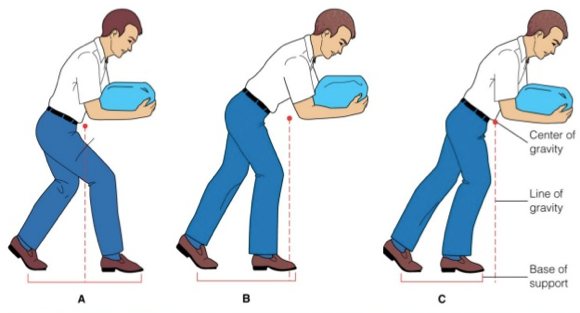
A: Wide BOS, LOG within BOS, lowest COG
200
Which is a true example of linear motion?
Running 100 m
Swimming 50 m
Downhill skier
A gymnast on the uneven bars
Downhill skier
200
How much momentum does an object with a mass of 100 kg and a velocity of 5 m/sec have?
500 kg m/s
20 kg m/s
200 kg m/s
50 kg m/s
500 kg m/s
200
How much force is generated by an object with a mass of 75 kg and and acceleration of 3 m/s2 ?
25 N
225 N
78 N
250 N
225 N
200
Which athlete is the most balanced?
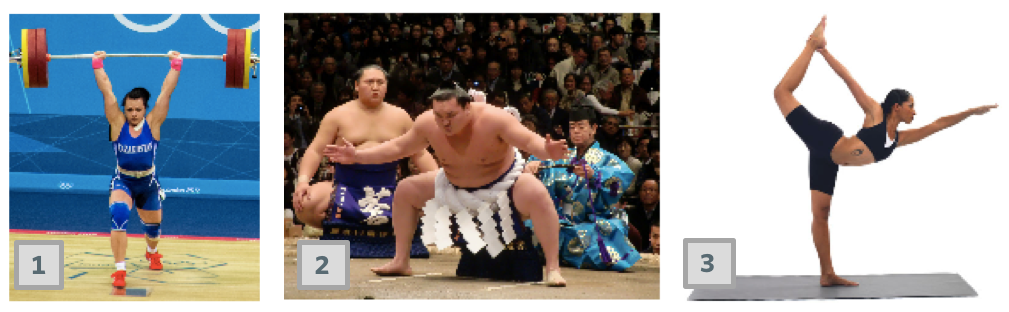
1
2
3
1, 2 and 3 have equal balance.
B. 2
200
The Magnus effect is a phenomenon that imparts an additional force on a:
A: Streamlined Object
B: Floating Object
C: Spinning Object
D: Sinking Object
C: Spinning Object
300
If an athlete runs 400 m on an Olympic track in 40 seconds, what is their velocity and speed respectively?
Zero and 10 m/s
300
Drafting in cycling is used to reduce:
A: Magnus effect
B: Drag force
C: Lift force
D: Flotation
B: Drag force
300
Complete the following sentence:
In order for an object to ______, the water they ________ must _______ more than they do.
In order for an object to float, the water they displace must weigh more than they do.
300
To minimise resistance forces that oppose movement in fluid mediums, four key areas are considered.
List the four areas.
Technique, Tactics, Clothing and Equipment Design
300
Complete the following sentence:
The ________ explains why ______ objects deviate from their ________ path.
When an object is _______ or _______ into the air, its _______ motion causes a whirlpool of ______ around it that attaches to the object.
The Magnus effect explains why spinning objects deviate from their flight path such as cricket/golf balls.
When an object is bowled or hit into the air, its spinning motion causes a whirlpool of fluid around it that attaches to the object.