Linear Momentum
Impulse
Collisions
COLM 1-D
COLM 2-D
100
The units of linear momentum.
What is kg*m/s?
100
The definition of Impulse.
What is the product of a force acting over a time interval?
100
A collision where momentum is conserved but not kinetic energy.
What is Inelastic Collision?
100
The law that allows us to derive COLM.
What is Newton's 3rd Law?
100
The only difference between COLM 1-D and COLM 2-D.
What is one dimension?
200
Symbolically, the difference between the linear momentum of an object and the linear momentum of a system.
What is p and P?
200
The law we can apply to derive Impulse-Momentum Theorem from the definition integral of Impulse (Eqn 41).
What is Newton's 2nd Law?
200
The quantities conserved in an elastic collision.
What are linear momentum and kinetic energy?
200
An assumption that leads to only a change in velocity causing a change in momentum.
What is a closed system?
200
Why we can break down linear momentum into x and y components.
What is the independence of motion in perpendicular axes?
300
Linear momentum is a vector quantity with magnitude and direction. The direction of this quantity gives linear momentum its direction.
What is velocity?
300
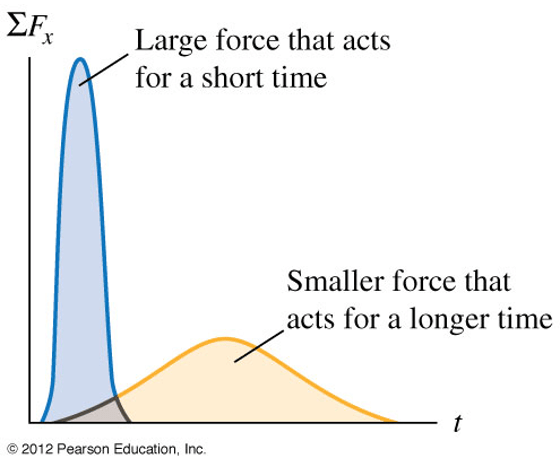 The curve with the larger impulse?
What are they have the same Impulse?
300
The type of collision results in the maximum loss of kinetic energy?
What is a completely inelastic collision?
300
The tool we use to help us apply COLM to solve problems involving collisions or interactions.
What is a "Just Before" and "Just After" diagram?
300
A 1.80 kg falcon is diving at 28.0 ms−1 at a downward angle of 35.0◦. It catches a 0.650 kg dove from behind
in midair. Calculate the combined velocity after impact if the dove’s initial velocity was 7.00 ms−1 directed
horizontally.
What is 22 m/s @ 32 degrees below +x axis?
400
The two types of notation linear momentum can be written in.
What is magnitude angle and unit vector notation?
400
Why the egg broke against the wall, but not against the sheet.
What is the time of collision was smaller against the wall, resulting in a larger average force that exceeded the shells capacity?
400
In an explosion, _______ is conserved and _________ increases.
What is linear momentum and kinetic energy?
400
The final velocity of the blue pack after two hockey pucks of identical mass on a flat, horizontal ice hockey rink collide. Initially, the red puck is motionless, and the blue puck is moving at 2.5 m/s to the left. After the collision, the red puck is moving at 2 m/s to the left. The pucks have a mass of 15 g.
What is .5 m/s?
400
If two objects of equal mass are moving with equal and opposite velocities when they collide. Can all the kinetic energy be lost in the collision?
What is Yes!
500
A system of two objects, each with individual linear momentum of p_1=(10 i-5 j) (kg∗m)/s and p _2=(-6i+7 j) (kg∗m)/s. What is the linear momentum of the system?
What is P = (4i +2j) (kg*m/s)?
500
The average force when Captain Picard commands, “Take us out,” the starship Enterprise (Figure 9.11) starts from rest to a final speed of 𝑣f=7.5×10^7m/s. Assuming this maneuver is completed in 60 s.
What is 2.5 x 10^15 N?
500
"Hit and Stick" also refers to this type of collision.
What is completely inelastic?
500
The final velocity of two train cars that are coupled together by being bumped into one another. Suppose two loaded train cars are moving toward one another, the first having a mass of 1.50×10^5kg and a velocity of (0.30m/s)𝐢, and the second having a mass of 1.10×10^5kg and a velocity of (-0.12m/s)𝐢.
What is (0.122m/s)𝐢 ?
500
The velocity of the third piece after a 200. kg rocket in deep space moves with a velocity of v = (121 m/s)ı + (38.0 m/s)ȷ explodes into 3 pieces. The first piece, with a mass of 78 kg, moves with a velocity of v 1 = −(321 m/s)ı +(228 m/s)ȷ. The second piece, with a mass of 56 kg, moves with a velocity of v2 = (16.0 m/s)ı − (88.0 m/s)ȷ.
What is Vf = (732i - 79.6j) m/s?