Muscle Fibers
Muscle Fibers/Muscle Contractions
Muscle Contractions
Factors of Muscle Contractions 1
Factors of Muscle Contractions 2
100
What element has to be released in order to start muscle contractions?
Calcium, Ca+2
100
Do thick and thin filaments ever change length during muscle contractions?
No, they just overlap.
100
What controls all muscle contractions?
The Brain.
100
200 point question:
What is Load in muscular biology?
What is Recruitment in muscular biology?
Load: Weight put on a muscle.
Recruitment: How many motor units are involved in the muscle contraction.
100
What is the difference between Aerobic and Anaerobic?
Aerobic uses oxygen and Anaerobic does not use oxygen.
200
What are thinner Myofilaments called?
Actin.
200
What is happening in the pictures below?
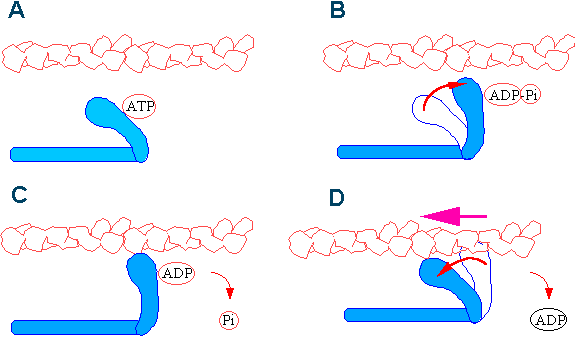
Cross Bridging.
Make sure for the test you could put these 4 images in order from 1-4 if they are mixed up in order.
200
When do muscle contractions end?
When cross-bridging ends
200
What is the ONLY thing that determine the force of your muscle contraction?
How many cross-bridges activate.
200
What type of pathway is faster for muscle contractions: Aerobic or Anaerobic?
Anaerobic.
300
What are thicker Myofilaments called?
Myosin.
300
What is Cross-Bridging?
When myosin heads link thick and thin filaments together.
300
What happens in the Sliding Filament Model of muscle contractions?
Thick and Thin myofilaments overlap with each other decreasing the total length of the sarcomere.
300
What kind of muscle fibers use aerobic pathways and are responsible for short term/powerful movements?
Type 2-B: Fast Glycolytic Fibers.
300
What type of muscle fibers use aerobic pathways and are responsible for low intensity and endurance activities?
Type 1: Slow oxidative fibers
400
What are the three special organelles that muscle cells have?
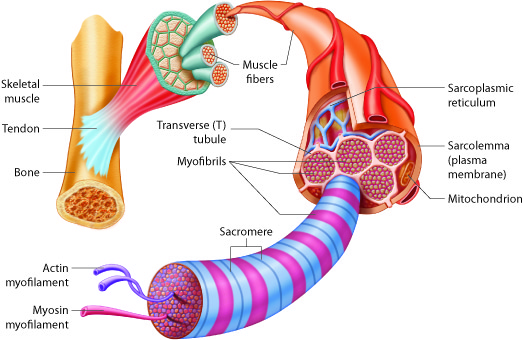
Myofibrils, Sarcoplasmic Reticulum, and T-Tubules.
400
On the blank diagram provided by Mr. Breitenfeld, label the Skeletal Muscle, the fascicles, the individual Muscle Fibers, where the Myofibrils are, label the Sarcoplasmic Reticulum, The T-Tubule, and the Actin and Myosin Filaments
400
Put these step to muscle contraction in order from 1-4:
_____ The message from the brain goes to the T-tubule and causes the release of calcium ions. The calcium ions start the chain reaction that causes heads of the thick myofilaments to interlock with the thin myofilaments.
_____ The shrunken membrane allows for the action potential (the message from the brain) to go across the entire sarcolemma.
_____ The nerve receives a signal from the brain. This causes the release of a neurotransmitter (fancy chemical) that stimulates the skeletal muscle. This causes the membrane (sarcolemma) to shrink.
_____ Cross bridging then occurs to finish the process of muscle contraction.
1. The nerve receives a signal from the brain. This causes the release of a neurotransmitter (fancy chemical) that stimulates the skeletal muscle. This causes the membrane (sarcolemma) to shrink.
2. The shrunken membrane allows for the action potential (the message from the brain) to go across the entire sarcolemma
3. The message from the brain goes to the T-tubule and causes the release of calcium ions. The calcium ions start the chain reaction that causes heads of the thick myofilaments to interlock with the thin myofilaments.
4. Cross bridging then occurs to finish the process of muscle contraction.
400
What are the two factors that play a role in how fast and how long a muscle will contract?
What type of muscle fiber is being used + load and recruitment.
400
What kind of muscle fiber uses both aerobic and anaerobic pathways and is responsible for medium intensity activities?
Type 2-A: Fast oxidative fibers.
500
What are the three main features of Myofibrils?
Striations, divided into sarcomeres, and have Myofilaments.
500
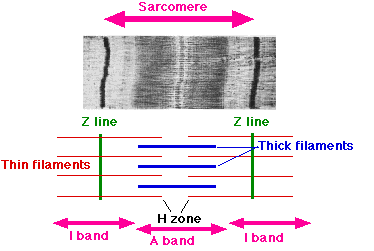
Come up to the board and label the drawing of the sarcomere on the board above. Label all the important zones/bands and all proteins.
500
What is an Action Potential?
A rapid, temporary reversal of an electric charge across a neuron's or muscle cell's membrane, acting as an electrical impulse for signaling.
500
What are three things that affect how many cross-bridges will activate?
The number of muscle fibers stimulated, The relative size of the muscle fibers, the frequency of stimulation, and the degree of muscle stretch.
500
800 point, 4 Part Question:
What is muscle Hypertrophy?
When will Hypertrophy occur?
What is muscle Atrophy?
When will Atrophy occur?
Hypertrophy is increase in muscle size and happens when muscles are stimulated frequently .
Atrophy is decrease in muscle size and happens when muscles are not stimulated frequently.