Skeletal System
Muscular System
Nervous System
Circulatory System
Digestive System
100
We have 300 of these when we are born.
Bones
100
This is also known as a Pulled Muscle.
What is a Muscle Strain
100
These are the Four Types of Reactions
What are...
Fight - aggressive response
Flight - avoid and flea
Freeze - do nothing
Fawn - do everything one can to avoid conflict
100
These compose the Circulatory System. (choose one of the following)
a) The heart, blood, and blood vessels
b) The heart, the brain, and the lungs
c) The brain, the heart, and the blood vessels
d) The lungs, the blood, and the blood vessels
a) The heart, blood, and blood vessels
100
The body needs this to survive.
What is food
200
This is also known as the chest bone.
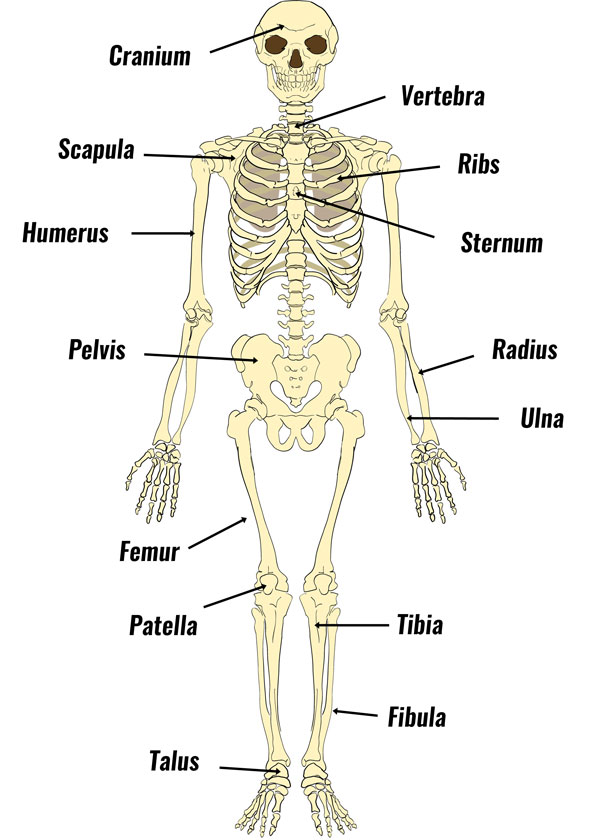
What is the Sternum
200
The muscle located at the front of your upper arm. (Think of anatomical position)
what is the Bicep
200
These are included in the Central Nervous System (CNS).
What are Brain and Spinal cord
200
These carry blood away from the Heart.
What are Arteries
200
Adults have between 2000 and 4000 of these in total. They renew once a week.
What are Taste Buds
300
These are the two bones that stick out near the neck. They make up your shoulders.
What are Clavicles
300
The heart muscle beating, is an example of a(n) _________ muscle.
What is an Involuntary muscle
300
Humans have billions of these.
What are Neurons
300
This is the smallest Blood Vessel.
What are Capillaries
300
Most of the Digestive Process takes place here.
Where is the Small Intestine
400
This is Bone Marrow.
What is the soft, spongy tissue that has many blood vessels and is found in the center of most bones
400
The connected tissue that attaches muscle to the bone.
What is a tendon.
400
The two divisions of the Nervous System.
What are Central Nervous System and Peripheral Nervous System
400
The Four main Blood Groups.
What are A, B, AB, and O
400
The path food takes, as it goes through the digestive system.
What is Mouth, Esophagus, Stomach, Small Intestine, and Large Intestine
500
This bone is named for a Greek line of battle formation. (choose one of the following)
a) Scapula (Shoulder Blade)
b) Phalanges F. (Fingers)
c) Femur (Thigh Bone)
d) Phalanges T. (Toes)
b) Phalanges F. (Fingers)
500
This group lines the organs and helps in digestion and breathing.
What is the Smooth Muscle group
500
These are Four Lobes of the Brain.
What are Frontal, Temporal, Parietal, and Occipital
500
Blood carries _____ and _____ to the cells of the body.
What are food and oxygen
500
These produce saliva, used to moisten your mouth.
What are Salivary Glands