Ionic Bonds
Covalent Bonds
Polar Bonds/Molecules
Intermolecular Forces
100
What Is A Cation?
A positively charged ion. This happens when an atom loses an electron it becomes positively charged.
100
What Is A Covalent Bond?
A covalent bond is a chemical bond between two non-metal atoms that share pairs of electrons.
100
What Are Polar Bonds?
Polar bonds are bonds between two atoms that have significantly different electronegativities. Ranging from 0 to 1.7. This means they do not share electrons equally.
100
What Are I.M.F?
Intermolecular forces are attraction and repulsion forces that exist between molecules that cannot be broken.
200
What Is An Anion?
A negatively charged atom. This happens when an atom gains an electron.
200
Nitrogen and Oxygen Will Create What Type Of Bond?
A Covalent Bond
200
A Polar Bond Is Also Know As?
An Ionic Bond
200
How Do Dipole-Dipole Interactions Work?
D.D interactions occur when a partial positive and negative charge from a molecule create an attraction known as a dipole between them. Then, as another molecule approaches with it's own dipole, the opposite charges from both molecules begin to attract creating a permanent double dipole bond. This bond increases attraction between both molecules.
300
What Is An Ionic Bond?
An Ionic Bond is a chemical bond that occurs when a positively charged ion forms a bond with a negatively charged ion and they transfer electrons between eachother.
300
What is a non-polar covalent bond?
It is a bond between two non-metals that have very similiar or almost exact electronegativities and therefore have equal sharing over the bonding electron pair.
300
How Are Polar Bonds Formed?
Polar bonds are formed by a more covalent bond between two atoms with different electronegativties. The atom with the higher electronegativity will attract the electrons away from the atom with the lower electronegativity. The atom that loses electrons will develop a positive charge while the atom that gains an electron will have a negative charge. The electrostatic attraction between opposite charges is what creates and is a polar bond.
300
How Do Hydrogen Bonds Work?
Hydrogen bonding occurs between two polar molecules consisting of a hydrogen atom bonded with either an oxygen, fluorine or nitrogen atom. What happens in this bond is that the positive and negative partial charges create a dipole and become attracted to the other dipole in the other element. This creates a very strong dipole-dipole interaction because the electronegativity difference between them is very high.
400
Magnesium And Oxygen Will Create What Type Of Bond?
An Ionic Bond
400
What Is The Most Famous Covalent Bond?
H2O or Water
400
What Are The Electronegativities Differences To Consider When Determining Polarity?
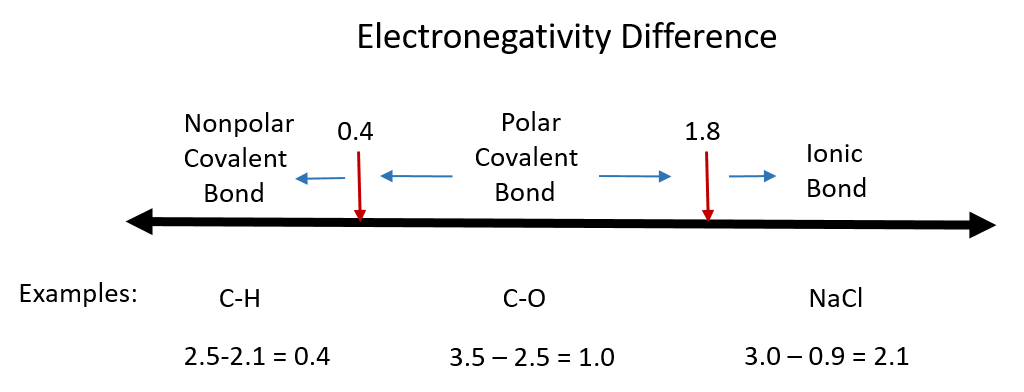
400
How Do London Dispersion Forces Work?
L.D.F can occur between essentially any molecule but mostly non-polar molecules. L.D.F happens when a cloud of negative charges moves to one side of the molecule creating an uneven balance of negative charges on one side of the molecule. One side of the molecule becomes more positive than the other negative side. This results in the creation of a temporary dipole. When another molecule is present, this temporary dipole can induce another temporary dipole in another molecule resulting in a weak dipole-dipole interaction.
500
How Do Ionic Bonds Form?
Ionic bonds are formed from an electrostatic attraction between large arrays of oppositely charged ions. This bond forms when the valence electrons from one atom transfer to another atom. One atom will lose a valence electron which results in that atom becoming charged positively and the atom that gains the electrons will be charged negatively. The attraction of opposite charges creates the strong polar ionic bond.
500
How Do Covalent Bonds Form?
Covalent bonding is a result of two atoms sharing a pair of electrons. They can only form between two non-metals. Atoms that are covalently bonded seek to become stable. Atoms will share or receive atoms from their valence shell in order to gain stability and form a full valence shell. Atoms with similar electronegativities will form covalent bonds.
500
What Is A Polar Molecule?
A polar molecule is a molecule that exists when both tests are passed:
1- The molecule contains polar bonds
2- The polar bonds pull electrons from the central atom unevenly
500
Rank The Strength Of The 3 I.M.F
Strongest To Weakest
1. Hydrogen Bonds
2. Dipole-Dipole
3. London Dispersion Forces