Gotta Go!
Urine for a Treat
Under Pressure
Emesis Nemesis
Tame that Flame
100
Psyllium
Bulk forming laxative
100
This potassium wasting class of diuretics that includes Furosemide (Lasix) has side effects that include ototoxicity, hyperglycemia and hypereuricemia
Loop Diuretics
100
This class of blood pressure medications has the unwanted side effect of a dry cough that requires the patient to discontinue use.
ACE Inhibitors
100
This anti nausea drug shoud be used cautiously as it can cause QT prolongation that can lead to a dangerous cardiac arrythmia called Torsades de Pointes
Ondansetron (Zofran)
100
This drug class commonly used to treat GERD, works by inhibiting acid secretion but increases the user's risk for osteoporosis
Proton Pump Inhibitors (PPI)
200
Polyethylene Glycol (PEG)
Osmotic Laxative
200
This class of diuretics, which includes HCTZ, has a common side effect of photosensitivity
Thiazide diuretics
200
Angiotensin II Receptor Blockers or ARBS, commonly have this suffix
-SARTAN
200
This antiemetic works by blocking dopamine receptors in the chemoreceptor trigger zone and can cause CNS depression as a side effect
Prochlorperazine (Compazine)
200
Calcium Carbonate, more widely known as TUMS, belongs to this drug class
Antacids
300
Bisacodyl
Stimulant Laxative
300
Spironolactone is this type of diuretic
Potassium sparing
300
This type of Beta blocker should be used with caution in patients with lung disease
Non-selective Beta blockers (Propranolol)
300
This prokinetic drug that is also used to treat nausea can have the unwanted side effect of extrapyramidal symptoms
Metoclopramide (Reglan)
300
PPIs increase the risk of developing this type of infection in the gut that can be extremely hard to treat
Clostridium Difficile (C. Diff)
400
Docusate
Stool softener
400
The EKG findings below are signs of this electrolyte imbalance

Hypokalemia
400
This class of blood pressure medication is commonly used for its nephroprotective effects in diabetic patients
ACE inhibitors
400
Dronabinol (Marinol) belongs to this drug class that can be used to help with nausea and increase the appetite in patients recieving chemotherapy
Cannabinoids
400
Sucralfate belongs to this drug class that acts like a bandaid by adhering to ulcerated areas in the stomach
Mucosal Protective Agents or Cytoprotective Agents
500
Mineral Oil
Lubricant Laxative
500
The EKG findings below are signs of this electrolyte imbalance
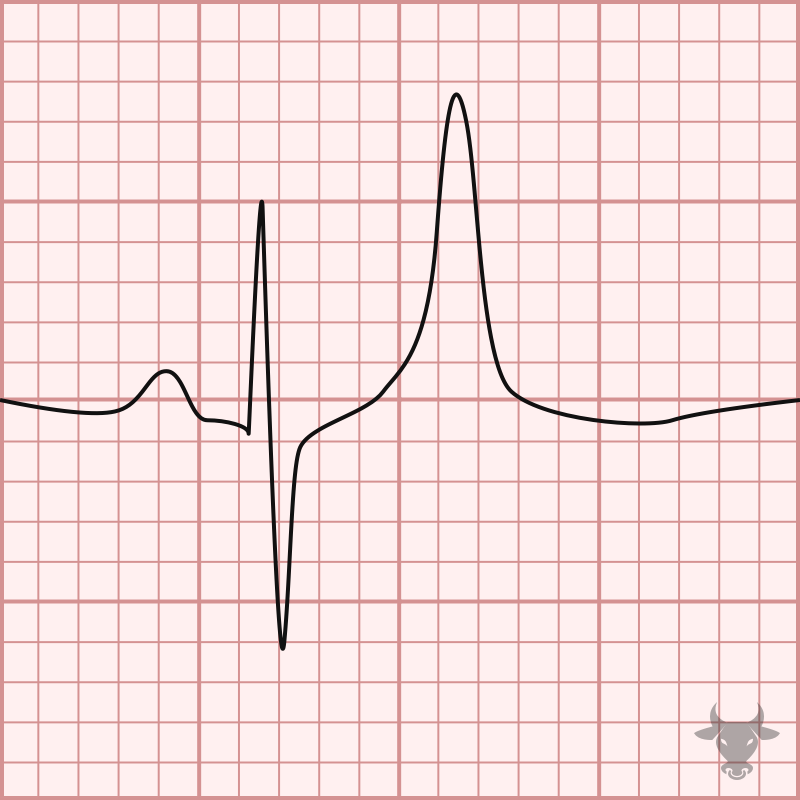
Hyperkalemia
500
This class of cardiac medication is frequently used for its antihypertensive effects but can also be used to treat angina and dysrhythmias
Calcium Channel Blockers (CCB)
500
This drug used to treat nausea carries a blackbox warning for severe tissue injury and gangrene caused by extravasation or accidental leakage of a tissue damaging substance from an IV into the surrounding tissue
Promethazine (Phenergan)
500
Famotadine is this type of drug commonly used to treat PUD and GERD but should be used cautiously in patients taking Warfarin
Histamine 2 Receptor Blockers or Antagonists