It's Electric
Brrr, it's Cold in Here
These chemicals hit me like white wine
It's Getting Hot in Here
Staying Alive
100
Name 2 tests that you must obtain if concerned for electrical injury.
EKG
Cardiac monitoring
Cardiac enzymes
Creatine kinase
Urinalysis for myoglobin
100
What is the optimal timeline for surgical excision/amputation in frost-bite?
Weeks to months
100
What is a systemic side effect of phenol burns?
Cardiac toxicity
Treat with polyethylene glycol.
100
What bacteria are burn patients especially susceptible to?
Pseudomonas aeruginosa
100
Burns > ___ % TBSA in adults and ___ % TBSA in pediatrics require resuscitation protocol.
20% TBSA in adults
15% TBSA in pediatrics
200
A pressure gradient greater than ___ mmHg is an indication to perform fasciotomy.
A pressure gradient greater than 30 mmHg is an indication to perform fasciotomy.
200
What is the difference between passive and active rewarming? Which do you use for frostbite treatment?
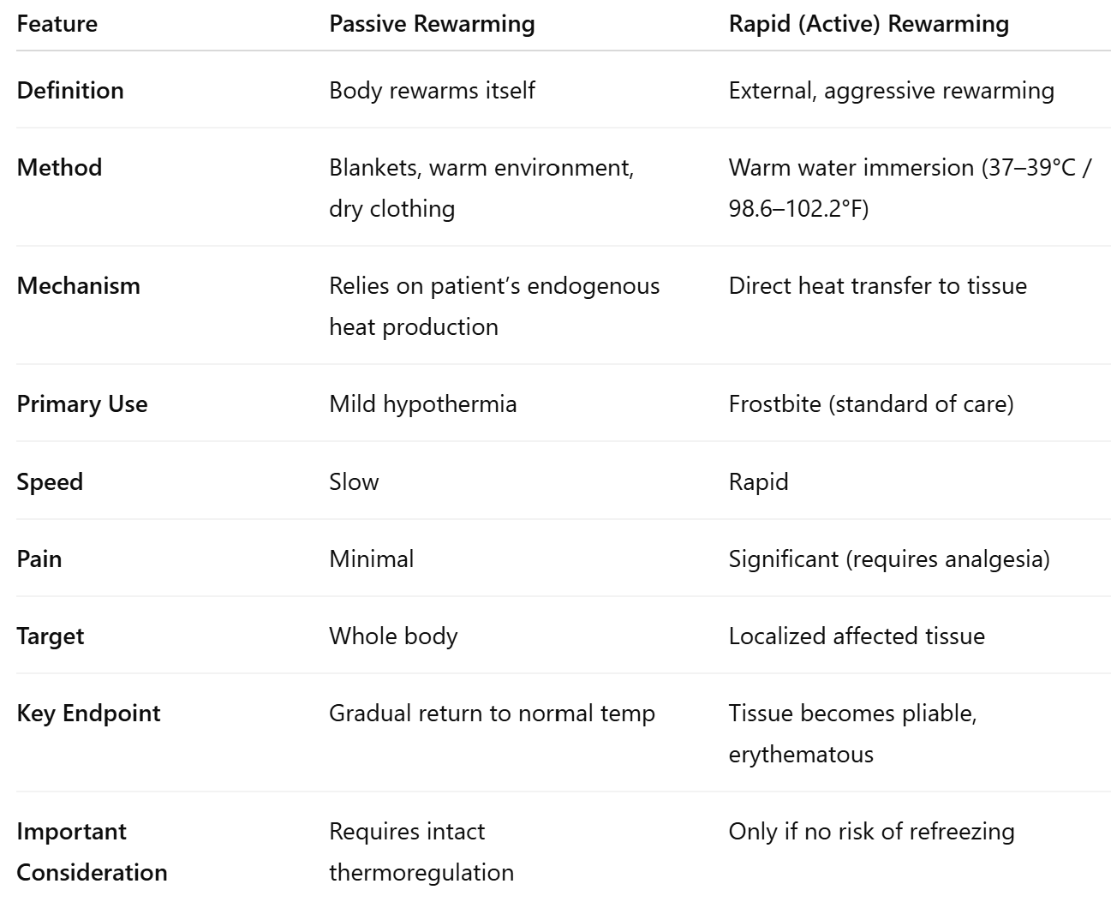
200
What is the first-line treatment in cyanide poisoning?
Hydroxocobalamin
Binds cyanide --> forms cyanocobalamin (vit B12) --> excreted in urine
200
What is the Baux score mortality estimation?
Age + TBSA = % Mortality
Historically thought of as rough estimate of mortality, but model consistently overestimates mortality now.
200
What vitamin is thought to help stabilize endothelial injury seen in burn shock?
Vitamin C
Tanaka et al found that vitamin C administered at a rate of 66 mg/kg/h limited the crystalloid requirement for initial resuscitation.
300
Name the voltage that differentiates high from low-voltage burns.
High-voltage burns > 1000 V
Low-voltage burns < 1000 V
300
What class of medication has been shown to improve salvage if used within the first 24 hours after injury?
Thrombolytics (tPA)
300
Fireworks, industrial accidents, and military munitions are examples of what kind of chemical burn?
White phosphorous
- Stains with copper sulfate or can see with ultraviolet light
- Treatment - surgical excision
300
Name the various burn depths, layers affected, and their clinical characteristics.
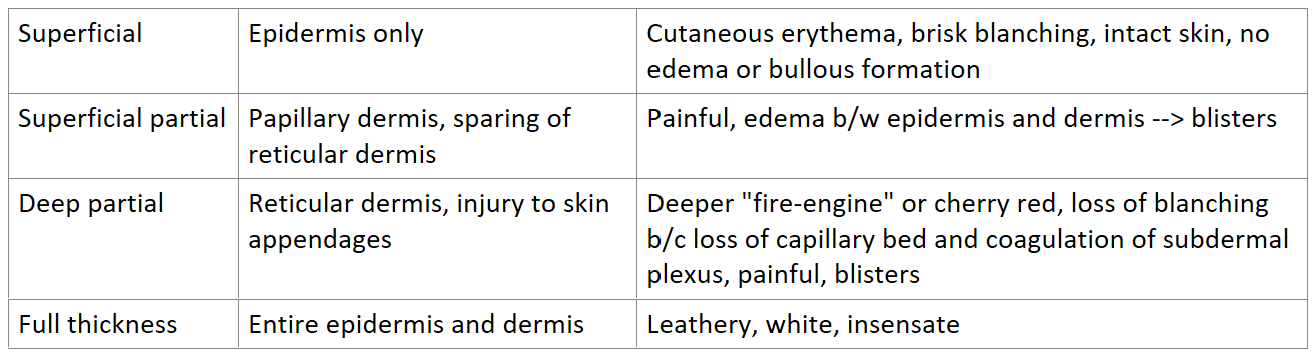
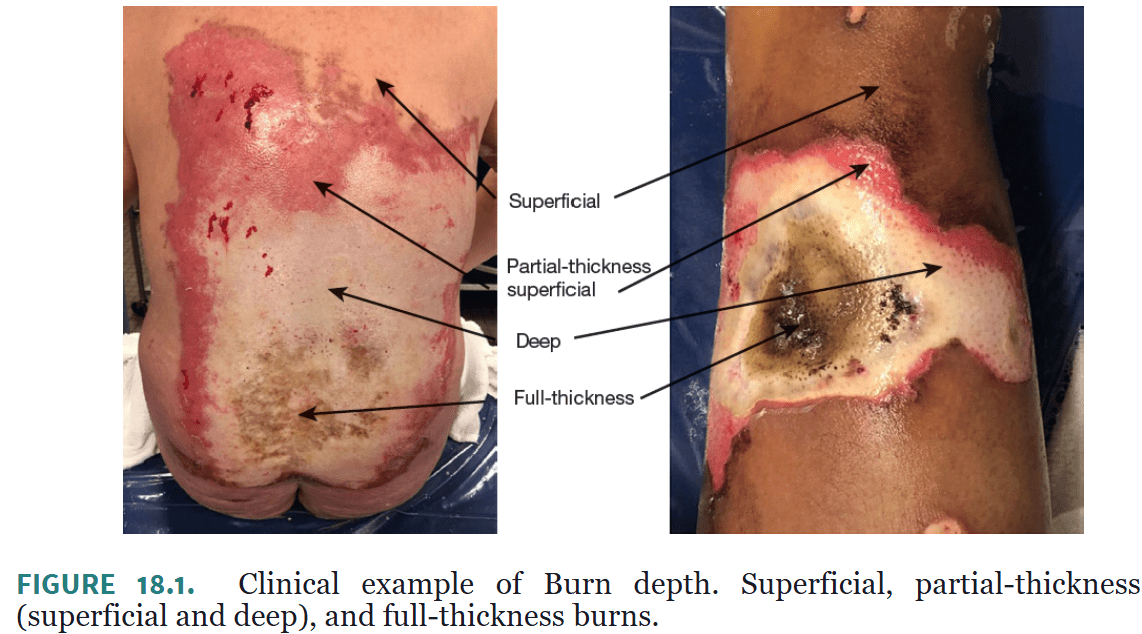
300
Name the notable side effect for each of the following burn treatments:
Mafenide acetate (sulfamylon)
Silver sulfadiazene
Silver nitrate
Mafenide acetate - metabolic acidosis
MA
Silver sulfadizene - leuopenia
deen - peen
Silver nitrate - Hyponatremia
Na
400
In an electrical burn to the hand, which 2 muscles are at most risk for necrosis?
Deep flexor compartment:
- Flexor digitorum profundus (FDP)
- Flexor pollicis longus (FPL)

400
What prostacyclin analog is used in some centers as an alternative to thrombolytics for severe frostbite? (e.g. presentation > 24 hrs after injury)
Iloprost
- Vasodilator + inhibits platelet aggregation
- Improves microcirculatory flow in ischemia tissue
400
Alkaline burns cause ______ necrosis.
Acid burns cause _____ necrosis.
Alkaline burns cause liquefactive necrosis.
Acid burns cause coagulative necrosis.
Alkaline burns are typically more severe because coagulative necrosis is irreversible. In contrast, acid burns are somewhat reversible with immediate and significant dilution.
400
What is this person's TBSA?
Entire left arm with deep partial thickness burn
Entire right arm with superficial
Half of anterior torso with superficial partial thickness
Anterior left leg with deep partial thickness
No full thickness burns
9+9+9 = 27
Entire left arm with deep partial thickness burn (9)
Entire right arm with superficial (0)
Half of anterior torso with superficial partial thickness (9)
Anterior left leg with deep partial thickness (9)
No full thickness burns (0)
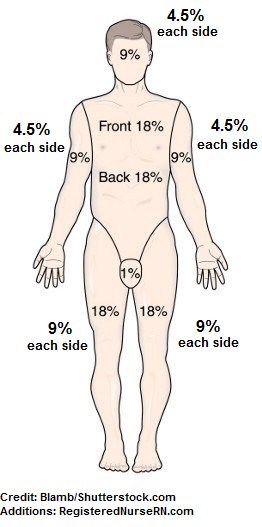
400
A 47-year-old, 50-kg otherwise healthy woman presents to the trauma bay with 55% total body surface area burns to the chest, back, and extremities. She has an additional 10% TBSA of first-degree burns. Pulses are intact and extremities are warm. The burns are pink and blanching, but bullae are present in most areas. The patient was given 2L of Lactated Ringer’s (LR) in the field over the last 2 hours since sustaining the burn. What is the recommended initial rate of resuscitation for this patient?
583.3 ml/hr
Parkland Formula
% TBSA x kg x 4
55 %TBSA x 50 kg x 4 = 11,000
11,000/2 = 5,500
5,500 - 2,000 = 3,500
3,500/6 = 583.3333
500
List the tissues from highest to lowest inherent resistance. (6)
Bone
Fat
Tendon
Skin
Muscle
Blood Vessels/Nerves
B F T S M B = Big Fat Tendons Stop Muscle Bleeding
500
What is the pathophysiology of frost bite (include all 3 aspects)?
Vasoconstriction
Endothelial injury
Microvascular thrombosis
500
What electrolyte abnormality can result from hydrofluoric acid injury?
Hypocalcemia
B/c fluoride's propensity to bind to the calcium in the body that has been mobilized from the bones.
Treatment: Topical calcium gluconate gel and 10% calcium gluconate IV
500
Name the three Jackson Zones denoting the response of local tissues toward heat.
Zone of coagulation (necrosis) - central area of burn with total necrosis and nonviable tissue
Zone of stasis (edema) - area immediately surrounding zone of coagulation, can be improved/influenced by proper resuscitation and wound care
Zone of hyperemia - outermost layer, erythema, localized swelling, zone recovers w/in 48-72 hours
500
Name 4 criteria for transfer to a burn center.
> 10% TBSA (excluding superficial burns)
Critical areas (face, hands, feet, genitalia, perineum, major joints)
Any full-thickness burn
Special mechanism - electrical burns, chemical burns, inhalation injury
Associated injuries - burns with trauma, significant co-morbidities
Pedatrics