6.1 Law of Sines
6.2 Law of Cosines
6.3 Vectors
6.4 Dot Product and Work
100
Fill in the ?'s
(sin(?))/?=(sin(?))/b=(sin(C))/?
(sin(A))/a=(sin(B))/b=(sin(C))/c
100
pg 444 #19
use the law of cosines to solve the triangle
a=9, b=12, c=20
cosC=(81+144-400)/(2(9)(12))=-.8102
C=144.1°
sinA=(asinC)/c=(9sin(144.1)/20=.264
A=15.3
B=180-144.1-15.3=20.6°
100
pg 445 #39
Find the component form of the vector v satisfying the given conditions.
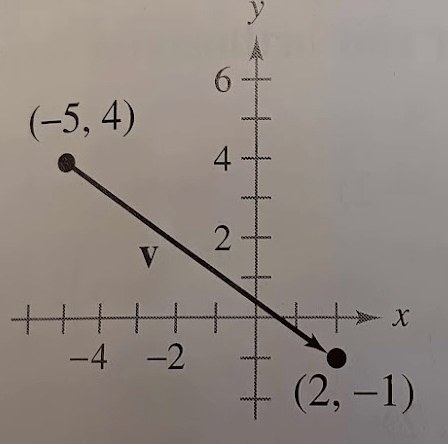
<2-(-5),-1-4> =<7,-5>
100
pg 446 #73
Find the dot product of u and v
u=6i-j
v=2i+5j
(6*2)+(-1*5)=12-5=7
200
pg 444 #5
Use the law of sines to solve the triangle. If two solutions exist, find both.
B=115°, a=9, b=14.5
(sin115°)/14.5=(sinA)/9=(sinC)/c
A=34.2°
C=30.8°
c=8.18
200
pg 444 #23
use the law of cosines to solve the triangle
B=150°, a=10, c=20
b^2=100+400-400(cos(150))=846.4
b=29.09
sinC=(20(.5))/29.09=.3437
C=20.1°
A=180-150-29.09=9.9°
200
pg 445 #61
Write the linear combination of the standard unit vectors i and j for the given initial and terminal points.
Initial Point: (-8,3)
Terminal Point: (1, -5)
(1-(-8))i+(-5-3)j=9i-8j
200
pg 446 #79
Use the vectors to find the indicated quantity
4u•v
u=<-3,-4>
v=<2,1>
4u=<-12,-16>
4u•v=(-12*2)+(-16*1)=-24+-16=-40
300
pg444 #11
Find the area of the triangle having the indicated angle and sides.
A=27°, b=5, c=8
A=1/2bcsinA=1/2(5)(8)(sin27°)
9.08 square units
300
pg 445 #33
Use Herons Area Formula to find the area of the triangle with given side lengths.
a=4, b=5, c=7
s=(4+5+7)/2=8
A=root()(8(8-4)(8-5)(8-7))=9.798 " square units"
300
pg 445 #45
Find (a) u+v (b) u-v (c)3u, and (d) 2v+5u
u=<-1,-3>
v=<-3,6>
(a) <-4,3>
(b) <2,-9>
(c) <-3,-9>
(d) <-11,-3>
300
pg 446 #81
Find the angle θ between the vectors.
u=<2root()(2),-4>
v=<-root()(2),1>
u•v=-4-4=-8
||u||=root()(8+16)=root()(24)
||v||=root()(2+1)=root()(3)
cosθ=(-8)/(root()(24)root()(3))
θ=160.5°
400
pg 444 #7
Use the law of sines to solve the triangle. If two solutions exist, find both.
A=15°, a=5, b=10
sinB=(bsinA)/a=(10sin(15°))/5=.5176
B_1=31.2° or B_2=148.8°
C_1=133.8°
c_1=13.94
C_2=16.2°
c_2=5.4
400
pg 444 #29
The lengths of the diagonals of a parallelogram are 10ft and 16ft. Find the lengths of the sides of the parallelogram if the diagonals intersect at an angle of 28°. (Hint: diagonals of a parallelogram bisect each other)
The diagonals get bisected and make four triangles. Two with sides 5 and 8 and an included 28° angle. And two triangles with 5 and 8 sides with an included angle of 152°.
a^2=25+64-2(5)(8)cos152°=159.5
a=12.63ft
b^2=25+64-2(5)(8)cos28°=18.36
b=4.285ft
400
pg 445 #59
Find the unit vector in the direction of the given vector.
v=5i-2j
||v||=root()(25+4)=root()(29)
u=v/(||v||)=5/root()(29)i-2/root()(29)
400
pg 431 #59
A toy wagon is pulled by exerting a force of 20 pounds on a handle that makes 25° angle with the horizontal. Find the work done in pulling the wagon 40 ft.
W=F*d
F=20cos20°
d=40
W=20cos20°*40=725.05 foot pounds
500
pg 444 #17
A tree stands on a hillside of slope 28° from the horizontal. From a point 75 feet down the hill, the angle of elevation to the top of the tree is 45°(see figure). Find the height of the tree
We will need to use the top triangle to find the height of the tree. To find the top angle of the triangle we will need to look at the big right triangle to find the sum of all three angles.
180°=45°+90°+"top angle"
"top angle"=180-90-45=45°
Now we can use the law of sines for the top triangle to find the height of the tree h
The bottom angle for the top triangle is
45-28=17°
(sin17°)/h=(sin45°)/75ft
h=(75ft(sin17°))/(sin45°)=31ft
500
pg 444 #31
Two planes leave the airport at essentially the same time. One is flying 425 miles per hour at a bearing of 355°, and the other is flying 530 miles per hour at a bearing of 67°. Determine the distance between teh planes after they have flown 2 hours.
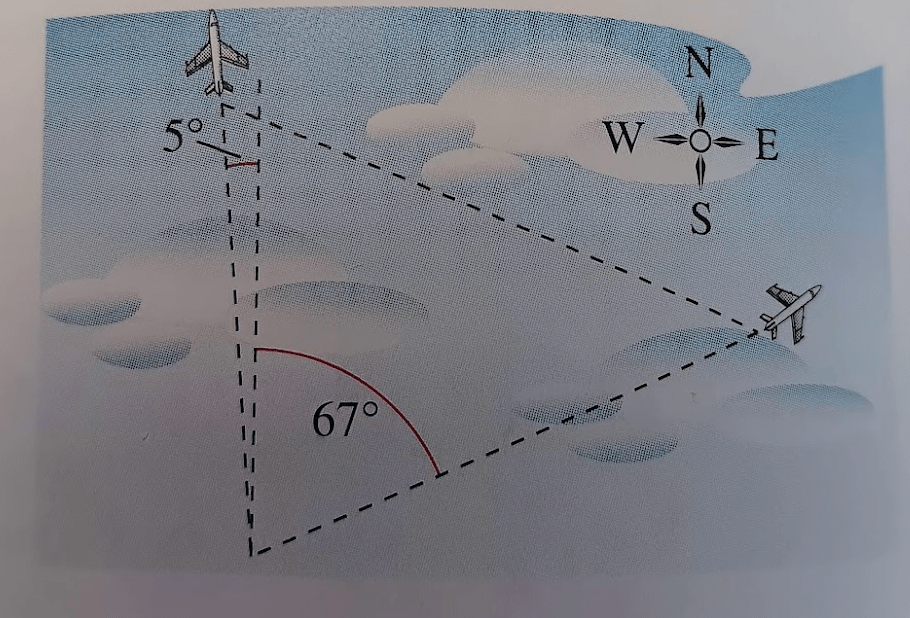
In 2 hours, the planes have flown 850 miles at a 355° bearing and 1060 miles at a 67° bearing. So for the triangle formed, we have two sides of 850 miles and 1060 miles with an included angle of 72° (67+5). So
c^2=850^2+1060^2-2(850)(1060)cos(72°)=1289251.376
c=1135.5 miles
500
pg 445 #65
Graph the vectors and the resultant of the vectors. Find the magnitude and direction of the resultant.
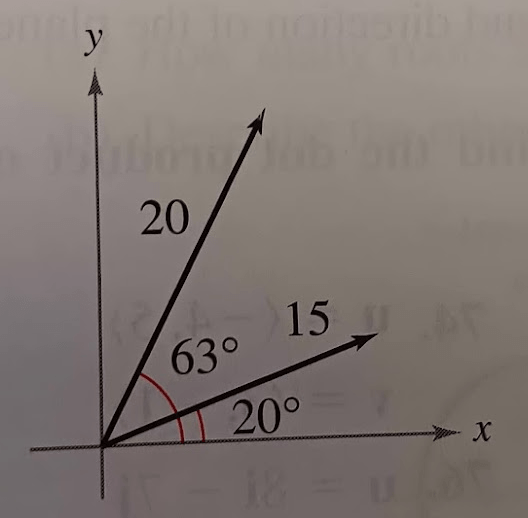
u=15cos20°i+15sin20°j
v=20cos63°i+20sin20°j
u+v=23.175i+22.950j
||u+v||=23.175^2+22.950^2=32.62
tanθ=22.950/23.175
θ=44.72°
500
pg 446 #93
Find the projection of u onto v. Then write u as the sum of two orthogonal vectors, one which is the projection of u onto v.
u=<-4,3>
v=<-8,-2>
u•v=(-4*-8)+(3*-2)=32-6=26
||v||=root()(64+4)=root()(68)
w_1=proj_vu=((u•v)/(||v||^2))v=(26/68)<-8,-2>=<(-52)/17,(-13)/17>
w_2=u-w_1=<-4,3> - <-52/17,-13/17> = <-16/17,64/17>
u= <-52/17,-13/17> + <-16/17,64/17>