3.1 Exponential Funcitons and Graphs
3.2 Logarithmic Functions and Graphs
3.3 Properties of Logs
3.4 Solving logarithmic functions
3.5/3.6 Data and Nonlinear Models
100
3.1
pg.185 #19
Use f(x) to determine the transformation(s) of g(x)
f(x)=(3)^x
g(x)=(3)^(x-5)
Shifted Right 5
100
3.2 pg. 196 #5
Write the logarithmic function in exponential form. For example, the exponential form of
log_5 25=2
5^2=25
log_32 4 =2/5
32^(2/5)=4
100
3.3 pg. 203 #5
Rewrite the logarithm using the change of base formula in terms of a. common logarithm(base 10) and b. natural logarithm (base e)
log_a(3/10)
a.
log_10(3/10)/log_10a
b.
ln(3/10)/lna
100
3.4 pg. 213 #41
Simplify the expression.
e^(lnx^2)
x^2
100
What is the name of the function for the graph below?
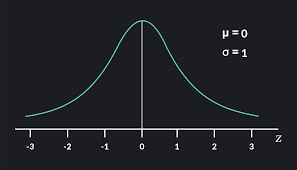
Gaussian Distribution/Normal Bell Curve
200
3.1
pg.185 #21
Use f(x) to determine the transformation(s) of g(x)
f(x)=(3/5)^x
g(x)=-(3/5)^(x+4)
Left 4 and flipped over the x-axis
200
Write the exponential equation in logarithmic form. For example
2^3=8
log_2 8 =3
6^(-2)=1/36
-2=log_6 (1/36)
200
Expand the logarithm to an expression as a sum, difference, and/or a constant multiple of logarithms.
log_b(x^2/(y^2z^3))
2log_bx-(2log_by+3log_bz)
200
3.4 pg. 213 #27
Solve for x
lnx-ln5=0
ln(x/5)=0
e^(ln(x/5))=e^0
x/5=1
x=5
200
What is the name of the distribution for the graph below?
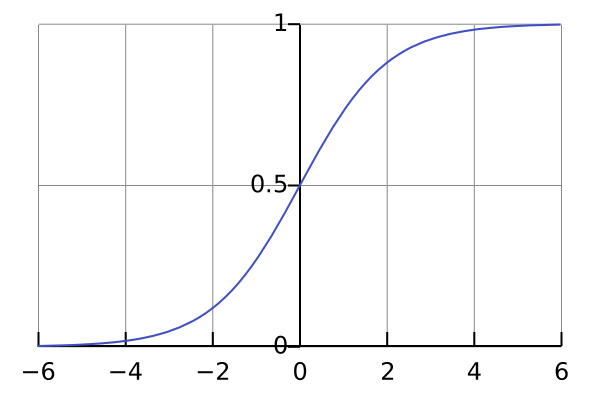
Sigmoidal Curve/Logistic Curve
300
3.1
pg. 186 #45
Graph the function on your calculator and identify any asymptotes.
s(t)=2e^(0.12t)
y=0
300
Describe the relationship between the graphs of functions f and g
f(x)=e^x
g(x)=lnx
They are inverses of each other
f(x)^-1=g(x)
g(x)^-1=f(x)
300
4.3 pg 203 #53
Condense the expression to a logarithm of a single quantity
lnx-3ln(x+1)
ln(x/(x+1)^3)
300
3.4 pg. 213 #23
Solve for x
(2/3)^x=81/16
log_(2/3)(2/3)^x=log_(2/3)(81/16)
x=log_(2/3)(2^4/3^4)
x=log_(2/3)(3/2)^-4
x=-4
300
3.6
Name 5 types of regression models on your calculator and how do you pick the best fitting model?
linear, cubic, quadratic, quartic, logarithmic, power, exponential, natural log, sine
R squared Value!
400
3.1
pg.186 #55
Complete the table to determine the balance A for P dollars invested at a rate r for t years and compounded n times per year.
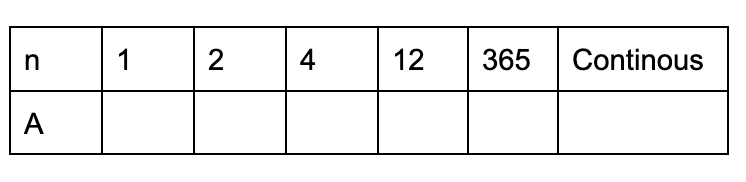
P=2500, r=2.5%, t=10 years
A=P(1-r/n)^(nt)
A=2500(1-(0.025/n))^(10t)

400
3.2 pg. 195 #43
Find the domain, vertical asymptote, and x-intercept of the logarithmic function and sketch it by hand.
f(x)=6+log_6(x-3)
Domain: (3,inf)
Vertical asymptote: x=3
x-intercept
(3+6^-6,0) about(3,0)
400
3.3 pg. 204 #75
find the exact value of the logarithmic function without using a calculator
lne^3-lne^7
3-7=-4
400
3.4 pg. 213 #57
Solve the exponential function algebraically. Round to three decimal places.
400/(1+e^-x)=350
400=350+350e^-x
50/350=e^-x
-ln(50/350)=x
400
3.5 pg. 225 #22
Find the initial quantity of the radioactive isotope that has a half-life of 24,110 years and has an amount of 0.4 g after 1000 years
V=A(1/2)^(t/h)
.4=A(1/2)^(1000/24110)
A=.4117 g
500
3.1
pg. 186 #65
Let Q represent a mass of radioactive radium RA, in grams, whose half-life is 1620 years. The quantity of radium present after t years is given by
Q=25(1/2)^(t/1620)
a.Determine the initial quantity when t=0
b.Determine the quantity present after 1000 years
a. 25 grams
b. 16.30 grams
500
Students in a mathematics class were given an exam and then tested monthly with an equivalent exam. The average scores for the class are given by the human memory model.
f(t)=80-17log_10(t+1),0<=t<=12
where t is time in months
a. Find the average score of the original exam (t=0)
b. What was the average score after 10 months?
a. 80
b. 62.3
500
3.3 pg. 204 #79
Find the exact value of the logarithmic function without using a calculator
ln(1/sqrte)
ln(e^(-1/2))
-1/2
500
3.4 pg. 214 #89
Solve the logarithmic function algebraically.
log_3(x)+log_3(x-8)=2
log_3(x(x-8))=2
x^2-8x=3^2
(x-9)(x+1)=0
x=9,-1
500
3.6 pg 237 #35
The amounts y (in billions of dollars) donated to charity (by individuals, foundations, corporations, and charitable bequests) in the United States from 1996 to 2001 are shown in the table, where x represents the year, with x=6 corresponding to 1996.
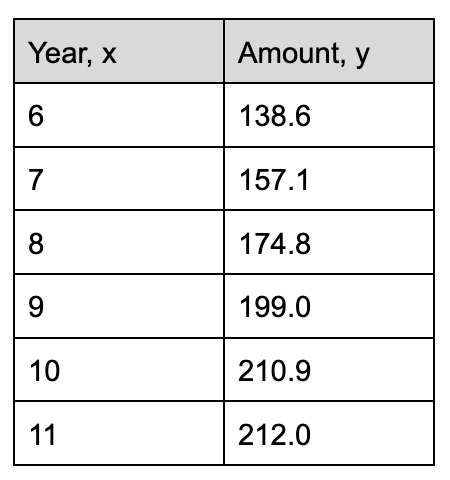
a. Find the regression models for linear, logarithmic, quadratic, exponential, and power models.
b. Find the model of best fit and write the equation for it.
c. Graph the model on your calculator.
R squared values
Linear: 0.9526
Logarithmic: 0.9736
Quadratic: 0.9841
Exponential: 0.9402
Power:0.9697
y=-1.968x^2+49.24x-88.6