Domain & Range
Graphing
Solving Equations
Trig
Misc.
200
What is the domain of the following function, in interval notation?
y = x/(x^2 + 4x)
(-oo, -4)U(-4,0)U(0, oo)
200
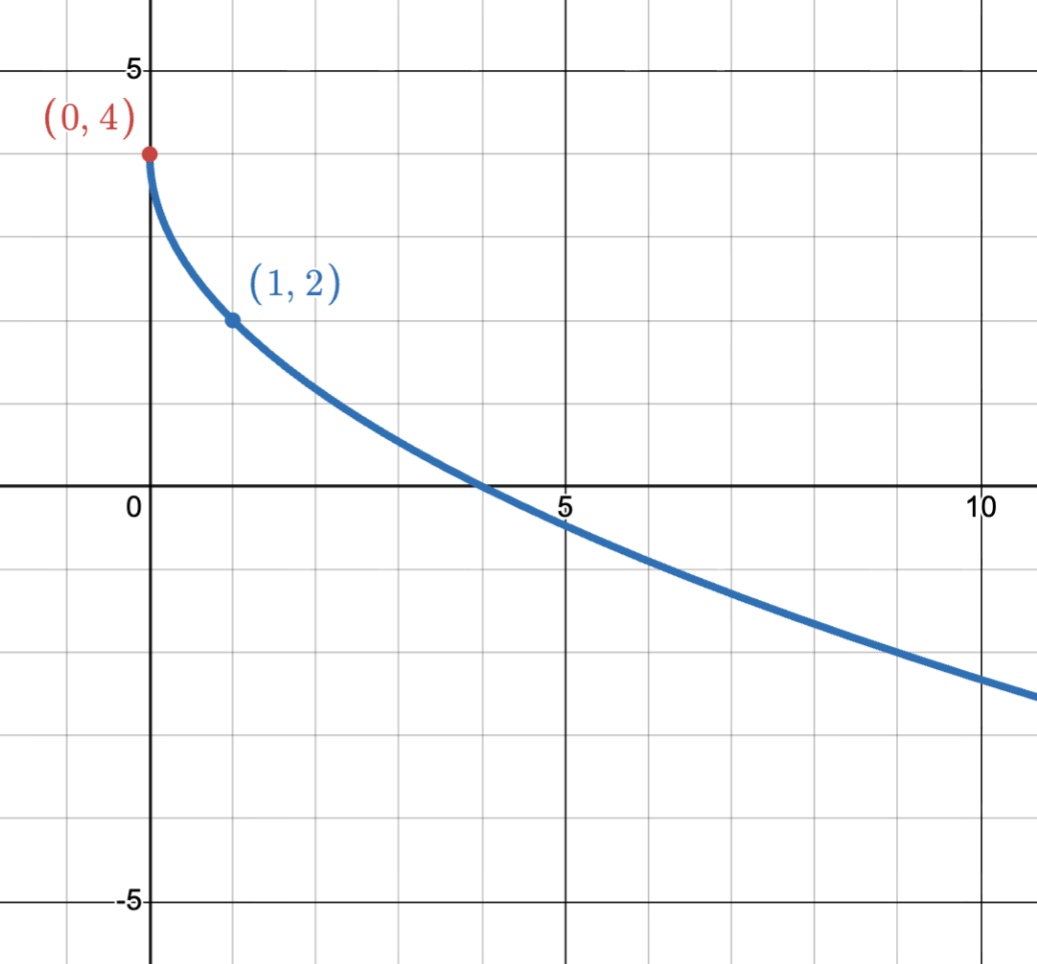
Sketch a graph a include at least two exact coordinates.
y = -2sqrt(x) + 4
200
Solve. Provide an exact, fully simplified answer.
3x^2 - 6x + 7 = 0
x = (3 +- 2isqrt3)/3
200
Evaluate:
a)
sin((7pi)/6)
b)
cos((3pi)/2)
c)
tan((5pi)/3)
a) -1/2
b)0
c)
-sqrt(3)
200
Create a linear equation in point-slope form that goes through the points (-2, 3) and (4, 7).
y - 3 = 2/3(x + 2)
y - 7 = 2/3(x - 4)
300
State the domain and rage of the following in interval notation:
a) arcsine
b) arccosine
c) arctangent
a)
D: [-1, 1], R: [-pi/2, pi/2]
b)
D: [-1, 1], R: [0, pi]
c)
D: (-oo, oo), R: (-pi/2, pi/2)
300
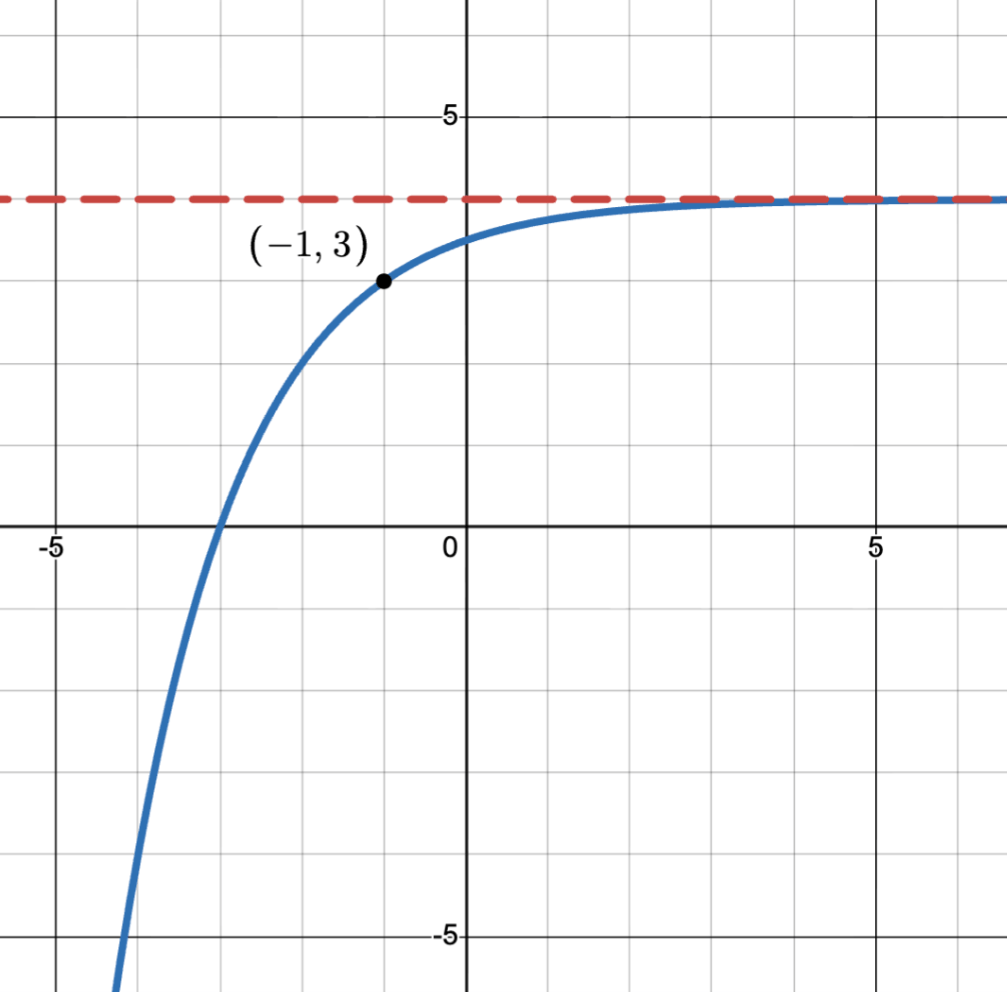
Graph the following function. Include the asymptote equation and at least one exact coordinate.
y = -(1/2)^(x+1) + 4
Asymptote: y = 4
300
Solve. Provide an exact answer.
4e^(2x - 1) + 3 = 19
x = (ln4 + 1)/2
x = ln2 + 1/2
x = 1/2ln4 + 1/2
300
Evaluate:
a)
tan(-(9pi)/4)
b)
csc(3pi)
c)
cos((17pi)/6)
a) -1
b) undefined
c)
-sqrt(3)/2
300
Simplify:
a)
log(0.01)
b)
lne^(2x)
c)
log_4(32)
a) -2
b) 2x
c)
5/2
400
State the domain and range of the following functions in interval notation:
a)
y = -ln(-x) + 1
b)
y = 3e^-x - 5
a)
D: (-oo, 0), R: (-oo, oo)
b)
D: (-oo, oo), R: (-5, oo)
400
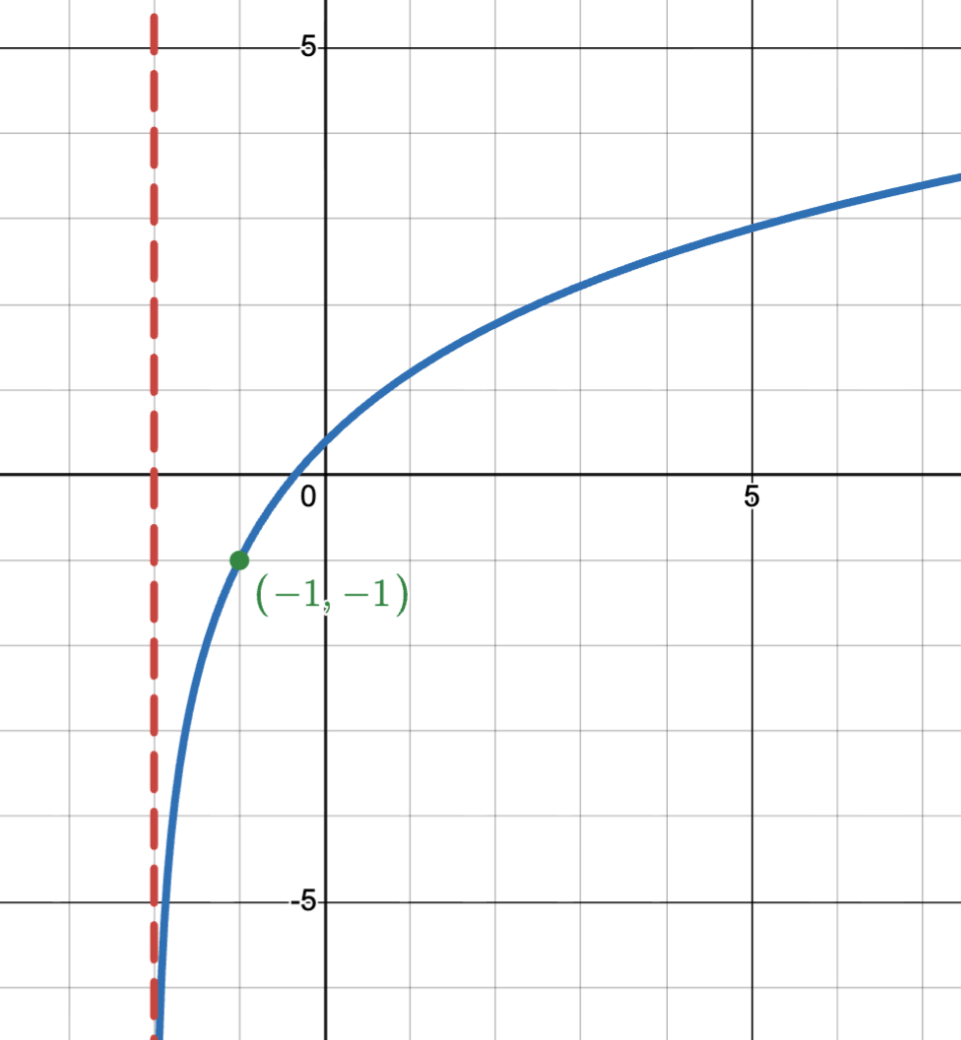
Graph the following function. Include asymptote equations and at least one exact coordinate.
f(x) = 2ln(x + 2) - 1
asymptote: x = -2
400
Solve for x.
log_2(x + 2) + log_2(x - 1) = 2
x = 2
(x = -3 is extraneous)
400
Evaluate. All answers should be in radians.
a)
sin^-1(-sqrt3/2)
b)
cos^-1(-sqrt2/2)
c)
tan^-1(-sqrt3/3)
-pi/3
(3pi)/4
-pi/6
400
Simplify.
(3/(x+1)-2/x)/(5/(x^2+ x)
(x-2)/5
500
Define the domain using interval notation:
y = x/(sqrt(-4x^2 + 4x + 3)
(-1/2, 3/2)
500
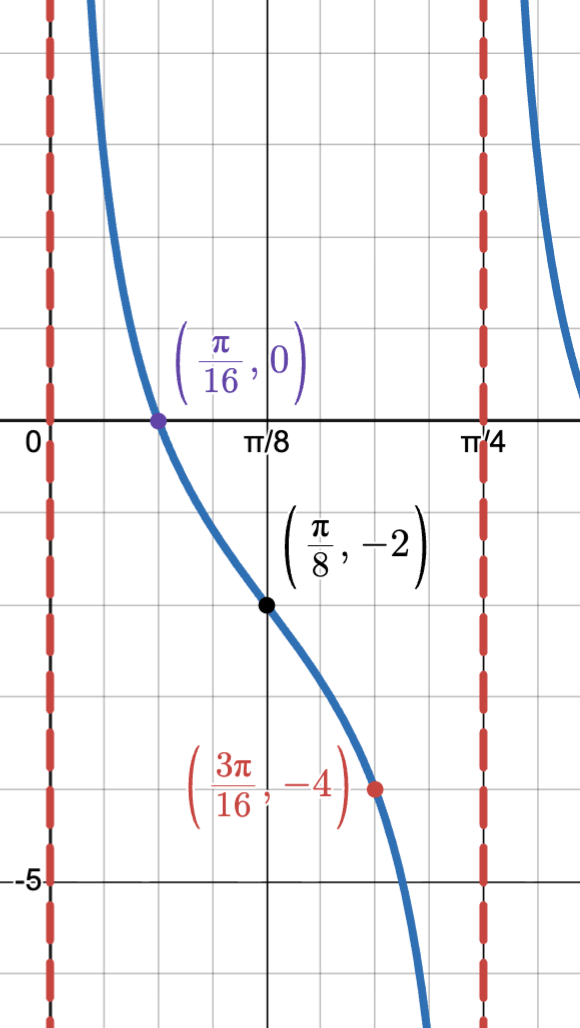
Sketch at least one full period of the following function. State the period and asymptote equations. Label at least three exact coordinates.
y = 2cot(4theta) - 2
Period: pi/4, Asymptote equations: x=0, x=pi/4
500
Find all solutions in the interval [0, 2pi]
sec^2x - sqrt3tanx - 1 = 0
x = 0, pi/3, pi, (4pi)/3, 2pi
500
Solve the inequality over the interval [0, 2pi]. Your answer should be in interval notation.
tanx >= 1
[pi/4, pi/2)U[(5pi)/4, (3pi)/2)
500
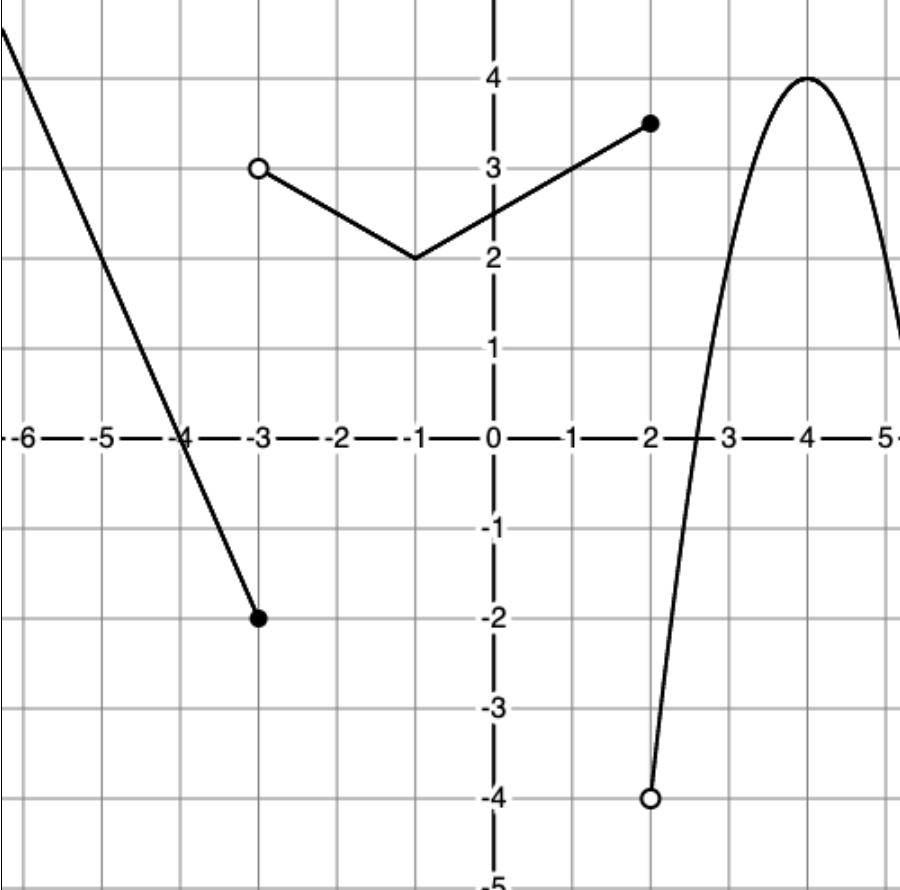
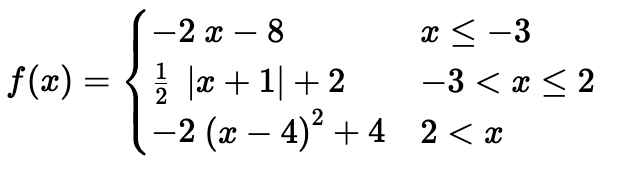
Write the piecewise function that describes the graph below (assume arrow if no clear endpoints):