Approximating Area Under a Curve
Definite Integrals
Indefinite Integrals
Net Change Theorem
Misc
300
The graph below represents f(x). Approximate the value of the integral expression below using an M2 rectangular approximation with evenly spaced rectangles.
int_(-4)^(4)f(x)dx

0
300
Evaluate:
int_0^3dx/(5x + 1)
1/5ln16
300
Evaluate:
int_()^()((1 +x)/x)^2dx
-1/x + 2lnabs(x) + x + C
300
If g(t) is a positive, differentiable function that represents the gallons per hour of water flowing through a dam, for t>=0, describe the meaning of the following expression.
int_0^24g(t)dt
The total gallons of water that have flowed through the dam in the first 24 hours. (or the net change in the gallons of water flowing in the first 24 hours)
300
The function below represents f(x). Evaluate the expression, providing an exact answer.
int_1^6abs(f(x))dx

7/2 + pi/2
400
What is the difference between the R4 and L4 rectangular approximations for the area under the curve, f(x), from 0 to 10.
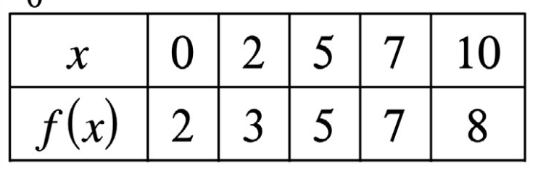
15
400
int_(-2)^3 (1- abs(x))dx
-3/2
400
Evaluate:
int_()^() (2^t)/(2^t + 3)dt
1/ln2ln(2^t + 3) + C
Please note that the function inside the natural log is always positive.
400
A particle is traveling along a horizontal axis with a velocity of v(t) = cos(t), in inches per second. Create the integral expression that you would use to find the total distance the particle travels over the first 5 seconds IF YOU WERE SOLVING WITHOUT A GRAPHING CALCULATOR. You do not need to evaluate the expression!
int_0^(pi/2)v(t)dt + abs(int_(pi/2)^((3pi)/2)v(t)dt) + int_((3pi)/2)^5v(t)dt
int_0^(pi/2)v(t)dt - int_(pi/2)^((3pi)/2)v(t)dt + int_((3pi)/2)^5v(t)dt
400
Find F'(x) if
F(x) = int_sinx^(x^2)e^(t^2)dt
F'(x) = 2xe^(x^4) - cosxe^(sin^2x)
500
Approximate the value of the following expression using an M4 rectangular approximation with evenly spaced rectangles.
int_(2)^(14)x^2dx
903
500
Evaluate:
int_0^4x/sqrt(1 + 2x)dx
10/3
500
Evaluate (challenge problem!):
int_()^() x/(sqrt(1 - x^4))dx
1/2sin^(-1)(x^2) + C
500
If the velocity of a particle moving along a horizontal axis in miles per hour (where x>=0) is presented by
v(x) = -x^3 + 2x^2 - x + 2
Find the total distance traveled by the particle over the first 3 hours. Provide a simplified improper fraction with units as your final answer.
89/12 miles
500
The graph below represents f(x). Find the value(s) where a local minimum of g(x) occurs if
g(x) = int_(-2)^xf(t)dt
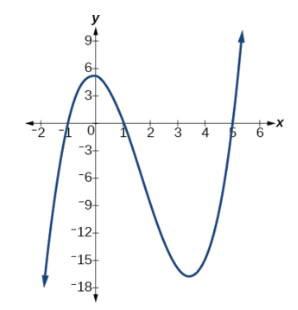
x = -1, 5