Basic Derivatives & Limit Process (2.1 & 2.2)
Product & Quotient Rules (2.3)
Chain Rule (2.4)
Implicit Differentiation (2.5)
Related Rates (2.6)
100
The graphs of f(x), f'(x), and f''(x) are graphed on the same coordinate axes below. Identify the graphs of f(x), f'(x), and f''(x). Then, explain your reasoning.
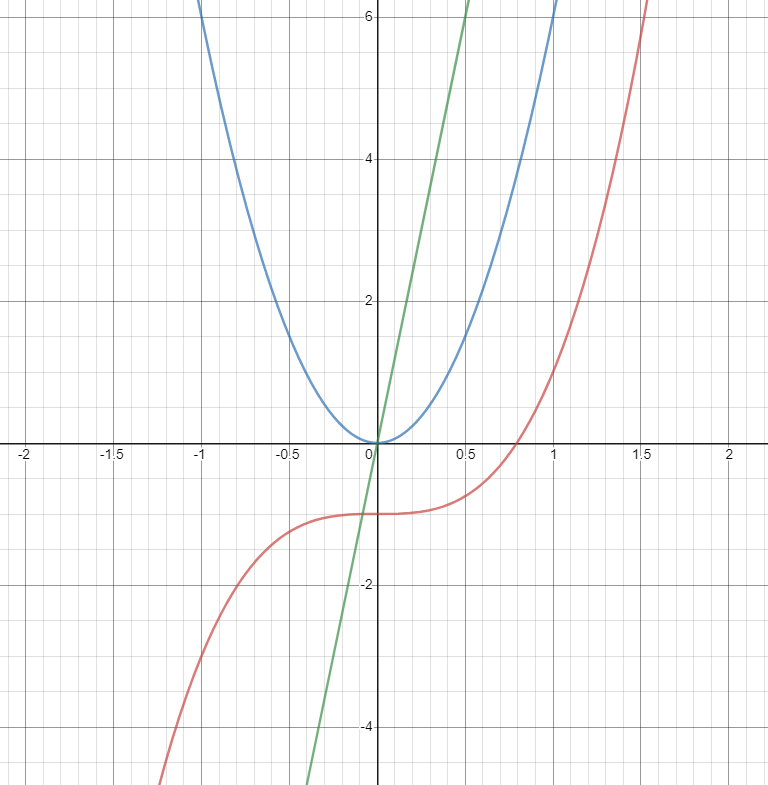
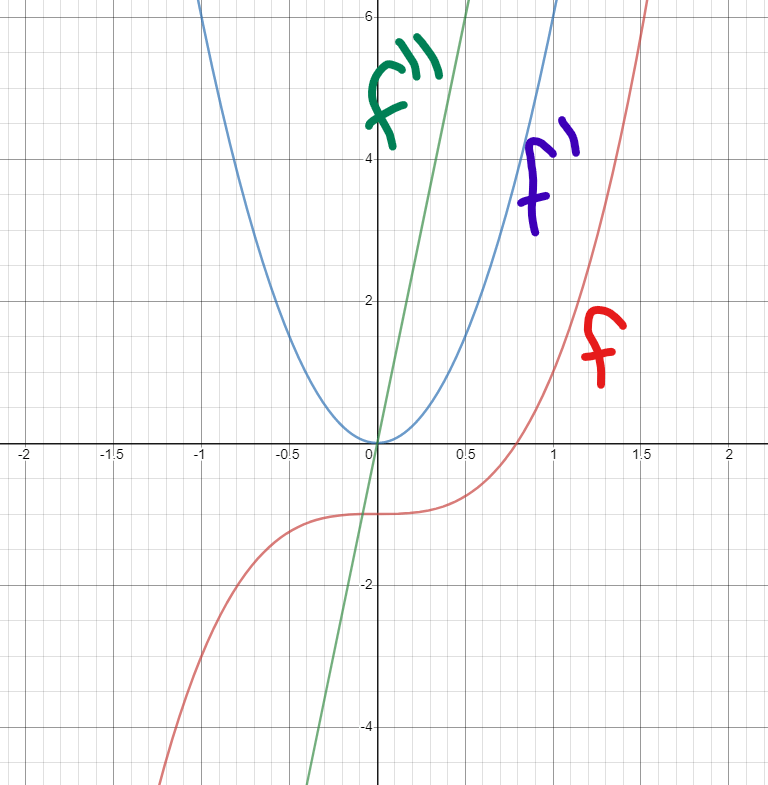
f(x) has two turning points, while f'(x) has one and f''(x) has none; f(x) is a cubic function, while f'(x) is a quadratic function and f''(x) is a linear function-- because each derivative "drops" a power.
100
Find the derivative of the function:
f(x)=xsin(x)
f'(x)=xcos(x)+sin(x)
100
Find the derivative of the function:
f(x)=sqrt(x+1)
f'(x)=1/(2sqrt(x+1)
100
Find the derivative of the function:
x^2+y^2=64
dy/dx=-x/y
100
Find dy/dt when x = 2, y = 1, and dx/dt = 3 m/sec for the function:
x^2+y^2=49
dy/(dt)=6 m/sec
200
Find the derivative of the function:
f(x)=2x^3-2x+1
f'(x) = 6x^2-2
200
Find the derivative of the function:
f(x)=(2x+7)/(x^2+4)
f'(x)=(-2(x^2+7x-4))/(x^2+4)^2
200
Find the derivative of the function:
f(x)=1/((5x+1)^2)
f'(x)=-10/((5x+1)^3)
200
Find the derivative of the function:
x^2+4xy-y^3=6
dy/dx=(2x+4y)/(3y^2-4x)
200
Find dx/dt when x = 2, y = 3, and dy/dt = -4 cm/min for the function:
xy=1
dx/(dt)=8/3 (cm)/min
300
Find the derivative of the function:
f(x)=-sqrtx
f'(x) = (-1)/(2sqrtx)
300
Find the derivative of the function:
f(x)=root(4)(x)sin(x)
f'(x)=root(4)(x)cos(x)+(sin(x))/(4root(4)(x^3))
300
Find the derivative of the function:
f(x)=5cos(9x+1)
f'(x)=-45sin(9x+1)
300
Find the equation of the tangent line at (-6, -1) of the function:
xy=6
y+1=-1/6(x+6)
300
The edges of a cube are all expanding at a rate of 6 cm per second. How fast is the volume changing when each edge is 10 cm?
(dV)/(dt)=1800 (cm^3)/sec
400
Find the derivative of the function:
f(x)=(8)/(3x^2)
f'(x)=(-16)/(3x^3)
400
Find the derivative of the function:
f(x)=2xsin(x)+x^2cos(x)
f'(x)=4xcos(x)+(2-x^2)sin(x)
400
Find the equation of the tangent line at (3, 2) of the function:
f(x)=root(3)(x^2-1)
y-2=1/2(x-3)
400
Find the equation of the tangent line at (-1, 1) of the function:
(x+y)^3=x^3+y^3
y-1=-1(x+1)
400
The volume of oil in a cylindrical container is increasing at a rate of 150 cubic inches per second. The height of the cylinder is approximately ten times the radius. At what rate is the height of the oil changing when the oil is 35 inches high? The formula for the volume of a cylinder is:
V=pir^2h
(dh)/(dt)=200/(49pi)
inches/second
500
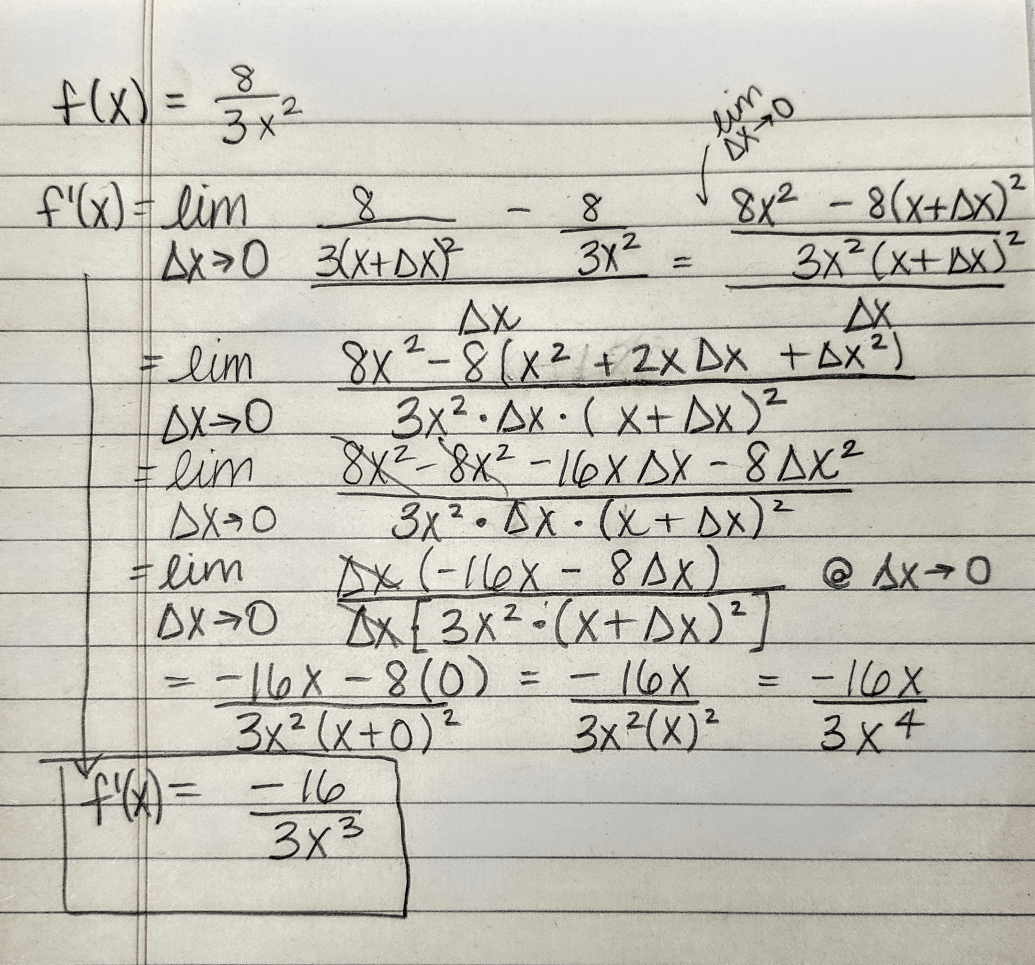
Find the derivative of the function using the limit process:
f(x)=(8)/(3x^2)
500
Find the derivative of the function:
f(x)=(2-1/x)/(x-3)
f'(x)=(2x^2-2x+3)/(x^2(x-3)^2)
500
Find the equation of the tangent line at (1, 4) of the function:
f(x)=(3x+1)/(4x-3)^3
y-4=-45(x-1)
500
Find the equation of the tangent line at (6, 0) of the function:
4y^3=(x^2-36)/(x^3+36)
dy/dx = Ø
500
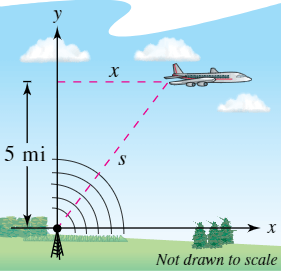
An airplane is flying at an altitude of 5 miles and passes directly over a radar antenna (see figure). When the plane is 10 miles away (s=10), the radar detects that the distance s is changing at a rate of 240 miles per hour. What is the speed of the plane?
480/sqrt3~~277.1281 (mi)/(hr)