Differentiation
Theorems/Definitions
Derivative Tests
More Questions
100
Assume that y is a function of x . Find y' = dy/dx for x3 + y3 = 4 .
y' = (-x2)/y2
100
State the Intermediate Value Theorem.
the intermediate value theorem states that if f is a continuous function whose domain is the interval [a, b], then it takes on any value between f(a) and f(b) at some point within the interval.
100
By the first derivatve test, how do you know if a point is a local maximum?
The derivative to the left must be increasing and the derivative to the right must be decreasing.
100
We need to enclose a rectangular field with a fence. We have 500 feet of fencing material and a building is on one side of the field and so won’t need any fencing. Determine the dimensions of the field that will enclose the largest area.
250ft x 125ft
200
find y' for ex−sin(y)=x
y' = -(1-ex)/cos(y)
200
State the Mean Value Theorem.
If f is a continuous function on the closed interval [a,b], and differentiable on the open interval (a,b), then there exists a point c in (a,b) such that: fʼ(c)=(f(b)-f(a))/(b-a)
200
If the second derivaitve is negative, what does that tell you about the original function?
The graph is concave down at that point.
200
A person is standing 350 feet away from a model rocket that is fired straight up into the air at a rate of 15 ft/sec. At what rate is the distance between the person and the rocket increasing:
(a) 20 seconds after liftoff?
(b) 1 minute after liftoff?
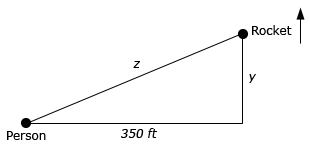
a.) 9.76
b.) 13.98
300
Find y' for the following equation: 4x2y7−2x=x5+4y3
y′ = (8xy7−5x4−2)/(12y2−28x2y6)
300
What is the Extreme Value Theorem?
The extreme value theorem states that if a real-valued function f is continuous on the closed interval [a,b], then f must attain a maximum and a minimum, each at least once.
That is, there exist numbers c and d in [a,b] such that: f(c)≥f(x)≥f(d) for all x∈[a,b].
300
Say you have the following: f'(x) = 0
Using the first derivative test, what can you say about the original graph?
Nothing, the test is inconclusive
300
A 15 foot ladder is resting against the wall. The bottom is initially 10 feet away from the wall and is being pushed towards the wall at a rate of 1414 ft/sec. How fast is the top of the ladder moving up the wall 12 seconds after we start pushing?
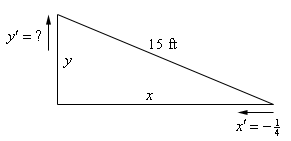 rate = 0.1319 ft/sec
400
find the line tangent to the equation at the given point: y2e2x=3y+x2 at (0,3)
y=−6x+3
400
State Rolle's Theorem.
Rolle's theorem states that any real-valued differentiable function that attains equal values at two distinct points must have at least one stationary point somewhere between them—that is, a point where the first derivative (the slope of the tangent line to the graph of the function) is zero.
400
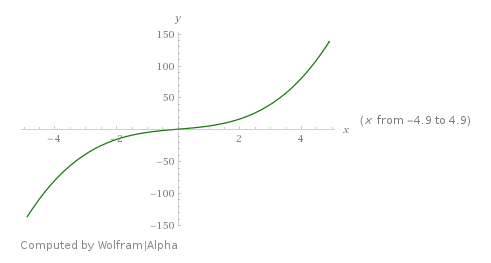
Sketch a curve with the following properties:
1. f'(x)>0 for -4 < x < 4
2. f''(x)>0 for 0 < x < 4
3. f''(x)<0 for -4 < x < 0
400
h(x)=e4-x^2
a. Determine a list of possible inflection points for the function.
b. Determine the intervals on which the function is concave up and concave down.
c. Determine the inflection points of the function.
a. x = -0.7071, 0.7071
b. CCU: (-inifinty, -0.701)U(0.7071, infinity), CCD: (-0.7071, 0.7071)
c. same as a
500
Find y' using implicit differentiation of tan(x2y4)=3x+y2
y' = 3−2xy4sec2(x2y4)/(4x2y3sec2(x2y4)−2y)
500
Suppose we know that f(x) is continuous and differentiable on the interval [−7,0], that f(−7)=−3 and that f′(x)≤2. What is the largest possible value for f(0)?
11
500
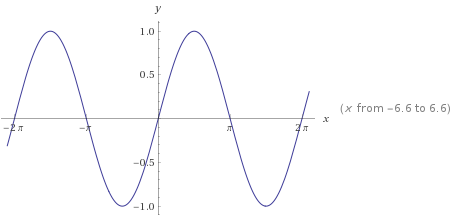
Sketch a curve with the following properties:
1. f'(x)>0 for -2pi < x < -(3pi)/2
2. f''(x)<0 for -2pi < x < -pi
3. f'(x)<0 for -(3pi)/2 < x < -pi/2
4. f''(x)>0 for -pi < x < 0
What kind of function would give you a curve like this?
500
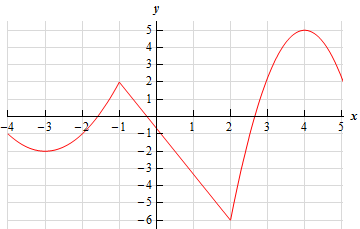 Identify all of the relative extrema and absolute extrema of the function.
Absolute Maximum : (4,5)(4,5)
Absolute Minimum : (2,−6)(2,−6)
Relative Maximums : (−1,2)(−1,2) and (4,5)(4,5)
Relative Minimums : (−3,−2)(−3,−2) and (2,−6)(2,−6)