Limits and continuity
derivative rules
Theorems
Antiderivatives
Differential equations
100
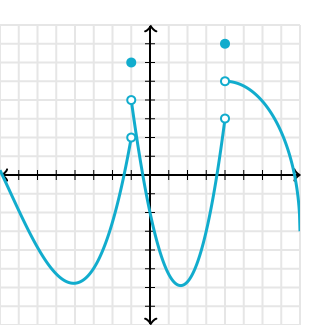
Which limit expressions agree with the graph?
A,lim g(x)=6
x→−1
B,lim g(x)=5x
x→4
C,lim g(x)=−1
x→6
D,None of the above
D,None of the above
100
Jessica tried to find the derivative of -3+8x−3+8x minus, 3, plus, 8, x using basic differentiation rules. Here is her work:
d/xd(−3+8x)
Step 1 =d/xd(−3)+d/xd(8x)
Step 2 =0+d/xd(8x)
Step 3 =d/xd(8)d/xd(x)
Step 4 =0⋅1
Step 5 =0
Step 3
100
Let f be a continuous function on the closed interval [-2,1],where f(-2)=3 and f(1)=6
which of the following is guaranteed by the intermediate value theorem?
A, f(c)=4 for at least one c between -2 and 1
B, f(c)=0 for at least one c between 3 and 6
C, f(c)=0 for at least one c between -2 and 1
D, f(c)=4 for at least one c between 3 and 6
A, f(c)=4 for at least one c between -2 and 1
100
f′(x)=9ex and f(8)=-8+9e8
f(0)=
1
100
g′(x)=(2x+5y)/x
Is g(x)=x5-2x a solution to the above equation?
A, Yes
B, No
B, No
200
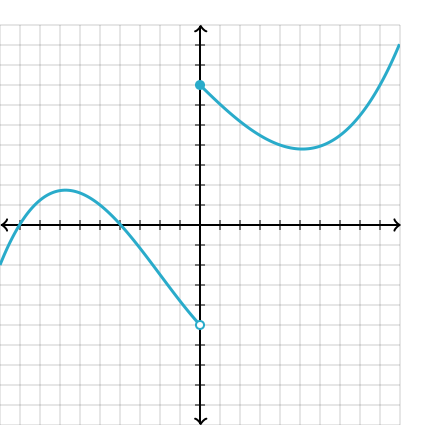
What appears to be the value of lim f(x)?
x→0+
A, 7
B,-5
C, 0
D,The limit doesn't exist
A, 7
200
y=X10
Find dy/dx
dy/dx=10X9
200
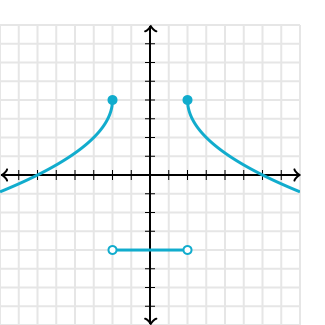
Does the Mean Value Theorem apply to f over the interval [-3,3]?
A, Yes
B,No
B,No
200
f′(x)=−5x4+9x2 and f(3)=-80
f(-3)=
244
200
A habitat of prairie dogs can support mmm dogs at most.
The habitat's population, ppp, grows proportionally to the product of the current population and the difference between mmm and ppp.
Which equation describes this relationship?
A, dp/dt=km(m−p)
B, dp/dt=kp/(m-b)
C,dp/dt=kp(m−p)
D,dp/dt=km/(m-p)
C
300
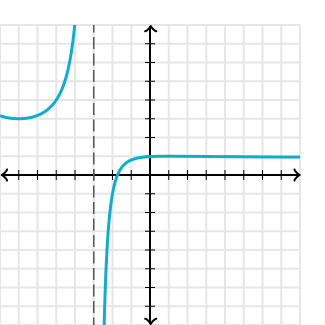
What is a reasonable estimate for lim f(x)?
x→−3
A,-3
B,1
C,0
D, The limit doesn't exist
D, The limit doesn't exist
300
Which of the following is an equation of the line tangent to the graph of g(x)=x^3-5x^2 at the point where x=2 ?
A,y=−8x+4
B,y=8x+96y
C,y=8x-28y
D,y=-8x-94y
A,y=−8x+4
300
Let h be a continuous function on the closed interval [-3,4], where h(-3)=-1 and h(4)=2
Which of the following is guaranteed by the Intermediate Value Theorem?
A, h(c)=1 for at least one c between -3 and 4
B, h(c)=-2 for at least one c between -1 and 2
C, h(c)=-2 for at least one c between -3 and 4
D, h(c)=1 for at least one c between -1 and 2
A, h(c)=1 for at least one c between -3 and 4
300
f′(x)=16/x2 and f(-2)=0
f(4)=
-12
300
f′(x)=(3f(x))/(xln(x))
Is f(x)=2(ln(x))3 a solution to the above equation?
A, Yes
B, No
A, Yes
400
Functions g and h are graphed.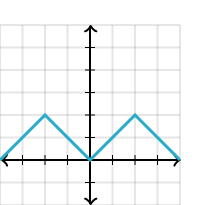
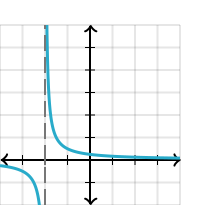
Find lim(−5g(x)−3h(x)).
x→−2
A,-10
B,-4
C,0
D,2
E,The limit doesn't exist
E,The limit doesn't exist
400
Find d/xd(cos(ex))
-exsin(ex)
400
Let f(x)=4x-31/2 and let c be the number that satisfies the Mean Value Theorem for f on the interval 1≤x≤3
What is c ?
A, 1.5
B, 1.75
C, 2
D, 2.25
B, 1.75
400
Find the general indefinite integral ∫2xdx
Which graph below shows several members of the family?
Choose 1 answer:
A,
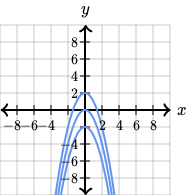
b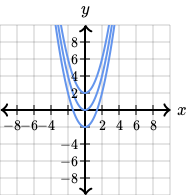
C
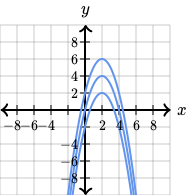
d,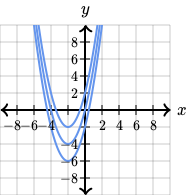
b
400
Find the general solution of dy/dx = 2x/3y2
y=(x2+C)1/3
500
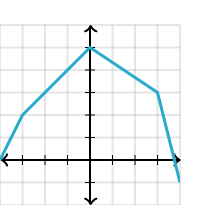
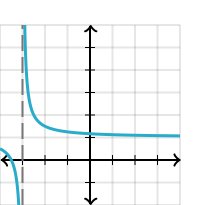
Find lim g(f(x)).
x→−3
A,4
B,-3
C,-12
D,2
E,The limit doesn't exist
E,The limit doesn't exist
500
f(x)=x(2x2−5x−7)How would you rewrite f(x), so it can be differentiated using the power rule?
A,2x2−5x−7/x-1
B,x(x+1)(2x−7)
C,2x3−5x2−7x
D,This is not possible.
C,2x3−5x2−7x
500
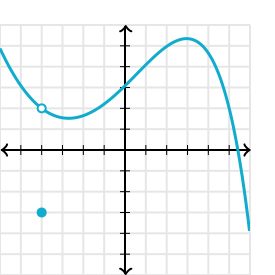
Does the Extreme Value Theorem apply to g over the interval [-2,5]?
A, yes
B, no
A, Yes
500
∫(−4x3−8x2−4)dx= ____+C
-x4-8/3x3-4x
500
Find the general soluton to dy/dx=-ex/8
y=-ex/8 + C