PAD vs PVD
Left or Right
Angina/Myocardial Infarction
Rhythms
Patient Teaching
Misc.
100
Claudication is associated with what peripheral vascular disease?
Peripheral arterial disease (PAD)
100
Dyspnea, orthopnea, and paroxysmal nocturnal dyspnea (PND) are hallmark respiratory symptoms of _____ -sided heart failure.
Left-sided heart failure.
100
What does STEMI & NSTEMI stand for?
ST elevation MI
Non-ST elevation MI
100
These two rhythms are the ONLY shockable rhythms.
Ventricular Tachycardia (V-Tach)
Ventricular Fibrillation (V-Fib)
100
This intervention treats unstable tachycardia.
Synchronized cardioversion
100
This daily self-care action helps heart failure patients detect fluid retention early and should be done at the same time each morning.
Daily weight
200
These superficial veins become enlarged, twisted, and visible due to incompetent venous valves.
Varicose Veins
200
This visible venous abnormality is a key sign of right-sided heart failure.
Jugular venous distension (JVD)
200
What lab do we check in patients who we suspect is having an MI?
Troponin
200
The definitive treatment for unstable bradycardia if medications are ineffective.
Transcutaneous pacing
200
Patients are advised to avoid this habit before a stress test because it can artificially raise heart rate and blood pressure, potentially affecting test results.
Smoking
200
Patients allergic to this element in contrast dye are at risk for reactions during coronary angiography, ranging from mild hives to severe anaphylaxis.
Iodine
300
This would be a dietary recommendation for patients with peripheral arterial disease
Reduce cholesterol intake
300
Peripheral edema and hepatomegaly occur in this type of heart failure.
Right-sided heart failure
300
This type of angina occurs at rest and is unpredictable.
Unstable angina
300
This is the drug of choice for torsade's de pointes.
Magnesium sulfate
300
Patients experiencing this rapid, narrow-complex rhythm (SVT) can sometimes convert to normal sinus rhythm by performing this.
Valsalva Maneuver
300
This dietary restriction—often limited to about 2 grams per day—helps prevent fluid retention and worsening heart failure symptoms.
Sodium
400
This symptom—swelling in only one leg—is often an early sign of a
DVT (Deep Vein Thrombosis)
400
Pink, frothy sputum is a hallmark sign of this condition in left-sided heart failure.
Pulmonary edema
400
This medication, often given sublingually, works by dilating coronary arteries to relieve chest pain in patients experiencing a myocardial infarction.
Nitroglycerin
400
This common arrhythmia is characterized by chaotic atrial electrical activity and an irregularly irregular pulse, significantly increasing the risk of stroke (blood clot).
Atrial fibrillation (A-fib)
400
Which would be the best meal for a patient who has had an MI
A. Barbecue ribs & corn
B. Ham and cheese sandwich & baked chips
C. Fried fish sandwich & fried okra
D. Baked turkey and salad
400
The myocardium is profused by what?
The coronary arteries
500
Dry, shinny skin with minimal body hair in lower extremities is evident of what?
Peripheral arterial disease (PAD)
500
This symptom differentiates right-sided heart failure due to systemic congestion and involves abdominal fluid accumulation.
Ascites
500
Pain from an MI may radiate to these three common areas, making it mimic other conditions like a stroke or arm injury.
What are the left arm, jaw, and neck
500
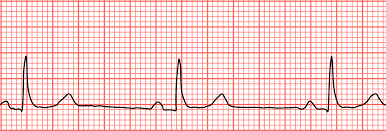
What Rhythm is this?
Bradycardia (< 60 BPM)
500
For acute angina, nitroglycerin can be taken sublingually as needed every this many minutes, up to three doses, before seeking emergency care.
What is every 5 minutes (Call 911 after the first does if no relief)
500
This sudden symptom suggests rupture of an AAA and requires immediate emergency care.
What is severe abdominal or back pain
600
Wet PVD often produces pain at rest that is relieved only when the limb is in this position to improve perfusion.
What is a dependent position (hanging the leg down)
600
What is the normal ejection fraction?
55-70%
600
What is the acronym for the treatment of a MI on arrival to the hospital, and what does each stand for
M (morphine)
O (oxygen)
N (nitroglycerin)
A (aspirin)
600
Regular rhythm with one P wave before every QRS
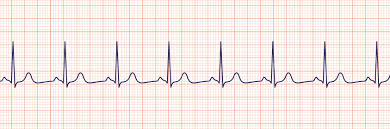
Normal Sinus Rhythm (NSR)
600
For patients at very high risk of cardiovascular disease, guidelines recommend keeping this “bad” cholesterol below 55 mg/dL.
LDL
600
In acute pulmonary edema, fluid and red blood cells leak into the alveoli, sometimes producing this characteristic frothy secretion.
Pink-frothy sputum