Shortness of Breath
Heart Attack
Syncope
Structural
Infection
100
What is the most common ECG finding in PE?
What is Sinus Tachycardia; S1Q3T3 is specific but not sensitive for PE; Also look for RV strain (ant TWI, etc); Sinus tachycardia is the most common
100
What is the most common underlying etiology of cardiac arrest from polymorphic ventricular tachycardia?
What is myocardial ischemia
-pVT usually due to ischemia, TdP is a type of pVT specifically due to long QT
-monomorphic VT often due to myocardial scar
100
What is the mainstay of treatment in a patient with pulmonary hypertension presenting with syncope?
What is maintain right ventricular filling pressure
100
What drug is the treatment of choice in acute aortic dissection and what are your vital sign goals?
What is Esmolol. Goal HR <60 and SBP <100-120
---May need nicardipine as well
100
What is the most appropriate outpatient treatment of community-acquired pneumonia in a previously healthy adult?
What is azithromycin
200
A 25-year-old man presents with a severe asthma exacerbation and is intubated. After being stable for several hours, he develops hypoxia with hypotension and is increasingly difficult to ventilate. Breath sounds are equal bilaterally. What is the next step in management?
What is disconnect from the ventilator
Obstructive lung disease---> air trapping
200
A harsh crescendo-decrescendo midsystolic murmur that increases with a Valsalva maneuver suggests...
What is Hypertrophic cardiomyopathy
200
According to the San Francisco Syncope Rule, what are the 5 criteria to be considered low risk?
What are... Absence of: 1. abnormal ECG 2. shortness of breath 3. hypotension (SBP <90 mm Hg) at triage 4. anemia (Hct <30%) 5. history of CHF
200
What is the effect of placing a magnet over a pacemaker
What is... enters fixed rate mode
200
What two laboratory tests may be abnormal in pneumonia caused by Legionella?
What are hyponatremia and elevated liver enzymes
300
Name the 5 cyanotic congenital heart diseases
A mnemonic for the five cyanotic congenital cardiac diseases: 1 -Truncus arteriosus (1 trunk) 2 -Transposition of the great vessels (2 vessels)3 -Tricuspid atresia (Tri = 3) 4 -Tetralogy of Fallot (Tet = 4, RVH, overriding aorta, pulmonic stenosis, and ventricular septal defect) 5 -Total anomalous pulmonary venous return (5 letters in "TAPVR")
300
Name two ECG features of Brugada's syndrome
What are incomplete RBBB pattern and "coved" ST-segment elevations in leads V1 and V2.
-Sodium Channelopathy
300
The most common cause of an inappropriate shock given in a patient with an AICD is...
What is Atrial Fibrillation
300
Name 3 conditions in which antibiotic prophylaxis for dental procedure should be recommended
What is:
1) Prosthetic cardiac valve repair
2) Previous infective endocarditis
3) Unrepaired cyanotic congenital heart disease
4) <6 mo s/p repair of cyanotic congenital heart disease w/prosthetic valve
5) Cardiac transplant recipients with valve regurgitation due to a structurally abnormal valve
300
Which pathogen is the most common cause of pneumonia in children with cystic fibrosis and what pathogen are most patients colonized with by age 18.
What is staph aureus and P. aeruginosa
400
Name 2 findings on a neonatal/pediatric ECG that are normal but would be abnormal on an adult ECG
What are 1. right axis (large R ventricle mass) 2. inverted T waves in V1-V3
400
What diagnosis is suspected by this ECG in a 78 year old male with 2 weeks of worsening SOB?
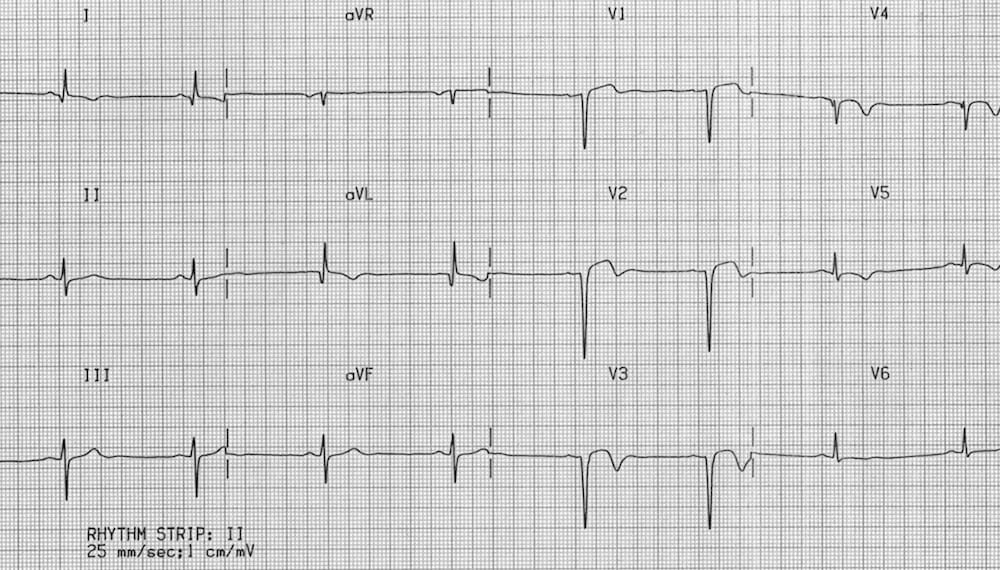
What is LV aneurysm
400
What is Beck's triad and what would you expect to see on ECG with this condition?
hypotension, jvd, muffled heart sounds (pericardial tamponade). Low voltage QRS complexes, diffuse ST elevation, and PR-segment depression (due to pericardial inflammation). Also can see electrical alternans, where there is beat-to-beat variation in the amplitude of the R waves
400
Name the three criteria for MI diagnosis based on Sgarbossa's Criteria
• Concordant ST-segment elevation greater than 1 mm (same direction as the QRS complex) (5 points)
• ST-segment depression of greater than 1 mm in lead V 1, V2, or V 3 (3 points)
• Discordant ST-segment elevation greater than 5 mm (opposite direction of the QRS complex) (2 points)
--> An accurate diagnosis of ischemia requires a minimum score of 3.
Modified Sgarbossa Criteria:
- ≥ 1 lead with ≥1 mm of concordant ST elevation
- ≥ 1 lead of V1-V3 with ≥ 1 mm of concordant ST depression
- ≥ 1 lead anywhere with ≥ 1 mm STE and proportionally excessive discordant STE, as defined by ≥ 25% of the depth of the preceding S-wave. (LIFTL)
400
What is the most common underlying infectious etiology of myocarditis?
What is Parvovirus
500
Chest XR shows bilateral pleural effusion with mediastinal widening, and chest CT show hilar lymphadenopathy but no pulmonary embolism. What is the most likely diagnosis?
What is inhaled anthrax
500
Name 8 contraindications to thrombolytic therapy in MI
What are: • Strong suspicion for aortic dissection or pericardial tamponade • Active gastrointestinal or other internal bleeding • Known structural cerebrovascular lesion such as AVM or aneurysm • Known malignant intracranial neoplasm • Ischemic stroke within 3 months • Previous intracranial hemorrhage • Intracranial procedure or head injury within past 3 weeks • Known severe bleeding disorder such as a coagulation abnormality (hemophilia, von Willebrand disease) or severe thrombocytopenia
Relative contraindications include: • Traumatic or prolonged(>10 min) CPR or recent (<3 weeks) major surgery such as coronary artery bypass graft, obstetric delivery, organ biopsy, previous puncture of noncompressible vessels • Gastrointestinal or genitourinary bleeding within the past 10 days • Older than 75 years • Severe uncontrolled hypertension (systolic >180 mm Hg, diastolic > 110 mmHg) • Hemostatic defects from systemic disease such as hepatic cirrhosis, severe renal insufficiency, malignancy • Current use of anticoagulant medications with INR above 1.7 or PT longer than 15 seconds • Pregnancy • High likelihood of left heart thrombus or subacute bacterial endocarditis • Diabetic hemorrhagic retinopathy or other hemorrhagic ophthalmic condition
500
Name one drug that would require you to increase the dose of adenosine and one drug or condition that would increase the effects of adenosine.
Increase dose (decreased effects): Adenosine is antagonized by the methylxanthines (theophylline, caffeine) since they prevent binding of adenosine at receptor sites
Decrease dose (inc effects): Dipyridamole, carbamazepine, diazepam, and cardiac transplant potentiate the effects of adenosine
500
Name 3 ECG findings in Wolff-Parkinson-White syndrome
What are: 1) Delta wave 2) Short PR interval 3) Wide QRS
500
Name 5 medications that can precipitate torsades de pointes?
Class 1A antidysrhythmics (procainamide, quinidine) Class 1 C (flecanide), TCA, droperidol, methadone, erythromycin, phenothiazines ***hypoMg, hypoK