Heart Failure :(
EKG
IHD/CAD
Basics
Cardiac Rehab
100
A 70-year-old female with long-standing, poorly controlled hypertension presents with exertional dyspnea and fatigue. Echocardiography demonstrates a thickened, stiff left ventricular wall with impaired relaxation during filling, but her Left Ventricular Ejection Fraction (LVEF) is calculated at 55%.
How is this patient's heart failure classified, and what is its primary pathophysiological characteristic?
Diastolic Heart Failure (HFpEF); decreased myocardial compliance during diastole with normal LVEF
100

What is this? What are your actions as a PT?
Ventricular Tachycardia
Stop the session and notify the care team
100
List three modifiable risk factors for ischemic heart disease
Physical inactivity, tobacco smoking, elevated cholesterol/low HDL/high LDL/high triglycerides, hypertension, diabetes, obesity, oral contraceptives, menopause without ERT, sleep-disordered breathing, excess alcohol consumption
100
While taking a patient's pulse at EAC, you notice that the pulse varies between weak and strong beats. What is the term for this type of pulse?
Pulsus Alternans
100
In Phase I Cardiac Rehabilitation post-surgery, the target upper heart rate limit during early ambulation is calculated using this formula
Resting HR + 30 bpm
200
List 3 of the 5 causes of heart failure.
Ischemic Heart Disease, Hypertension, Dilated Cardiomyopathies, Diabetes, and Valvular Heart Disease
200
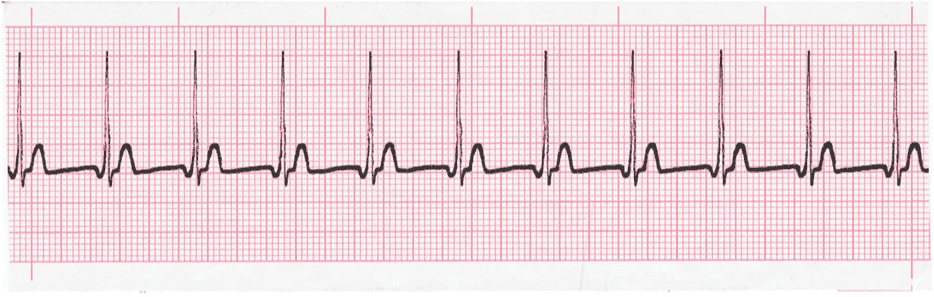
What is this?
Junctional Tachycardia
200
What are the two main EKG findings that indicate myocardial ischemia?
ST segment depression + T wave inversion
200
What sound should be heard at the left 2nd intercostal space?
S2; closing of aortic and pulmonary valves
200
When should you normally begin a resistance program during cardiac rehab?
2-3 weeks after initiating aerobic program
300
What are the surgical precautions for implantable cardioverter-defibrillators and permanent pacemakers
shoulder flexion/abduction less than 90 degrees for 4 weeks
lifting restrictions <10-15 lbs
300
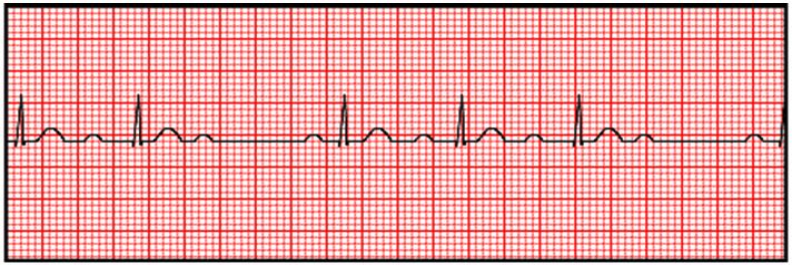
Patient is asymptomatic. What should your actions as a PT be?
2nd Degree Heart Block, Type I
Continue with exercise but monitor
300
During diastole, the intra-aortic balloon pump inflates. What is the purpose of this?
To obstruct backflow and increase coronary arterial perfusion while decreasing left ventricular workload
300
What is the normal HR recovery response after exercise?
drop by 12 beats in the 1st minute and 22 beats after the 2nd minute of recovery
300
What are the aerobic FIIT principles for Phase 3 Cardiac Rehab patients?
F: 5 days/week
I: HR: 60-80% of HRR or RPE 11-16
T: start w/ 30 minutes/day and progress to 45-60 minutes
400
A 67-year-old female with chronic heart failure reports that she is completely comfortable while sitting or resting. However, when she walks to her mailbox at the end of her driveway (less than ordinary daily activity, roughly 2.5 METs), she experiences marked shortness of breath, fatigue, and chest discomfort.
According to the New York Heart Association (NYHA) functional classification system, how should this patient's heart failure be classified?
Class III (marked heart failure)
400
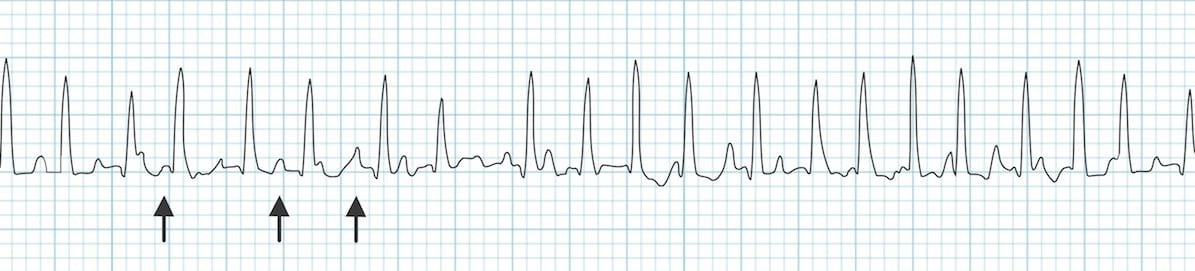
What is this? What are your actions as a PT?
Multifocal Atrial Tachycardia
If pt is symptomatic, stop exercise immediately as cardiac output is compromised
400
List three signs that would indicate ischemia during an exercise stress test
ST depression greater than or equal to 1 mm, exertional angina reproduced, exercise-induced arrhythmias, and fall in SBP greater than 10 mmHg with increasing workload
400
While listening to a patient's heart with the stethoscope placed at the apex, you hear an extra sound after systole (lub-dub-ta). What is this sound called? What populations is this normal in?
S3; younger individuals, those with volume overload (fever, pregnancy, and thyotoxicosis)
400
Mrs. B walked 450 meters during her 6MWT. She reports she has a treadmill at home that she can start using for her walking program. At what speed should she set her treadmill to when she walks at home?
1 meter/minute= 0.038 miles/hour
450/6= 75
75x 0.038= 2.85 miles/hour
500
A 74-year-old male with long-standing dilated cardiomyopathy presents to the clinic with severe fatigue. He reports needing 4 pillows to sleep (orthopnea), frequent nocturnal urination (nocturia), and a 7-lb weight gain over 3 days. On examination, you note pulmonary crackles at both lung bases, elevated JVD to the angle of the jaw, an S3 gallop at the apex, and +3 bilateral pitting edema extending to his mid-calves.
This patient's symptoms are consistent with what condition?
right and left sided heart failure
500
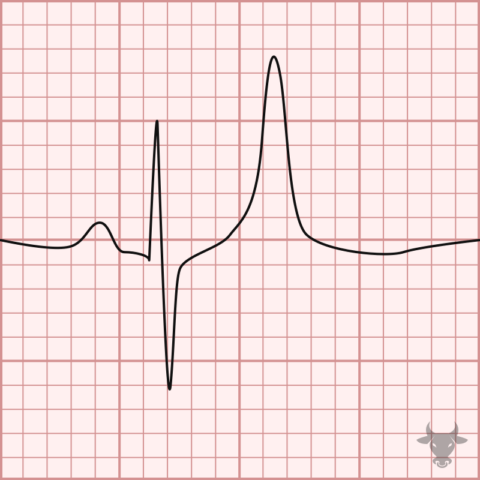
What is this?
Hyperkalemia
Hold the session and notify the care team.
500
What three things on an EKG indicate a Myocardial Infarction?
ST segment elevation (in 2 neighboring leads), hyperacute T-waves, and Q wave changes
500
A 62-year-old male with a history of stable angina undergoes a graded exercise stress test to evaluate his myocardial oxygen consumption. At rest, his heart rate is 70 bpm and his blood pressure is 120/80 mmHg. At peak submaximal exercise, his heart rate reaches 140 bpm and his blood pressure rises to 160/85 mmHg, at which point he reports the onset of mild chest discomfort.
What is this patient's peak Double Product?
22,400
160x140= 22,400
500
Mr. S is a 72 y/o male post CABG. In phase II he performed a Modified Bruce test. His resting HR is 80 bpm and max HR achieved was 155 bpm. What is his target HR for an aerobic exercise program?
110-125