Plate Boundaries
Topographic Maps
Rotation and Revolution
Lunar Cycle
Miscellaneous
100
1. What kind of Boundary?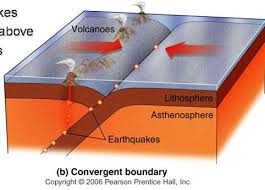
Convergent
100
6. What is the lowest point on this topographic map?
400
100
11. What causes the Day- Night cycle we experience on Earth?
The ROTATION of Earth
100
16. Why can we see the moon?
The moon reflects light from the sun onto the Earth
100
21. What about the sun and moon affects our planet's tides?
Gravity
200
2. What kind of Boundary?
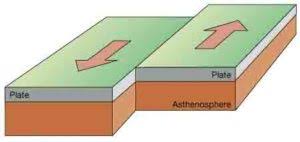
Transform
200
7. What is the interval on this map?
20
200
12. What causes a year to go by?
The REVOLUTION of the Earth around the Sun
200
17. What causes the phases of the moon?
The position of the moon as it revolves around the Earth. (Ex, if the moon is in between the Sun and Earth we have a new moon. If the Earth is in between the sun and moon we have a full moon)
200
22. What theory led to the creation of plate tectonics theory?
Continental Drift Theory
300
3. What kind of Boundary?
Divergent
300
8. Where is the mountain steepest?
Left Side
300
13.
Identify the season in the northern hemisphere
Winter
300
18.
Identify the phase of the moon that is the furthest up (Bonus 100 if you can identify if it is Waxing or Waning)
1st Quarter Moon, Waxing
300
23. What causes the breakdown of rocks?
Weathering
400
4. What kind of plate interactions cause the following? (need all to get points)
1. Mountains
2. Earthquakes
3. Mid Ocean Ridges
1. Convergent
2. Transform
3. Divergent
400
9. Where is the mountain at its flattest?
Right Side
400
14.
Identify the season in the southern hemisphere
Summer
400
19. When the dark half of the Moon faces the Earth, what phase will it be?
New moon
400
24. What causes the movement of rocks?
Erosion
500
5. How does Seafloor Spreading explain how new crust is being created?
As plates break apart magma rises and makes new crust. That crust is pulled apart. On both sides of the ridge the crust gets older and older as they drift away.
500
10. What is the highest point on this map? (numerical value)
520
500
15. Explain what happens during a summer/winter solstice
Because of the tilt of the Earth, there are times of the year in which the days elongate or shorten
Definition- the time or date (twice each year) at which the sun reaches its maximum or minimum declination, marked by the longest and shortest days (about June 21 and December 22).
500
20. What phase will it be 14 days after a Waning Gibbous?
Waxing Crescent
(14 days would be the opposite side of the circle, 7 days would be a quarter turn of the circle and 28 days would be a whole turn)
500
25. If a species was separated due to continental drift, what would likely happen to those populations?
hey would evolve independently