Recipe for Energy
Powerhouse Problems & Sugar Splitters
Oxygen All-Stars / The Krebs & Chain Gang
No Oxygen? No Problem!
ATP Countdown / Plant vs. AnimalCell Showdown
100
What is the overall purpose of cellular respiration?
To convert the chemical energy stored in food (glucose) into chemical energy stored in ATP.
100
In which organelle does cellular respiration mainly take place?
The mitochondria.
100
What is the two-step process a cell uses to make ATP when oxygen is present?
Aerobic respiration, the Citric Acid (Krebs) Cycle followed by the Electron Transport Chain.
100
What process does a cell use when oxygen is NOT available?
Anaerobic respiration, also called fermentation.
100
How much total ATP does aerobic respiration produce?
36–38 ATP.
30+
200
Write the complete balanced equation for cellular respiration.
C₆H₁₂O₆ + 6O₂ → 6H₂O + 6CO₂ + Energy (ATP)
200
What are the two main structural parts of the mitochondria?
The inner membrane (folded membranes) and the matrix (fluid-like substance filling the space).
200
Where does the Citric Acid (Krebs) Cycle take place?
The mitochondrial matrix.
200
What are the two main types of fermentation?
Lactic acid fermentation and alcohol fermentation.
200
Break down exactly where each ATP comes from in aerobic respiration.
2 ATP from glycolysis, 2 ATP from the Krebs Cycle, and 34 ATP from the Electron Transport Chain.
300
What are the two reactants in cellular respiration?
Glucose (C₆H₁₂O₆) and oxygen (O₂).
300
What is glycolysis, and where does it occur in the cell?
The splitting of oneglucose molecule into two pyruvate molecules; it occurs in the cytoplasm.
300
What waste product is released during the Krebs Cycle?
Carbon dioxide (CO₂).
300
Where does lactic acid fermentation occur, and what does it cause in your muscles during hard exercise?
It occurs in some bacteria (like in yogurt) and in animal cells (like your muscles); the lactic acid buildup causes short-term burning sensation.
300
Is photosynthesis endothermic or exothermic, and how does that compare to cellular respiration?
Photosynthesis is endothermic (absorbs energy); cellular respiration is exothermic (releases energy).
400
What are the two products of cellular respiration?
Carbon dioxide (CO₂) and water (H₂O).
400
Does glycolysis require oxygen? What term describes this?
No, glycolysis requires no oxygen, so it is anaerobic.
400
Where does the Electron Transport Chain take place, and what does it produce?
The inner membrane of the mitochondria; it produces 30+ ATP and water (H₂O).
400
What does yeast produce during alcohol fermentation, and what everyday foods/drinks result from this process?
Yeast breaks pyruvate down into alcohol, carbon dioxide, and 2 ATP. This process is used to make things like bread and wine, kimchi, Pickles, sourdough, etc.
400
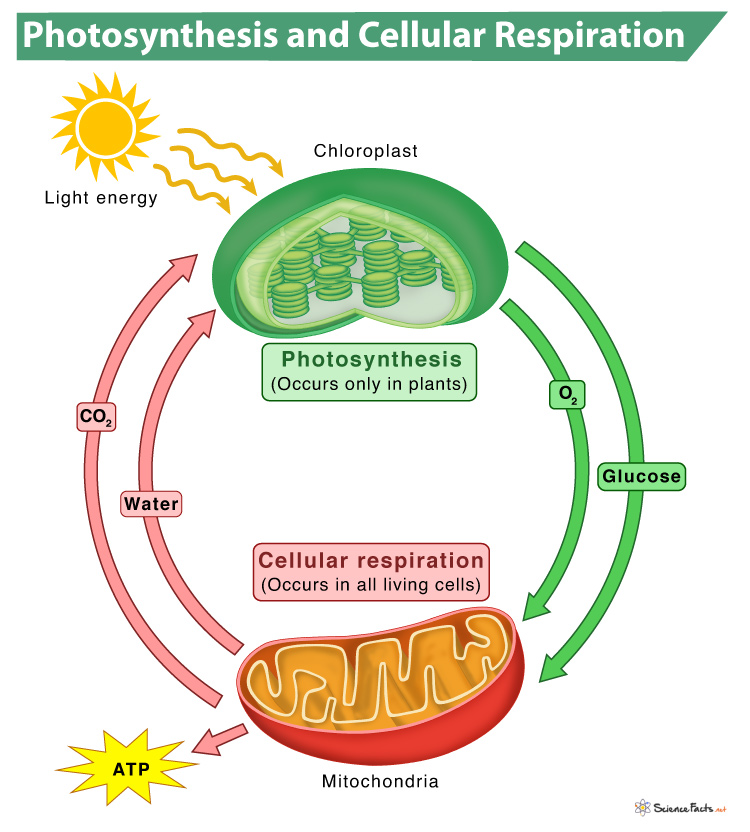
How do the reactants and products of photosynthesis compare to those of cellular respiration?
Photosynthesis uses CO₂ and H₂O to make glucose and O₂; cellular respiration uses glucose and O₂ to make CO₂ and H₂O the two processes are reverses of each other.
500
Look at the equation for cellular respiration. What do the little numbers (subscripts and coefficients) in C₆H₁₂O₆ actually tell you about a glucose molecule?
One molecule of glucose is made up of 6 carbon atoms, 12 hydrogen atoms, and 6 oxygen atoms.
500
What does glycolysis produce?
2 pyruvate molecules, 2 ATP, and NADH's.
500
A scientist compares the Krebs Cycle to a 'prep station' and the Electron Transport Chain to the 'main event.' Based on what each stage actually does, is this a fair way to describe them? Why or why not?
Yes, it's a fair comparison — the Krebs Cycle doesn't make much ATP itself (only 2), but it does the important prep work of breaking down pyruvate and loading up electrons/hydrogens that the Electron Transport Chain needs.
The Electron Transport Chain is where the "main event" really happens, since it uses those prepared materials to produce the vast majority of the cell's ATP (34 out of 36–38 total)
500
How much total ATP does fermentation typically produce, and why is it so much less than aerobic respiration?
2–4 ATP total — because fermentation only completes glycolysis and skips the Krebs Cycle and Electron Transport Chain, which is where most ATP is made.
500
Explain how photosynthesis and cellular respiration form a cycle between chloroplasts and mitochondria.
Chloroplasts use CO₂, H₂O, and light energy to produce glucose and O₂; mitochondria then use that glucose and O₂ to produce CO₂, H₂O, and ATP energy the outputs of one process become the inputs of the other, forming a continuous cycle.