Cell Theory
Prokaryote vs. Eukaryote
Animal & Plant Organelles
Membrane Transport
Osmosis
100
What technology was essential for the development of the Cell Theory?
Compound light microscope
100
True or False: All eukaryotes are multicellular
False
100
Which organelle contains digestive enzymes to help break down things in the cell
Lysosome
100
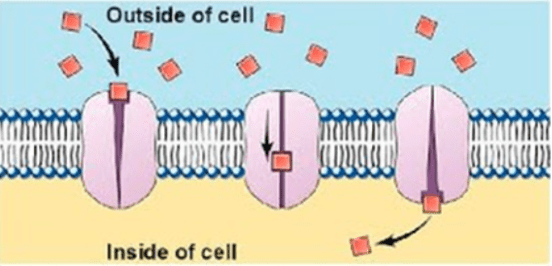
What type of transport is shown?
Facilitated diffusion
100
True or False: Osmosis can be simple or facilitated diffusion
True
200
Who was the first scientist to observe and name cells?
Robert Hooke
200
True or False: Protists are prokaryotic
(Mostly aquatic - amoeba, paramecium, algae, slime mold)
False
200
What is number 1 pointing to and what is made there?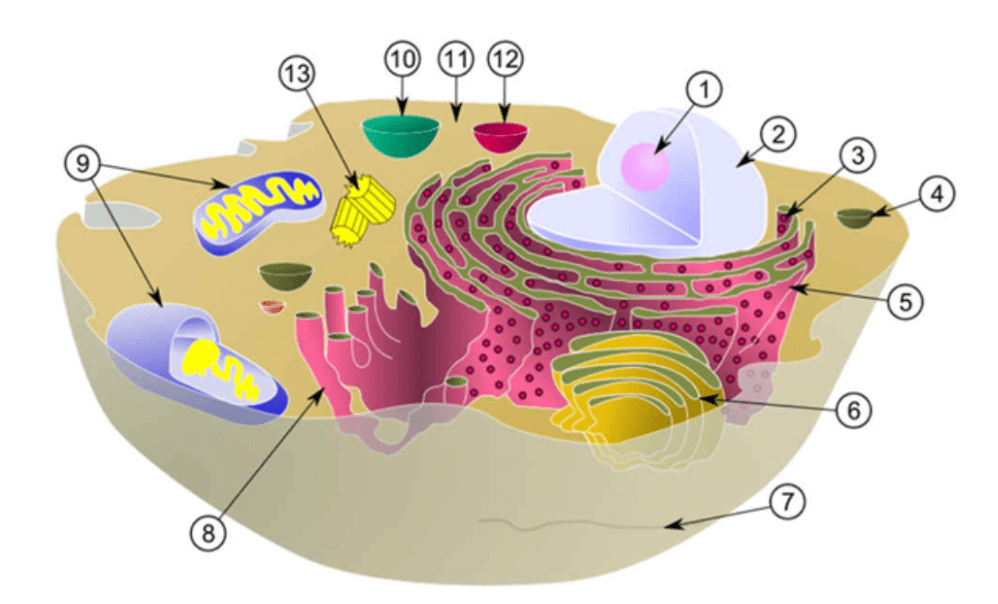
Nucleolus, makes ribosomes
200
Which part of a phospholipid is hydrophobic?
Fatty acid tails
200
Osmosis is the movement of water towards ____________ solute concentration. (Higher or Lower)
Higher
300
How many cells make up the average human body?
30 trillion
300
Which cell type is older (evolved first)
Prokaryote
300
What process occurs in mitochondria to make ATP?
Cellular Respiration
300
Which component of the cell membrane is important for maintaining a balance between stability and flexibility?
Cholesterol
300
What type of solution is shown here? (light blue)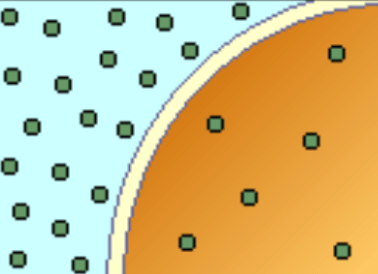
Hypertonic
400
Virchow's observation of cell division led to which part of the Cell Theory?
Part 3: All cells come from pre-existing cells
400
What are the small, circular, extra, non-essential chromosomes in prokaryotes called?
Plasmids
400
Name 3 organelles that a plant cell has that an animal cell does not have
Cell wall, chloroplast, large central vacuole
400
What is the function of carbohydrates on the surface of the plasma membrane?
Cell-to-cell recognition and communication
400
What will happen to the size of this cell?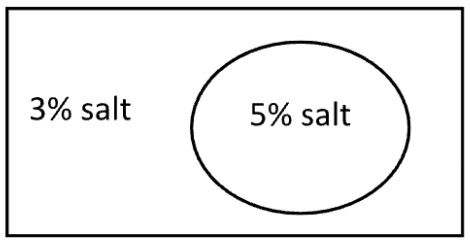
It will swell
500
What ratio in cells limits their size?
Surface Area : Volume Ratio
500
Name 3 cell structures that ALL cells have (both prokaryotic and eukaryotic)
Cell membrane, cytoplasm, ribosomes, DNA
500
A protein has been synthesized and is now being exported out of the cell. What path will it take through the organelles, from production to export? (Include 5 different organelles, 1 will be repeated)
___ --> ___ --> ___ --> ___ --> ___ --> ___
Ribosome --> Rough ER --> Vesicle --> Golgi --> Vesicle --> Cell Membrane
500
What types of molecules are able to do simple diffusion? List 2 examples
Small non-polar molecules like O2 and CO2
500
You put a freshwater fish in the salty ocean. What will happen to the fish's cells?
They will shrink/shrivel