Membrane
Transport
Solution
Homeostasis
Cell Transport IRL
100
This part of the cell acts like a security gate, controlling what enters and leaves.
cell membrane
100
The movement of molecules from an area of high concentration to low concentration is called this.
Diffusion
100
A cell placed in this type of solution will usually shrink
hypertonic solution
100
The process of maintaining stable internal conditions is called this.
homeostasis
100
An IV filled with pure water could cause red blood cells to do this.
Burst
200
These molecules make up most of the structure of the plasma membrane.
phospholipids
200
This type of transport requires no energy from the cell.
Passive
200
In this type of solution, water moves equally in and out of the cell.
isotonic solution
200
When equilibrium is reached, molecules continue to move, but there is no this.
movement
200
A steak soaked in fresh water overnight would likely become this because of osmosis.
Larger, swollen, full of water
300
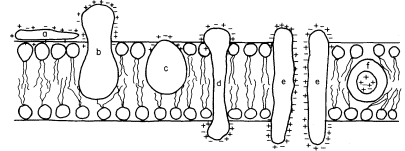 What is letter e?
Channel proteins/ carrier proteins
300
Water moving across a membrane is known as this process.
Osmosis
300
A plant cell survives in fresh water because of this rigid structure.
cell wall
300
Cells use this structure to control what enters and exits in order to maintain balance.
Cell membrane
300
This transport process is used when a cell releases materials outside the membrane in vesicles.
Exocytosis
400
These membrane structures help large molecules like glucose move across the membrane.
protein channels/carrier proteins
400
Moving materials against the concentration gradient requires this molecule for energy.
ATP
400
A red blood cell placed in pure water will most likely do this.
burst/swell
400
Carbon dioxide and oxygen move directly through the membrane because they are this type of molecule.
Small molecules
400
A freshwater fish constantly gains water through osmosis because its environment is this compared to its cells.
hypotonic
500
This property of the membrane allows some substances to pass while blocking others.
selective permeability
500
This type of diffusion uses transport proteins to move substances through the membrane.
Facilitated diffusion
500
Ocean water is dangerous to drink because it causes body cells to lose water through this process.
Osmosis
500
This transport process occurs when a cell membrane surrounds and brings materials into the cell using a vesicle.
endocytosis
500
This is the main goal of all cellular transport processes.
maintain equilibrium or homeostasis